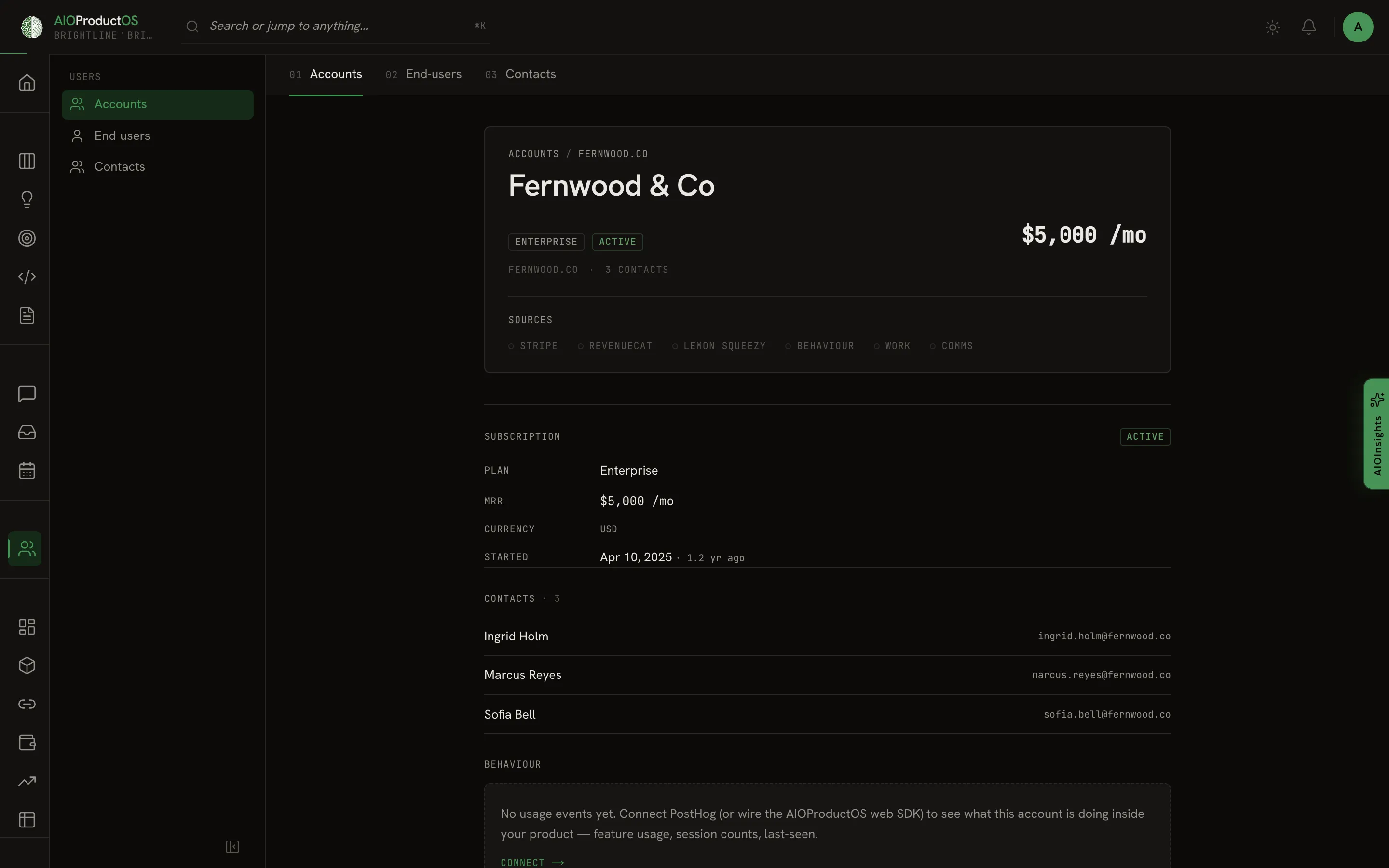
Connected, not consolidated. That is the whole thesis. AIOProductOS ships 100+ connectors that land data from the tools you already use onto one shared spine, keyed to the same customers - so you keep your best-of-breed stack, but its data joins on a single record. You are not asked to rip out your payment processor or your support desk. You are asked to let their data finally connect.
Why "connected" beats "consolidated"?
Consolidation asks you to trade tools for a view: give up the analytics product your growth team loves, the support desk your CS team lives in, and the CI system your engineers trust, in exchange for one system that does all of it - usually none of it as well. Most teams reject that trade, correctly. So they keep the good tools and accept the fragmentation as the price.
The spine refuses the trade. It keeps the tools specialized and makes the data connect. A Stripe subscription, a Zendesk ticket, a GitHub pull request, and a Mixpanel event all resolve to the same customer on one record. Consolidation is a religion about tools; connection is a fact about data. Only one of them survives contact with a team that already has favorite tools. Read how the join is modeled on the spine page.
What do 100+ connectors actually span?
Breadth is the point, because the join is only as good as its coverage. The catalog holds 117 connectors across 18 categories:
| Category | Examples of what lands on the spine |
|---|---|
| Analytics | Product and web event streams |
| Support | Tickets, conversations, CSAT |
| CRM | Accounts, deals, contacts |
| Billing | Subscriptions, payments, MRR |
| CI/CD | Builds, deploys, pull requests |
| Incident | Pages, postmortems, downtime |
| ...8 more | Feedback, docs, comms, and beyond |
Every one maps onto the same model, keyed to the same customer and account IDs, with EU and US data residency so the record stays in-region. If the mechanics of a single connector are unfamiliar, what is a product-data connector walks through how one source lands and joins. Browse the full catalog on the connectors page and the source list under integrations.
What changes when everything shares one record?
A product question stops being a research project and becomes a query. "Which paying accounts filed the most tickets and are stuck on the feature we deprioritized?" touches billing, support, and roadmap - three tools, three schemas, three exports, one painful reconciliation in the old world. On the spine it is one join, because the records already share keys.
That is the difference between a stack and a spine. A stack is eight tools and the reconciliation tax between them - the fully loaded cost we counted in the real cost of a product tool stack. A spine is those same eight tools' data on one record, plus a bill of Start $199 / Team $399 / Business $899 per month, 30-day money-back, 7-day free trial, no card. You keep the tools; you lose the reconciliation.
When do you not need a spine at all?
Be honest with yourself here: if you only need one or two integrations, you do not need a spine, and any tool will do. Piping Stripe into a single dashboard is a solved problem in every product on the market. The spine's value is not one connector - it is the join across many.
A spine earns its place at the moment you have several sources whose data has to answer questions no single tool can answer alone: revenue-weighted funnels, who-actually-pays, did-what-we-shipped-work, revenue-at-risk. Below that threshold, a lone integration is cheaper and simpler. Above it, the reconciliation tax on a growing stack is the thing quietly eating your team's week - and that is the problem 100+ connectors on one spine exists to end.
You can see the joined record before deciding anything. Open the no-signup demo and trace one customer from a support ticket to their subscription to the feature that shipped for them - all on the same record.