Search "Airtable vs Jira for product management" and every page-one result tells you the same story: Jira is the rigorous engineering system, Airtable is the flexible spreadsheet-database, pick based on how structured your team is. That framing is correct as far as it goes. It also stops one step short of the question that actually matters.
Is Airtable or Jira better for product management?
Jira is better for engineering delivery, sprints, and formal agile ceremonies; Airtable is better for flexible, cross-functional operations and custom databases. If your bottleneck is shipping code on a cadence, Jira wins. If it is organizing non-engineering workflows your way, Airtable wins. Neither, alone, ties the work to the revenue or customer feedback behind it.
That last sentence is the part page one skips, and it is the part that decides whether your product operation actually improves - so we will get there. First, the honest head-to-head.
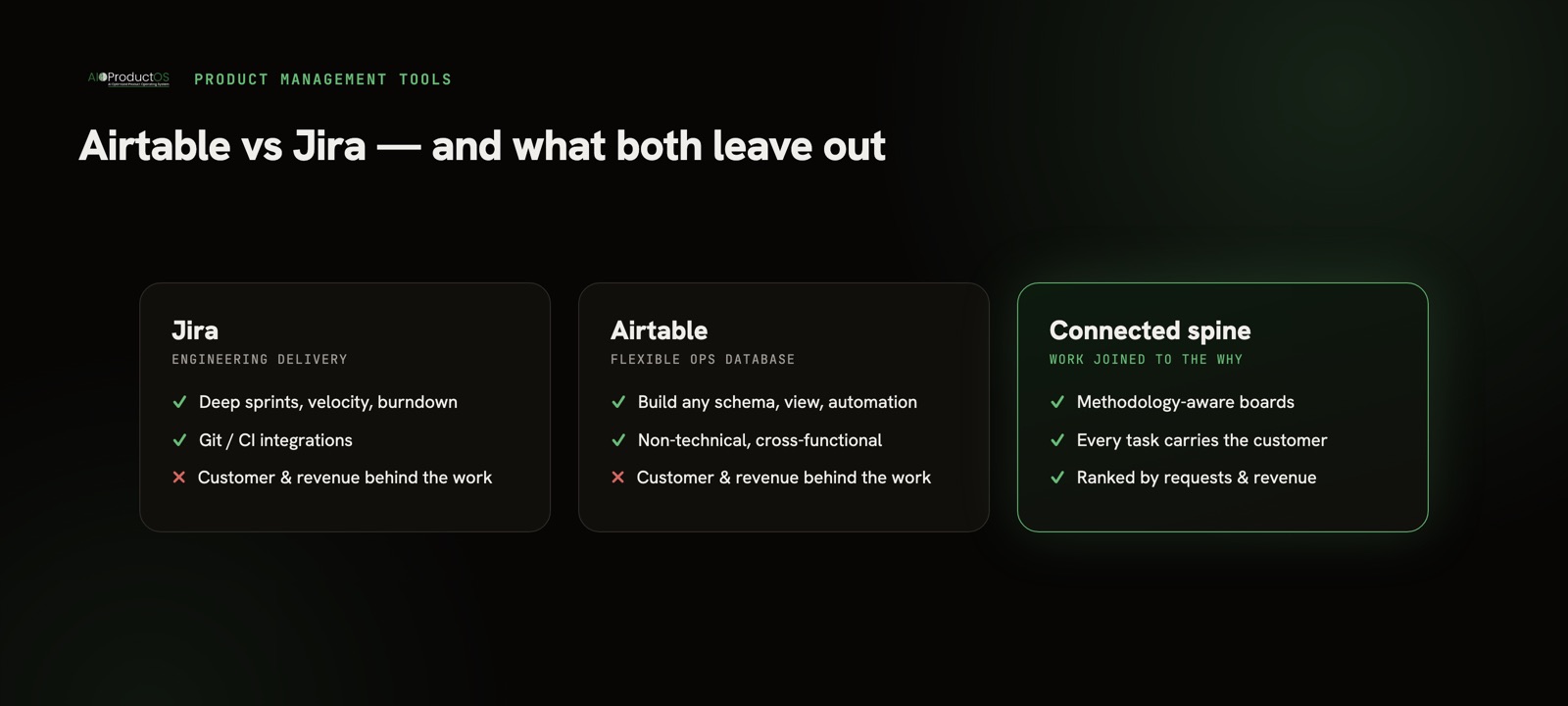
Airtable vs Jira, side by side
| Jira | Airtable | A connected spine | |
|---|---|---|---|
| Best-fit team | Engineering-led delivery at scale | Cross-functional ops, non-technical teams | Product teams of 5-50 joining feedback, work, and revenue |
| Agile / delivery depth | Deep: sprints, velocity, burndown, Git/CI | Shallow: no native agile mechanics | Methodology-aware boards (Scrum, Shape Up, Waterfall) |
| Flexibility | Rigid by design; configurable within an issue model | Very high: build any schema, view, or automation | Opinionated product spine, not a blank canvas |
| Pricing model | Per user (~$7.91→$14.54/mo, 2026) + AI credit pool | Per seat; tiers step up per user | Flat by tier from $199/mo, no per-seat |
| Connects work to revenue + feedback | No - tickets only | No - records, but no revenue or feedback join | Yes - every task carries the customer, feedback, and revenue |
The table earns its keep by making one thing visible: the flexibility-versus-rigor axis that dominates every comparison is a within-category choice. Both tools sit inside the "where does the work live" box. Neither reaches into the "why are we doing the work" box at all. The shape that does is the third column above: a task that carries the customer, the feedback, and the revenue behind it.
When Jira is the right call
Be fair to Jira, because on its home turf it is very good. If your product team is engineering-led and you run formal agile, with real sprints, story points, velocity charts, burndown, and backlog grooming ceremonies, Jira is the strongest option in this pair and one of the strongest anywhere. Its issue model, workflow engine, and Git/CI integrations are built for exactly that motion - engineering-led by design, which reads as a limitation to a non-technical team and a strength to the one shipping code.
The cost of that depth is well documented, and it is not only the per-user price. Jira's AI (Rovo) is bundled into paid tiers as a credit pool of 25, 70, or 150 credits by plan, with no rollover, so heavier AI use runs into a wall rather than a flat fee. There is also a data question worth reading separately: Atlassian's updated terms allow customer data to be used to improve AI models, with a per-product opt-out in admin settings, which is covered in what Atlassian AI training means for your Jira data. And the deeper structural cost is what Jira does not model: a Jira ticket knows its status, assignee, and sprint. It does not know which customer asked for the feature, how much revenue sits behind it, or whether shipping it moved a metric. For a full breakdown of where the true Jira bill lands, see how much Jira actually costs.
When Airtable is genuinely the better pick
Airtable deserves the same fairness. If your work is cross-functional and non-technical, think content calendar, launch checklist, vendor tracker, or a lightweight roadmap a whole company can read, Airtable is often the better tool. It lets a non-engineer build a real relational database, wire up views and automations, and shape the system around the workflow instead of forcing the workflow into someone else's issue model. That flexibility is the reason it spreads through operations, marketing, and early-stage teams.
The flip side is equally real. Airtable has no native agile machinery, so engineering teams that adopt it for delivery end up rebuilding sprints and status flows by hand, or bolting Jira on beside it. And Airtable's flexibility is unopinionated: it will happily let you build a product operation with no connection to revenue or to the customer, because it is a database engine, not a product system. It stores what you put in it; it has no point of view about what product work is.
The question both answers miss
Here is the gap page one leaves open. Choosing Airtable or Jira answers "where does the task list live." It does not answer "how do we know this task is worth doing." Both tools leave the customer in a support inbox or CRM, the feedback in a separate feedback tool, and the revenue in Stripe or a billing system. The backlog and the reason for the backlog live in different databases that never talk to each other.
This is not a niche complaint; it is a structural tax on the whole software industry. The average company already runs 101 SaaS apps and wastes around $21M a year on licenses nobody uses (Okta and Zylo). Adding Airtable and Jira, each billed per seat, is a small version of the same pattern: more tools, more per-head cost, and the connective tissue still missing.
So the real decision is not Airtable-flexibility versus Jira-rigor. It is whether your product work is joined to the why behind it, or floating free of it in whichever tool you picked.
A third option: connect the work to the why
There is a different shape of tool that starts from the join instead of the container. Instead of one more database for tasks, AIOProductOS puts every task on a shared record where it carries the customer who asked, the feedback that motivated it, and the revenue at stake. Trackers like Jira show the what - the task list. This shows the why - every task ranked by request count and revenue, on methodology-aware boards that render Scrum, Shape Up, or Waterfall per product.
The pricing model is deliberately the counter-argument to both incumbents. It is flat by tier, starting at $199/month with all modules included, no per-seat metering, and AI that is never credit-metered. Where Airtable and Jira both charge you more as your team grows, a flat tier does not - the whole team is included. That directly addresses the "we ended up paying two per-seat bills" trap that catches teams who run Airtable and Jira together.
To be clear about the tradeoff: this is not a like-for-like swap for Jira's deepest engineering ceremonies or for Airtable's build-anything canvas. If you need the single most configurable relational database on the market, that is Airtable's job. If you need the most battle-tested sprint engine at enterprise scale, that is Jira's. The connected-spine approach wins when the pain is that your product work is disconnected from customers and revenue - which, for most product teams of 5 to 50, is the pain that actually stalls them.
If you are weighing Jira specifically for a smaller team, the tradeoffs get sharper - that is covered in the Jira alternative for small product teams.
The honest verdict
Pick Jira if you are engineering-led and live in formal agile. Pick Airtable if you are cross-functional, non-technical, and need a flexible database you shape yourself. Pick a connected spine if the thing holding you back is that your roadmap, your customers, and your revenue live in three tools that never speak - because no amount of Airtable flexibility or Jira rigor closes that gap.
See how all three approaches stack up in our full, honest roundup of the best product management tools.