Every serious product tool shipped an MCP server in 2026, so "does it have an MCP?" stopped being a useful question almost immediately. The useful question is what each server lets an AI assistant see. This is an honest field guide - including where the single-tool servers beat us outright.
If you already know which server you want and just need it connected, skip this post: the MCP guides index has the setup walkthrough for each one. What follows is the comparison layer on top of those guides.
What makes an MCP server good for a product team?
Not tool count, and not the protocol - everyone uses the same standard Model Context Protocol. What matters is the shape of the data behind it.
Servers fall into two shapes. A tool-MCP exposes one product's data. A spine-MCP exposes data joined across systems onto one customer record. That distinction decides which questions the assistant can answer, and we unpack it in full in spine-MCP vs tool-MCP. Judge a server by the questions it can answer, not the tools it lists.
The honest comparison
Here is the landscape as we can verify it in mid-2026. Vendors move fast - check changelogs before you quote this.
| Server | Shape | Best at | Blind to |
|---|---|---|---|
| Linear MCP | Tool-MCP | Issues, cycles, engineering triage inside Linear | Revenue, feedback, anything outside Linear |
| Notion MCP | Tool-MCP | Docs, wikis, structured pages inside Notion | Customer, billing, and work data elsewhere |
| Productboard MCP | Tool-MCP | Feedback ops and roadmap inside Productboard | The revenue behind a request, code that ships it |
| Jira MCP | Tool-MCP | JQL queries across sprints, epics, and projects in Jira | Feedback, billing, and post-ship outcomes |
| GitHub MCP | Tool-MCP | PRs, issues, and code search against the work | The customer and revenue behind the work |
| AIOProductOS | Spine-MCP | Cross-system questions on one customer record | Deep first-party features of any single tool |
Each tool-MCP is genuinely the best server for its own surface, and we keep a setup guide for each: the Linear MCP, the Notion MCP, the Productboard MCP, the Jira MCP, and the GitHub MCP. If you want an AI assistant to summarize your Linear cycle, Linear's MCP is the right answer and we would not pretend to compete on Linear data inside Linear. The trade is scope: a tool-MCP is deep and narrow; a spine-MCP is broad and joined.
What can a spine-MCP answer that a tool-MCP can't?
The dividing line is any question that needs evidence from more than one system about the same customer.
- "Which paying accounts asked for SSO, and what's the combined ARR?" - feedback plus billing.
- "Is this bug hitting revenue or free users?" - error data plus billing.
- "What did we ship last quarter that moved retention?" - shipped work plus outcomes.
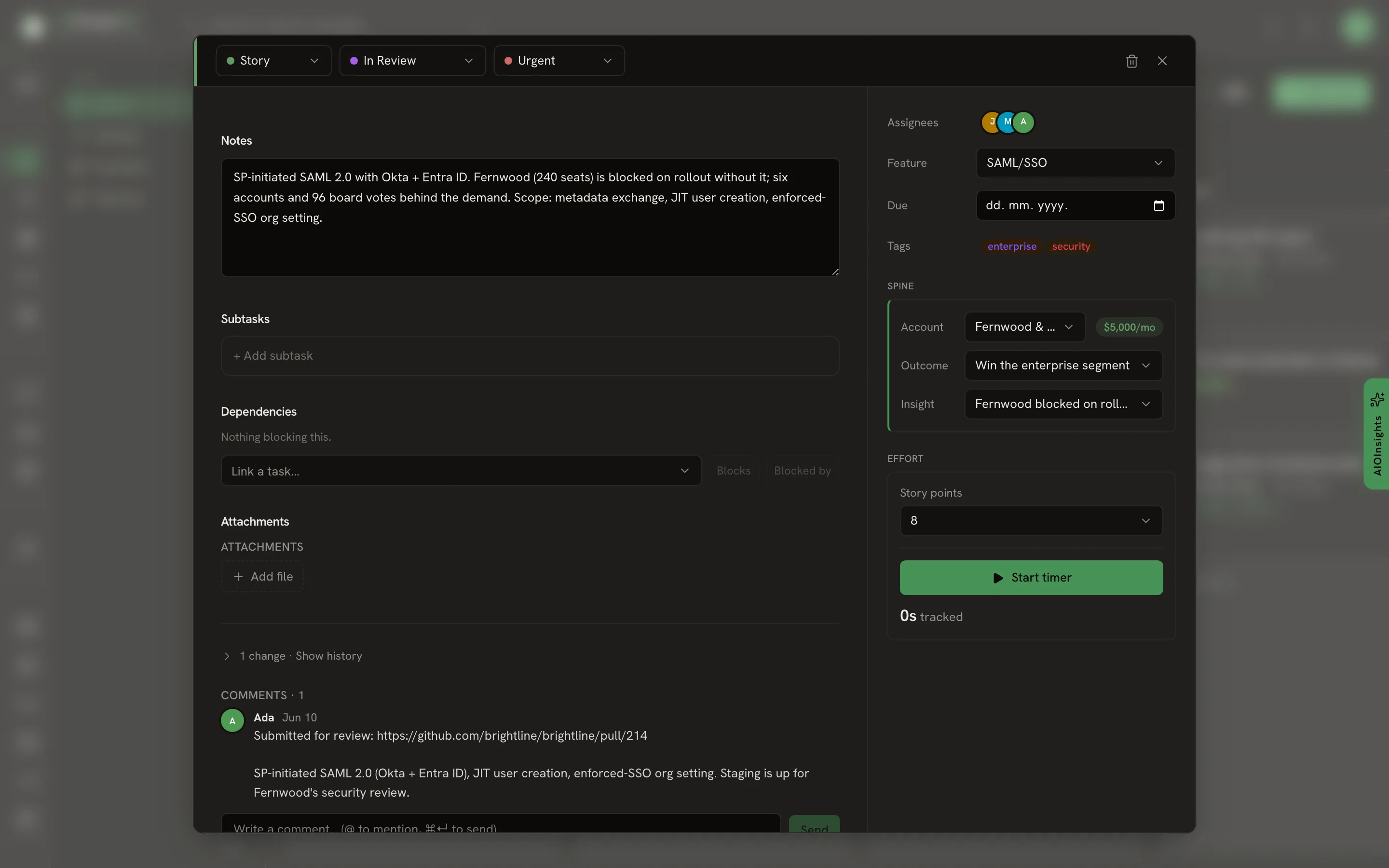
A tool-MCP hits a wall on all three: the feedback server knows the request but not the revenue; the tracker knows the task but not the customer behind it. A spine-MCP answers them in one call because the data is already joined on the account - the same paying customer's revenue, feedback, support, tasks, and code on one record. The AIOProductOS spine MCP is one such server, hosted at platform.aioproductos.com/api/mcp with 71 tools, and 100+ connectors feed the joined graph those tools read. You can see the model itself on the spine page.
How do you choose?
Two questions settle it.
- Do your questions stay inside one tool, or cross between several? If they stay inside one, use that tool's MCP. If they cross, you need the join.
- Do you already have a joined data layer? If a warehouse or CDP already unifies your customer data, a tool-MCP can plug into that and you may not need a separate spine. If you don't, the spine is what does the joining.
Note that "install several of the good ones" is not a free third option. Every connected server loads its full tool definitions before your first message, so a stack of tool-MCPs costs context and adds near-identical tool names to choose between - what happens when you connect more servers than you query works through the arithmetic.
When is a single-tool MCP all you need?
The honest counter-case, and it disqualifies the spine for a real slice of teams. If your work genuinely lives in one system, one tracker or one feedback tool, and the AI assistant is helping inside that surface, the first-party tool-MCP is the deepest, most accurate path, and a spine-MCP just adds connector overhead you will not use. Standing up a spine means connecting billing, your tracker, your feedback tool, and more; if you are only ever opening one window into one tool, that setup is wasted effort. The spine earns its keep exactly when your questions refuse to stay inside a single tool's walls - and for prioritization, they rarely do.
The takeaway
There is no single "best" MCP server for product teams - there is the best server for the shape of your questions. Single-tool questions want the deep first-party tool-MCP. Cross-system questions want the join, and as far as we can verify, a spine-MCP is the only way to expose that join over MCP in 2026. The protocol is the easy part; the join is the work.
To see a spine-MCP answer a cross-system question live, browse a real workspace with no signup.