What are the best project management tools for product teams?
The best project management tools for product teams do two jobs: track execution and carry the reason for the work. Execution is the WHAT - tasks, sprints, timelines. The product layer is the WHY - the customer, the feedback, and the revenue behind each item. Most teams cover both with a tracker plus a product tool, or with one platform that does both.
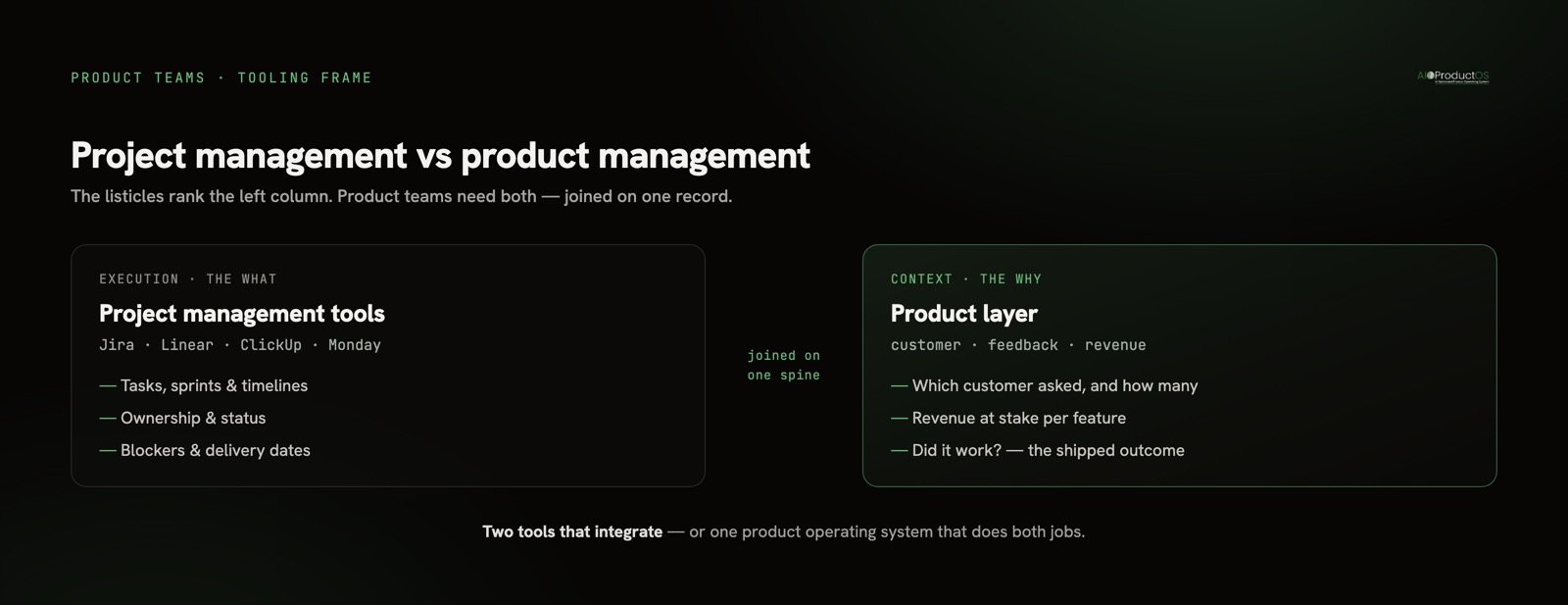
That distinction is exactly what the big generic listicles skip. Search "best project management tools" and you get the same 21-item roundups (Asana, Wrike, Monday, ClickUp) with a feature blurb and a star rating each. They're not wrong about the tools. They're wrong about the frame. A product team is not a project team. Your work isn't just "ship the ticket"; it's "ship the thing the customer asked for, that moves revenue, that we can measure afterward." A tool that only tracks the ticket leaves the most important half of your job in a different tab. The version where both halves sit on one board looks like a task that carries the customer and the revenue behind it.
Project management vs product management: the split every listicle skips
Project management is about delivery. Given a defined scope, it answers: what's the status, who owns it, when does it land, what's blocking it. Jira, Linear, ClickUp, and Monday are all fundamentally execution engines. They're good at it.
Product management is about deciding what's worth building in the first place, and proving it worked afterward. It answers: which customer asked for this, how many of them, how much revenue is attached, what did we learn when it shipped. That's opportunity management, feedback synthesis, prioritization, and outcome tracking.
Here's the trap: because the listicles only rank execution tools, teams buy an execution tool and then discover the product half is missing. So they add Productboard for feedback, a spreadsheet for prioritization, Amplitude for outcomes, and Notion for the roadmap. One SERP source noted product teams typically run between three and six tools. That's how you end up with a stack - and stacks have a cost.
The stack tax is real
The average company runs 101 SaaS apps and wastes roughly $21M a year on licenses nobody uses (Okta + Zylo). Product teams are a big contributor. Every tool in the stack is a seat bill, an integration to maintain, and a place where context goes to die - the feedback lives in one tool, the ticket in another, the revenue in a third, and nothing joins them.
The per-seat pricing model makes it worse. As your team grows, every one of those three-to-six tools bills you again per head. A 20-person team on four seat-priced tools is paying four times for the same headcount.
The tools, categorized honestly
Rather than a flat "top 21," here's how the real options break down for a product team - execution-first tools, and what each one is missing on the product side.
| Tool | Best for | Entry price | The gap for product teams |
|---|---|---|---|
| Jira | Deep engineering workflows, large orgs, heavy customization | $7.91 → $14.54/user/mo | No native customer, feedback, or revenue context on a ticket; you bolt on Productboard/Aha |
| Linear | Fast-moving engineering teams that value speed and polish | $10 → $16/user/mo | Purpose-built for eng execution; no product-discovery, feedback, or revenue layer |
| Monday | Cross-functional teams wanting flexible, visual boards | $9 → $19/seat (3-seat min, real floor ~$27-57/mo) | General work OS, not product-aware; no spine tying work to customer or revenue |
| ClickUp | Teams wanting one configurable tool for many job types | $7 → $12/user/mo | Breadth over depth; roadmapping and feedback are shallow, revenue context absent |
| AIOProductOS | Product teams wanting execution + the WHY on one spine | $199/mo flat | Younger than the incumbents; less third-party plugin sprawl (by design) |
The pattern in the right-hand column is the point. Every dedicated tracker shows you the WHAT. None of them natively shows you the WHY - which is why the two-tool split exists in the first place.
Where the product layer changes the work
AIOProductOS takes the opposite bet from the trackers: it's one product operating system that does the job of the stack, not a single tracker. The difference shows up in three places.
Boards are methodology-aware. One board renders Scrum, Shape Up, Waterfall, or an experiment board, per product - so the eng team's sprint and the growth team's experiment live in the same system instead of two.
Work is revenue-aware. Every task carries the customer's plan and the revenue behind it. Features rank by request count and revenue, and you can prioritize with RICE, WSJF, Value-Effort, MoSCoW, or Kano instead of arguing from opinion. The customer, the feedback, and the revenue travel with the ticket - the trackers show the WHAT; this shows the WHY.
And pricing is flat by tier - no per-seat tax, AI included: $199 Start (5 members), $399 Team (20), $899 Business (75), with a 7-day free trial, no card, and 30-day money-back. That's a deliberate answer to the seat-multiplication problem above.
If you're weighing consolidation more broadly, the market agrees with the direction: 68% of tech leaders are consolidating vendors in 2026, and best-of-breed stacks need 280% more maintenance. Fewer, better-joined tools is the trend, not the exception.
When a dedicated tracker is still the right call
Being honest about this matters more than selling. There are real cases where a single-purpose tracker beats a product operating system.
If you're a fast-moving, engineering-only team, Linear's speed and keyboard-driven polish are genuinely better than a broader platform - that depth is the whole product, and you'll feel the difference every day. If you're deep in a large enterprise with years of Jira automation, custom workflows, and integrations, the switching cost is real and the eng-workflow depth may be worth staying for.
And if your work genuinely doesn't need customer or revenue context, as with pure internal tooling, infrastructure, or a team that sits far from the customer, then the product layer is overhead you won't use. Buy the tracker, skip the rest.
The product layer earns its place when your team is deciding what to build for paying customers and needs to prove it worked. If that's not your job, a good tracker is enough. We'd rather you know that up front. For a wider view of the category, our best product management tools guide covers the full landscape, and if you're a smaller team specifically, best product management tools for small teams narrows it further. For the classic execution-vs-context debate in one place, see Airtable vs Jira for product management.
How to actually choose
Start by naming which half you're missing. If you have a tracker and your prioritization lives in a spreadsheet while feedback rots in a Slack channel, you don't need a better tracker - you need the product layer. If you have neither, decide whether you want to buy two tools that integrate or one platform that already joins them.
Then count the seats. Multiply your headcount by the per-user price of every tool in the stack, and compare it to a flat-tier platform. For teams past ten people running three-to-six seat-priced tools, the math usually favors consolidation - which is the whole reason two-thirds of tech leaders are doing it this year.
If moving looks daunting, it's a smaller job than it feels: AIOProductOS runs a 3-step migration from 12 sources including Trello, Asana, Monday, ClickUp, Shortcut, Productboard, Canny, Notion, Linear, Jira, PostHog, and CSV, so you bring your existing work with you rather than rebuilding it.
See how the full picture compares on our best product management tools guide.