Most "best product management tools" lists - and there are big ones, running to 16 or 25 entries - answer the wrong question for a small team. They sort tools by category and implicitly recommend you buy one from each: a PM platform, a task tracker, an analytics tool, a feedback inbox, docs, and something for engagement. Six subscriptions, six per-seat meters, six databases that don't talk to each other.
For a five-person team, that stack is the cost. This post takes the small-team cut of our full best product management tools guide: the honest picks per category, verified 2026 pricing, and the math on what a minimum connected stack actually runs. For the product's own take on that shape, see how AIOProductOS is built for small product teams.
What are the best product management tools for a small team in 2026?
The best product management tools for small teams in 2026 are Linear for delivery, Productboard for feedback and roadmap, Notion for docs, and ClickUp or Monday for general work management - or AIOProductOS if you want those jobs joined on one connected record instead of three or four subscriptions. The deciding factor is rarely features; it's how much fragmentation a small team can absorb.
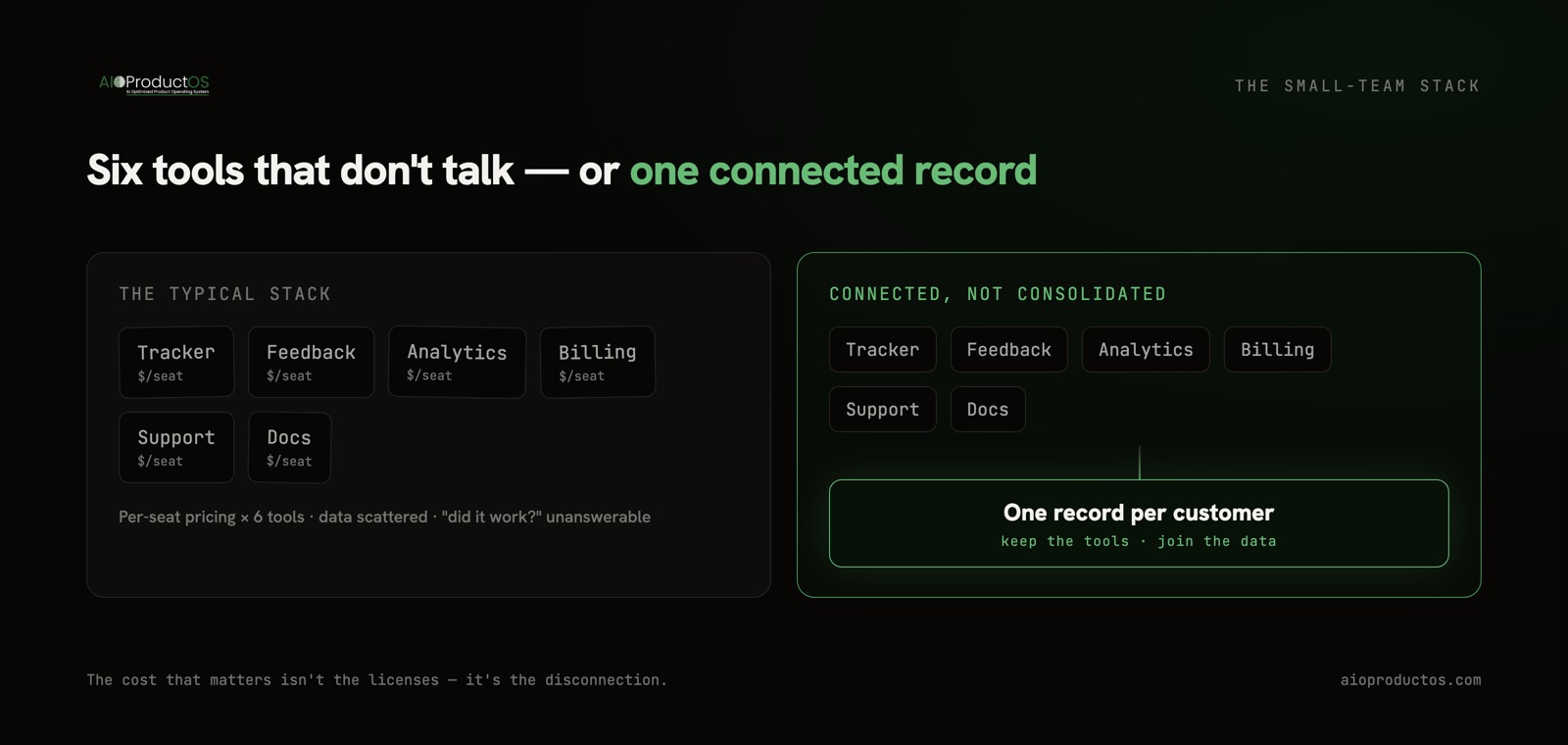
That fragmentation isn't a soft cost. Gallup-backed research puts context-switching at roughly $450B a year, with the average employee losing 40% of productive time to it. And the market has noticed: 68% of tech leaders are consolidating vendors in 2026, and best-of-breed stacks need 280% more maintenance than consolidated ones. On a five-person team there is no ops person to absorb that maintenance - it comes out of building.
What the joined version actually looks like is browsable without a signup in the live demo workspace. The rest of this post is the per-category detail and the arithmetic.
The honest picks, by category
Real tools, verified pricing, and where each genuinely wins. These six are ordered by category - delivery, then breadth, then docs, then feedback - not by rank. There is no first place here, because the right pick depends on which job dominates your week. Our own product is deliberately not in this list; it gets its own section below, clearly labelled, so a reader can weigh the six independent picks without a vendor grading itself among them.
Linear - delivery for engineering-led teams
$10/user/mo entry, $16/user for Business. The fastest issue tracker on the market, and if your team is mostly engineers, it's the right delivery tool - full stop. Two caveats for small product teams: advanced AI is gated to the Business tier, and users describe it as "engineering-oriented... limiting for non-technical users." Your designer and your founder-doing-sales live somewhere else. Full breakdown: AIOProductOS vs Linear.
Jira - the default, cheaper than you remember
$7.91/user entry, $14.54 for Premium (2026 rates actually dropped). Rovo AI is bundled into paid tiers, but on a credit system - 25/70/150 credits by tier, no rollover. Jira's depth is real; its weight is too. For teams under ten people it usually brings more process than product. We keep an honest roundup of Jira alternatives, and a small-team-specific take in our Jira alternative guide for small product teams.
ClickUp - the widest single tool
$7/user entry, $12 for Business. Genuinely broad - tasks, docs, goals, whiteboards. The trade-off is the one its own users name: "super bloated... try to do everything." And the AI is an add-on: Brain at +$9/user or Everything AI at +$28/user, which can nearly double a small team's bill. Comparison: AIOProductOS vs ClickUp.
Monday - work management with a seat floor
$9/seat entry, $19 for Pro - but with a 3-seat minimum, so the real floor is $27-57/mo. AI is credit-metered at 8 credits per action (~$0.08), with 2,000-credit packs at $20/mo. Good for mixed teams that want boards over backlogs; the meter is the thing to watch.
Notion - docs first, PM second
$10/member entry, $20 for Business. The best docs tool on this list. As a PM system it's a build-it-yourself kit, and its AI agents are gated to Business+ at $10 per 1,000 credits with no rollover - there's a documented case of a $1,500 single-month agent bill. Fine as the docs layer; risky as the system of record.
Productboard - feedback and roadmap, properly
Spark tier at $15-19/maker. If feedback-to-roadmap traceability is your one job, Productboard does it better than anyone. Small-team caveats: the Essentials-to-Pro jump goes $19→$59 per maker, which pricing guides describe as the bill tripling overnight, and AI is metered at 250 credits/maker/month, roughly 4-5 AI operations. Users also flag that "the dashboard is too crowded" and triage needs a "constant moderator" - moderation time a five-person team doesn't have.
AIOProductOS - what the connected option actually is
AIOProductOS is a product OS built for small SaaS teams that want one connected record instead of a stack: revenue, customer feedback, work, and code join on a single customer record, with methodology-aware boards, built-in product analytics, and AI teammates that operate the workspace over MCP. Pricing is flat by tier rather than per-seat - Start is $199/mo for 5 members, 1 product, 2 AI agents and all modules, Team is $399/mo for 20 members and Business is $899/mo for 75 members. AI is included from the first tier and is never credit-metered; the agents run on your own model credits. Every plan starts with a 7-day free trial, no card required, on your own data, followed by a 30-day money-back guarantee. There is no permanent free plan.
Where it is the wrong tool, stated plainly: enterprise procurement-led buying, sales-org CRM, and data-warehouse or BI use cases. And below roughly five people with little feedback volume, the specialist stack priced in the next section is usually still cheaper.
Disclosure: AIOProductOS publishes this guide. That is why the six picks above are reviewed on their own terms and our product is described here separately, with its weak fits named rather than omitted.
The stack math for a five-person team
Here's what the standard listicle advice actually costs. The minimum credible specialist stack for a small product team is three tools: delivery, feedback/roadmap, docs. Verified entry pricing, five people, three of them "makers":
| Layer | Tool | Verified entry price | 5-person team, monthly | With AI turned on |
|---|---|---|---|---|
| Delivery | Linear | $10/user/mo | $50 | Advanced AI needs Business ($16/user) → $80 |
| Feedback + roadmap | Productboard Spark | $15-19/maker/mo | $57 (3 makers) | 250 credits/maker ≈ 4-5 AI ops; top-ups $5/50 |
| Docs | Notion | $10/member/mo | $50 | Agents need Business ($20/member) + $10/1k credits → $100+ |
| Specialist stack | ~$157/mo | ~$237+/mo, three separate AI meters | ||
| One connected record | AIOProductOS Start | flat tier | $199/mo | Included, un-metered, 2 AI agents |
Read it honestly: at entry tiers with AI off, the specialist stack is cheaper - $157 against $199. The gap inverts the moment you want AI working across your product data, and widens as you grow, because three per-seat meters scale with headcount while a flat tier doesn't. And the specialist total still buys no analytics, no support inbox, and no join - your feedback tool doesn't know what the tracker shipped, and neither knows what any customer pays. Even Atlassian's CEO conceded the unbundled model: "when you have to buy everything individually... it got very difficult to explain to customers."
Run your own numbers - real tools, real team size - with the SaaS stack cost calculator, and see the full accounting in the real cost of a product tool stack.
When separate specialist tools are still the right call
Sometimes the stack is correct. Cases where we'd point you away from a connected platform, including ours:
- You're two or three engineers. Linear plus Notion at roughly $60/mo covers delivery and docs. You don't yet have enough feedback, revenue data, or coordination overhead for the join to pay for itself. (If that describes a pre-seed company, our shortlist of product management tools for startups is built for exactly that stage.)
- One job dominates everything. If feedback triage is 80% of your PM work, Productboard's depth in that single lane beats a broader platform's coverage of it.
- You need deep specialist analytics. Teams with a dedicated data function and warehouse-level analysis needs will outgrow built-in analytics; that's a genuine specialist lane.
- Procurement runs your buying. Enterprise procurement-led purchases are a weak fit for AIOProductOS - we say so on our own site.
- Your stack already works. If your tools are integrated, adopted, and nobody is copy-pasting context between them, switching costs are real and the status quo deserves respect.
How to decide
Skip the 25-tool listicles. For a small team, the question is not "which six tools" - it's "what's the minimum set of product management tools for small teams that stays connected as we grow." Count the jobs (delivery, feedback, docs, analytics), price the stack honestly including AI meters and seat growth, and decide whether the join - feedback, revenue, work, and code on one record - is worth more to you than single-tool depth.
If it is, AIOProductOS starts at $199/mo flat for five members, all modules, AI included, with a 7-day free trial, no card, on your own data. The tier-by-tier detail is on the AIOProductOS pricing page.