Every product team collects feedback. Far fewer can point to a shipped change, name the customers whose feedback caused it, and show the data proving it worked. The gap isn't effort - it's that feedback usually lives in one tool, revenue in another, work in a third, and outcomes in a fourth. This post covers the standard process honestly, then shows exactly where it breaks and how to fix it.
How do you turn customer feedback into product changes?
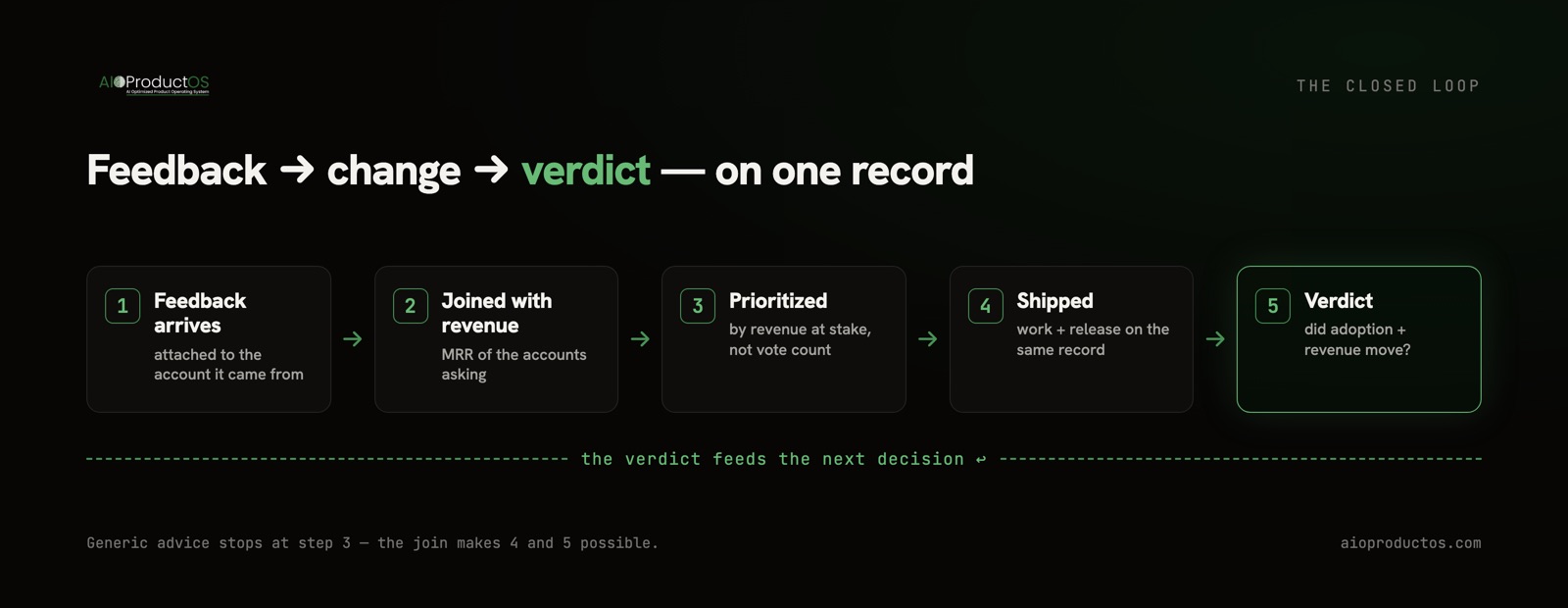
To turn customer feedback into product changes, join each piece of feedback to three things it's normally disconnected from: the revenue of the account that gave it, the work item that addresses it, and the outcome data that proves the change worked. Then prioritize by revenue at stake, ship, close the loop with the customer, and verify adoption before calling it done.
That one-sentence version hides the hard part. Consolidating and tagging feedback is a solved problem - dozens of feedback tools do it well. The unsolved part is the join. A feedback inbox knows what customers said; it doesn't know what they pay, whether the fix ever shipped, or whether they used it afterward. Every downstream step - prioritization, delivery, verification - inherits that blindness.
The standard five-step playbook - and where it breaks
The advice you'll find on page one of any search is broadly correct: consolidate, categorize, prioritize, implement, close the loop. Those are the right steps in the right order. What the playbooks skip is that each step silently depends on data the feedback tool doesn't have.
| Step | What the playbooks say | Where it breaks without a joined record |
|---|---|---|
| 1. Consolidate | Pull all feedback into one inbox | The inbox captures the quote but not the account behind it - plan, MRR, renewal date are in your billing system |
| 2. Categorize | Tag by theme and product area | Themes get counted by volume, so ten free-tier voices outweigh one strategic account quietly churning |
| 3. Prioritize | Score with RICE or MoSCoW | Reach and impact become guesses; the score looks rigorous but the inputs are opinions |
| 4. Implement | Create a ticket in the tracker | The ticket sheds the customer context on the way over - engineers ship without knowing who asked or why |
| 5. Close the loop & measure | Notify customers, watch metrics | Nobody can trace whether the requesters adopted the change; "closed" quietly comes to mean "emailed" |
None of these steps is wrong. They just assume a connection between systems that, in most stacks, doesn't exist. Okta and Zylo's research puts the average company at 101 SaaS apps with roughly $21M per year wasted on unused licenses - and the feedback-to-outcome chain typically crosses four of those apps with no shared record between them. The result is a process that produces motion at every step and proof at none.
Prioritize by the revenue of the accounts asking
Vote counts are the most common prioritization input and the least honest one. A hundred upvotes from free users and one request from an account worth a third of your ARR are not the same signal, but a vote-sorted list renders them identically. The next step is to prioritize customer feedback by business impact, combining account revenue, request frequency, effort, and strategic fit.
The fix is revenue-weighted prioritization: for each feedback theme, sum the actual revenue of the accounts requesting it, and rank themes by revenue at stake alongside request count. This turns "lots of people want dark mode" into "accounts representing $4,200 MRR want dark mode, and two of them renew next quarter" - a sentence a CEO can act on.
This doesn't replace scoring frameworks; it feeds them. RICE is only as good as its reach and impact estimates, and account revenue is the most defensible impact input you have. If you want to pressure-test your current scores, our free RICE prioritization calculator makes the inputs explicit - the useful exercise is asking where each number came from.
Two honest caveats. First, revenue weighting can bias you toward your largest customers' requests at the expense of the improvements that win the next hundred customers - so treat it as the primary lens, not the only one. Second, it requires feedback and billing data on the same customer record. In AIOProductOS, that join is the default: the Insights feed links every piece of feedback to its account, and features rank by request count and revenue at stake across RICE, WSJF, Value-Effort, MoSCoW, and Kano. In a disconnected stack you can approximate it with a monthly spreadsheet join - tedious, but far better than votes alone.
Close the loop twice: tell the customer, then verify the outcome
"Closing the loop" has degraded into meaning a changelog entry. It should mean two distinct acts.
The first is telling the specific people who asked. Not a broadcast - a direct note to the accounts whose feedback drove the change: "You asked for this in March. It shipped today." This is the cheapest retention work in software, and it's only possible if the shipped work item still knows which feedback and which accounts it came from. When a ticket is created by copy-pasting a quote into a tracker, that lineage is gone by ship day.
The second act is verification, and it's the one almost everyone skips: did the change work? Before shipping, state the expectation - which accounts should adopt this, and which metric should move. After shipping, check. In AIOProductOS, every shipped feature carries a verdict on its task card - adoption, MRR adopted, retention lift - because the analytics live on the same customer record as the feedback and the work. Without that join you can still verify manually; it's just expensive enough that, under deadline pressure, nobody does.
Verification is also what makes the whole system compound. A team that knows which feedback-driven changes worked gets better at prioritizing the next batch; a team that never checks is prioritizing on the same guesswork every quarter. A weekly cadence helps here - we've written about how a weekly product signal memo forces this review into the calendar instead of leaving it to good intentions.
There's a broader pattern behind all of this. The instinct is to buy more tools - a better feedback inbox, a better analytics suite. But 68% of tech leaders are consolidating vendors in 2026, and best-of-breed stacks need 280% more maintenance than integrated ones. The problem was never a missing tool. It's that the tools never shared a record.
When a simple feedback spreadsheet is enough
Not every team needs any of this. If you're pre-product-market-fit with under roughly 20 paying customers, you don't have a prioritization problem - you have a conversation problem. You should know every customer by name, and a spreadsheet with columns for who said it, what they pay, and what happened next is a genuinely complete system. Adding software to that would be procrastination.
The spreadsheet also wins when feedback volume is low (a few items per week), when a single founder is both collecting feedback and building, or when your customers all pay roughly the same amount - flat pricing removes most of the case for revenue weighting.
The spreadsheet breaks at a predictable point: when feedback arrives across enough channels (support, sales calls, reviews, surveys) that consolidation itself becomes a job, when account revenue varies enough that treating requests equally distorts the roadmap, and when enough time passes between request and ship that nobody remembers who asked. That's usually somewhere between 30 and 100 accounts. Before that line, the joined-record approach is overhead. After it, the spreadsheet is where feedback goes to be forgotten.
The loop, end to end
The generic playbook - consolidate, categorize, prioritize, implement, close the loop - is correct and incomplete. Each step works only when feedback, revenue, work, and outcomes sit on one customer record. That's the difference between a feedback process that produces a tidy backlog and one that reliably turns customer feedback into product changes the business can feel: you prioritize by the revenue of the accounts asking, ship with the customer context intact, tell the requesters personally, and get a verdict on whether it worked.
If you want to see what feedback looks like when it's already joined to revenue, work, and outcomes - one feed across reviews, requests, surveys, and support, linked to features and accounts - take a look at Insights in AIOProductOS.