Every product team has a roadmap. Far fewer have one that survives contact with the next planning meeting. The usual guides walk you through vision, themes, prioritization, and format - all correct, all generic. What they leave out is the thing that decides whether a roadmap works or rots: whether each item can be traced to who asked for it and the revenue at stake. This post covers the method honestly, then names the trap.
How do you write a product roadmap?
To write a product roadmap, start from the outcomes you want, not a feature list. Group work into themes that map to goals, prioritize each theme by the customer requests and revenue behind it, choose a format that matches how certain you are, and set a cadence to revisit it. A roadmap is a set of decisions, not a schedule.
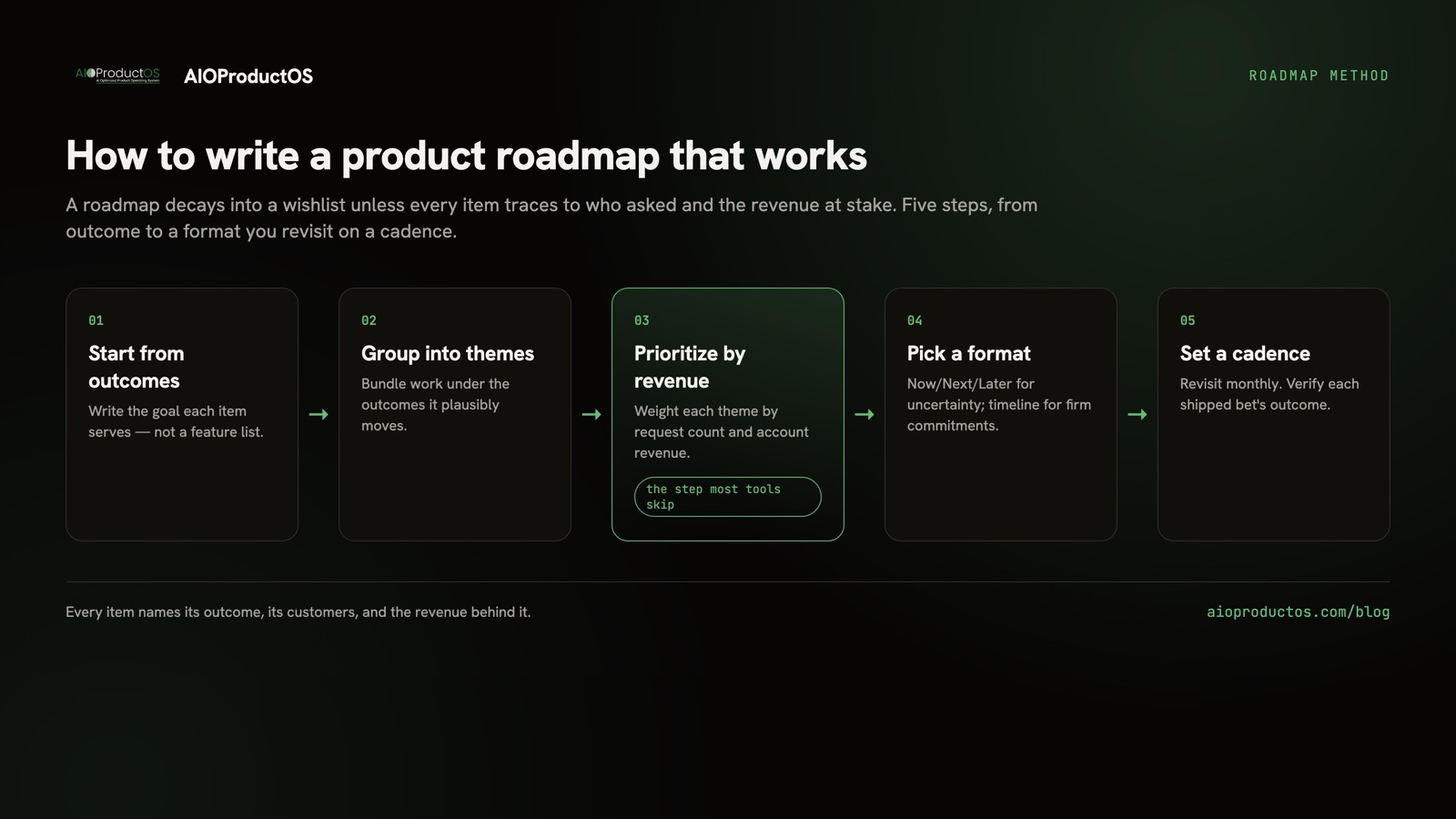
That one-sentence version is the easy part. The five steps below are what every page-one guide teaches - and they are right. The reason most roadmaps still fail is that each step quietly assumes information the roadmap tool doesn't actually hold.
Start from outcomes, not a feature list
A roadmap built as a list of features is a wishlist wearing a suit. The first discipline is to write down the outcome each item is meant to produce - reduce churn in the mid-market segment, lift activation, win a competitive deal type - and only then attach the work that plausibly gets you there.
This does two things. It gives you a way to say no (an idea that serves no current outcome comes off the list), and it gives stakeholders a reason each item exists. If your roadmap reads as "dark mode, SSO, bulk export," nobody can challenge it, because there's nothing to challenge. If it reads as "cut enterprise evaluation friction: SSO, audit log, bulk export," the debate is now about the goal, which is the debate you want. For how to present that roadmap to a skeptical audience, see communicating your roadmap to stakeholders.
Prioritize by who asked and the revenue at stake
Here is where roadmaps that look identical diverge into ones that work and ones that don't. Most prioritization runs on vote counts or gut feel. A hundred upvotes from trial users and one request from the account worth a third of your ARR render the same height on a sorted list - but they are not the same signal.
The fix is to weight each theme by the actual revenue of the accounts requesting it, alongside request frequency and strategic fit. "Lots of people want exports" becomes "accounts representing $6,100 MRR want exports, and two renew next quarter" - a sentence a CEO can act on. This feeds scoring frameworks rather than replacing them: RICE and WSJF are only as honest as their reach and impact inputs, and account revenue is the most defensible impact input you have. If you want to make those inputs explicit, our free RICE prioritization calculator and WSJF calculator force you to show where each number came from.
The catch is that this requires feedback and billing data on the same customer record - and in a typical stack they're in different tools entirely. Feedback lives in one app, revenue in another, the work in a tracker, the outcome in an analytics suite. The average employee already loses about 40% of productive time to context-switching across tools, and the roadmap sits at the exact seam where four of those tools meet. When the connection between them is a person copy-pasting, the "why" behind each roadmap item is the first thing to fall off. We've written separately on how to turn customer feedback into the work it should drive without losing that lineage.
Now/Next/Later vs a timeline roadmap
Format is the decision people agonize over most and it's genuinely a real choice, not a style preference. The two dominant formats optimize for opposite things: honesty about uncertainty versus a firm commitment stakeholders can plan around.
| Now / Next / Later | Timeline (Gantt-style) | |
|---|---|---|
| Best when | Priorities shift, discovery is ongoing, you're pre-scale | Commitments are firm - launches, contracts, compliance deadlines |
| Communicates | Sequence and intent, not dates | Specific dates and dependencies |
| Main risk | Stakeholders read "Now" as "this week" | Dates get treated as promises, then missed |
| Update cost | Low - move cards between three buckets | High - every slip cascades through the chart |
| Honest about uncertainty | Yes, by design | No - implies precision you rarely have |
For most product teams under scale, Now/Next/Later is the more honest default: it commits to order and intent without inventing dates you can't hold. Reach for a timeline only where a real external commitment exists - a launch tied to a contract, a regulatory deadline, a dependency another team is planning around. Many teams run both: Now/Next/Later for the product at large, a short dated view for the two or three items that genuinely have hard dates.
What belongs on the roadmap - and what belongs in the backlog
A roadmap and a backlog are different artifacts, and conflating them is the most common way a roadmap decays. The backlog is exhaustive: every ticket, bug, and small improvement. The roadmap is deliberately short: the few themes you're committing to, and the outcomes they serve.
The test is granularity. If your roadmap has line items an engineer could pick up and build in an afternoon, it's a backlog with better fonts. Roadmap items are themes ("reduce enterprise evaluation friction"); backlog items are the tasks under them ("build SAML SSO"). Keep the roadmap at the altitude where a stakeholder debates the bet, not the implementation.
How often to update it
Update the roadmap on a fixed cadence, not continuously. A monthly review of priorities plus a lighter weekly check on in-flight work covers most teams. Revisit sooner when a bet is invalidated, a major customer signal shifts, or a strategic goal changes - but resist editing it daily. A roadmap that changes every day is a task board, and stakeholders stop trusting a document that never holds still. The point of the cadence is to make the roadmap a periodic decision, not a live feed.
When a simple roadmap is all you need
None of this is free, and for some teams it's overhead. If you're pre-product-market-fit with under roughly 20 paying customers, you don't have a prioritization problem - you have a conversation problem. You know every customer by name, priorities change weekly, and a three-column Now/Next/Later in a shared doc is a genuinely complete roadmap. Adding revenue weighting when all your customers pay roughly the same, or a formal cadence when you replan every week anyway, is procrastination dressed as process.
A simple roadmap also wins when a single founder is both talking to customers and building - the "join" between feedback and revenue lives in one head, and formalizing it adds latency without adding truth. The lightweight version breaks at a predictable point: when feedback arrives across enough channels that nobody remembers who asked, when account revenue varies enough that treating requests equally distorts the roadmap, and when enough time passes between commitment and ship that "why is this on here?" has no answer. That's usually somewhere between 30 and 100 accounts. Before that line, keep it simple. After it, an unlinked roadmap is where good bets go to be forgotten.
The roadmap that actually works
The generic method - vision, themes, prioritize, format, keep flexible - is correct and incomplete. A roadmap works when every item on it can name the outcome it serves, the customers who asked, and the revenue at stake; and when you verify afterward whether the bet paid off, so the next round of prioritization is better than the last. That last step matters as much as the first: a roadmap where every shipped item carries a verdict compounds, while one that never checks re-runs the same guesswork every quarter. The failure mode isn't picking the wrong format - it's a roadmap disconnected from the demand and revenue underneath it, which decays into a wishlist no matter how it's drawn.
If you're weighing how to build and maintain one, we keep an honest, hands-on comparison of the best roadmap tools and a broader roundup of the best product management tools - including where each falls short. And if you want to see what it looks like when feedback, revenue, and work already sit on one record, start a 7-day free trial on your own data.