Every SaaS pricing page leads with a per-seat number because it looks small. Sixteen dollars a user. Twelve. Eight. The number is designed to be compared against your coffee budget, not your actual bill. But the sticker rate is the one cost that is easy to see - and for a product team, it is rarely the one that hurts.
Most guides that explain per-seat pricing are written for the people selling it: pricing consultants and billing vendors explaining how to structure a model. This one is written from the other side of the invoice - the buyer's. Here is what per-seat pricing actually costs a product team once you count the parts the pricing page leaves out.
What does per-seat pricing really cost a product team?
Less than the sticker rate suggests - and much more. A per-seat tool at $16/user looks cheap, but the real cost includes dead seats you keep paying for, stakeholders you never invite to save money, and AI charges metered on top. The bill grows with headcount, not with the value the tool delivers.
Break the real cost into four parts and it becomes clear why the invoice always lands higher than the demo implied. If you'd rather have your own number than a worked example, the SaaS stack cost calculator totals the seat fees and the AI meters across the tools you actually run. It works in the browser, no signup.
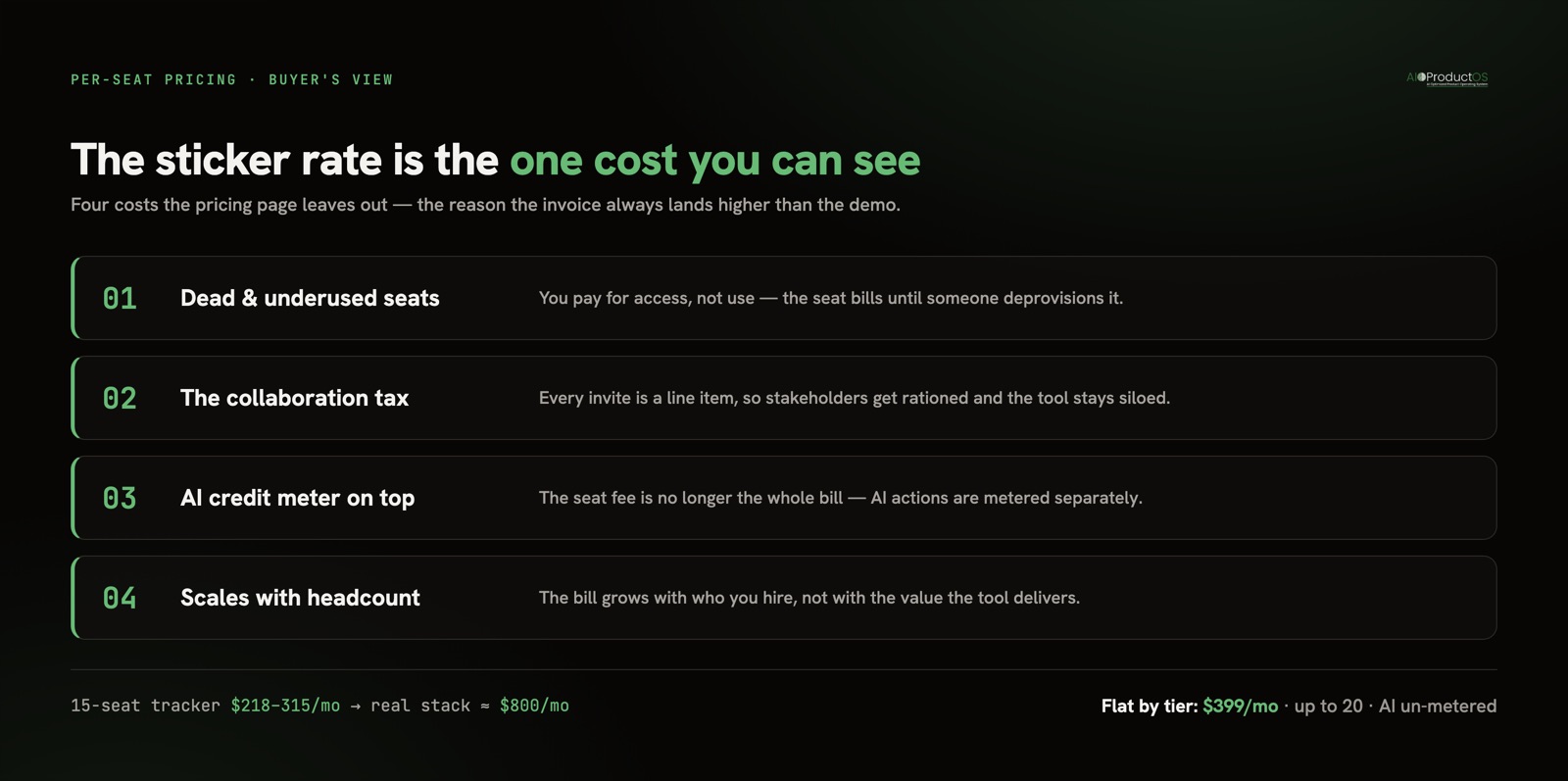
1. Dead and underused seats you keep paying for
Per-seat billing charges for access, not use. The moment someone leaves, changes roles, or simply stops opening the tool, that seat keeps billing until someone remembers to deprovision it. Across a whole company this waste is not a rounding error: the average company runs 101 SaaS apps and wastes roughly $21M a year on licenses nobody uses (Okta + Zylo). A product team is a small slice of that, but the mechanic is identical - you pay for the seat you provisioned, not the value anyone extracted from it.
2. The collaboration tax: rationing invites to save money
This is the cost nobody puts on a spreadsheet, and it is the most expensive. When every seat has a price, you start rationing them. The designer who needs to see the roadmap twice a month, the contractor on a six-week engagement, the account manager who wants to check whether a customer's request shipped - each one is a line item, so you don't invite them. The tool stays inside the core team.
The result is that the product record stays siloed by design. Stakeholders ask for status over Slack because they were priced out of the source. Feedback lives in someone's inbox because the person who received it doesn't have a seat. Per-seat pricing quietly pushes you toward the exact fragmentation the tool was supposed to fix - and as we've argued in the real cost of a product tool stack, the problem was never the number of tools, it's that they don't share one record.
3. AI credit-metering stacked on top of the seat fee
The seat fee used to be the whole bill. Now nearly every incumbent meters AI as a separate line on top. Monday charges credits per AI action - 8 credits (about $0.08) each. ClickUp's Brain add-on is +$9/user, or Everything AI at +$28/user, which nearly doubles the Business bill. Notion's Custom Agents run $10 per 1,000 credits with no rollover and a documented case of a $1,500 bill in a single month. You are no longer paying per seat; you are paying per seat, then per action, with the second meter running invisibly.
4. The bill scales with headcount, not value
Put the three together and you get the structural problem: a per-seat tool's cost is a function of how many people you hire, not how much the tool is worth to you. Hire five people and your bill goes up whether or not those five ever open the tool. That is a strange thing to sign up for - a cost that grows with your success at recruiting, decoupled from the outcome the software produces.
The worked math: a 15-person product team
Here is the concrete version. Assume a 15-person product team, and assume everyone who needs the tool has a seat (the honest ceiling - some vendors bill only "makers," noted below). Rates are the verified 2026 top self-serve per-seat prices.
| Tool | Per-seat / mo | 15 seats / mo | AI on top |
|---|---|---|---|
| Jira | $14.54 | $218 | Rovo credits, no rollover |
| Linear | $16 | $240 | advanced AI gated to Business |
| Monday | $19 (3-seat min) | $285 | 8 credits per AI action (~$0.08) |
| Notion | $20 | $300 | Custom Agents $10 / 1k credits |
| ClickUp + Brain | $12 + $9 | $315 | Brain add-on included in this row |
| Productboard | $15-19 / maker | ~$285 | metered credits, 250 / maker / mo |
| AIOProductOS - Team | flat | $399 (up to 20 members) | AI included, un-metered |
A single delivery tool at 15 seats is $218-315 a month - genuinely less than a flat tier, if a tracker were all a product team needed. It isn't. Real product work spans delivery, roadmap, and docs, so the true comparison is the stack: Jira for delivery ($218 - see what Jira actually costs) + Notion for docs ($300) + Productboard for roadmap (~$285) is roughly $800 a month across three disconnected products, with AI metered on two of them and no shared record between any of them. (Productboard bills per maker, so its line assumes all 15 edit; if only 6 do, it's ~$114 - but then nine people can't touch the roadmap, which is the collaboration tax in action.)
Against that, a flat-by-tier price is $399 a month for up to 20 members, AI included and never credit-metered, on one connected record. The flat number isn't cheaper than any one per-seat tool - it's cheaper than the stack, and it stops scaling with your headcount. You can add the fifth or fifteenth stakeholder without opening a spreadsheet.
When per-seat pricing is actually the fair model
Per-seat isn't a scam, and pretending it is would be dishonest. There are cases where it's the fairest model on the table, and a flat floor would cost you more.
Small teams should often pick per-seat. For a 3-person team, Jira at $14.54/user is about $44/month - far below any flat tier built for 20 members. If you're small and expect to stay small for a while, paying only for the heads you have is exactly right, and a flat price aimed at a bigger team is dead weight you'd be subsidizing.
Tools where a seat equals a genuine daily producer. When every user is an active, heavy user - an engineer living in the tracker all day, a designer in the canvas every hour - the seat fee tracks real value closely. There are few dead seats to bleed on, and the meter roughly matches usage. Per-seat is honest when access and value are tightly coupled.
The trap isn't per-seat pricing itself. It's per-seat pricing on a collaboration tool that a whole cross-functional team, including people who dip in occasionally, is supposed to share. That is precisely where dead seats accumulate and invite-rationing bites, because the tool's value depends on breadth of access while its price penalizes exactly that.
The honest takeaway
If you're a small team using one tool heavily, per-seat is probably your cheapest and fairest option - take it. If you're a growing product team that needs several connected tools and wants everyone who touches the product to see the same record, per-seat quietly works against you: it bills you for dead seats, taxes collaboration, stacks an AI meter on top, and scales with your org chart instead of your outcomes.
We built our pricing flat by tier for that second case - team always included, no per-seat metering, AI never credit-metered, and every tier ships EU or US data residency. It won't beat a single per-seat tool for a three-person team, and we'll say so on the honest comparison pages, each of which shows where the incumbent wins. But for a mid-size team, the flat number is the one that stops surprising you.
Total your own stack, every per-seat line plus the AI meters, with the SaaS stack cost calculator, and decide with the real figure in front of you.