Two protocols arrived in the same stretch of months with names that read like alternatives, and nearly every comparison of them lands on the same sentence: A2A is horizontal agent-to-agent, MCP is vertical agent-to-tool, they are complementary. That is correct. It is also where most of those pages stop.
Which leaves the question you arrived with sitting there unanswered. Not "how do these differ" but "which of them is a decision I have to make this quarter, and what do I actually have to do about it?" For most teams the honest answer is that only one of the two is live, and the real work is not in either protocol.
What is the difference between A2A and MCP?
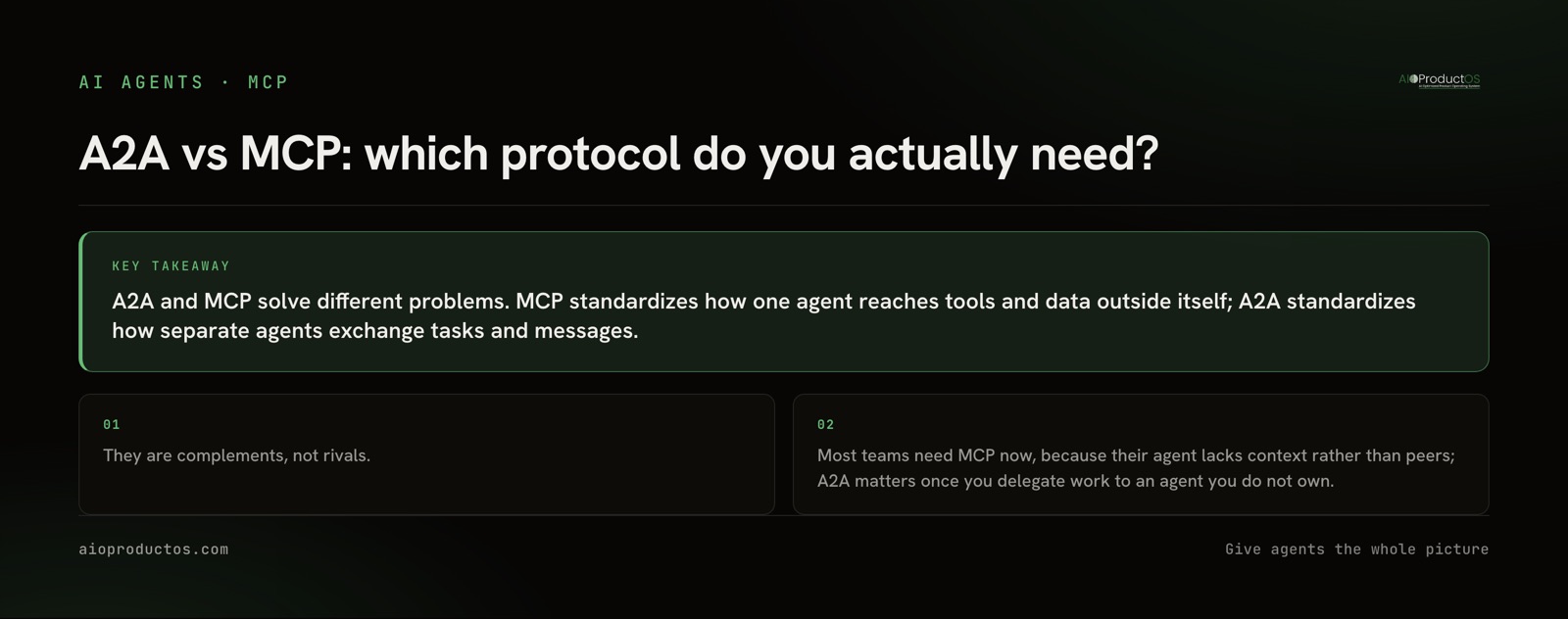
MCP standardizes how an AI agent reaches tools, data and actions outside itself. A2A standardizes how two agents exchange tasks and messages. One is about what a single agent can touch; the other is about who a group of agents can talk to. They sit on different axes, which is why they are complements rather than competitors.
Two nearby comparisons are not this one, and conflating them is where most of the confusion starts. MCP measured against REST APIs, meaning who builds the integration and who calls it at runtime, is a separate question with a separate answer. So is the difference between an MCP that exposes one tool's own data and one that exposes the join across systems, which is worked through here. This post is about a third axis entirely: messaging between agents, versus access from an agent to the things it needs.
The origins are worth one line, because they explain the shape of each spec. MCP came out of Anthropic and was written for the problem of a model that cannot see anything outside its own conversation. A2A came out of Google and was written for the problem of two agents, built by different teams on different frameworks, that need to hand work to each other without either one exposing its internals.
The comparison, side by side
Everything below follows from those two problem statements.
| MCP | A2A | |
|---|---|---|
| What it standardizes | How an agent discovers and calls tools, reads resources, and uses prompts exposed by a server | How an agent advertises what it can do, and how two agents exchange tasks, messages and results |
| Who talks to whom | One agent to one server per connection; the host opens one client per server it is configured with | One agent to another agent, each possibly built by a different team on a different framework |
| The unit of exchange | A tool call and its typed result | A task with a lifecycle, plus the messages and artifacts attached to it as it runs |
| How the other side is found | The server declares its tools, resources and prompts at connection time | The agent publishes a card describing its skills and how to reach it |
| Opacity | The agent sees the tool list and calls specific tools by name | Deliberately opaque: the calling agent sees advertised skills, not the other agent's internals |
| What it does NOT solve | Whether the data behind those tools is joined, current or complete | What either agent can actually do; delegating to an agent with nothing behind it changes nothing |
| When you actually need it | As soon as one agent must act on systems it does not contain | Once work must cross an agent boundary you do not control, or run long and asynchronously |
The decision most teams are actually facing
A2A presumes a condition most teams have not reached. It presumes more than one autonomous agent, each with real capability, owned by parties that will not converge on a single runtime, with work that genuinely needs to cross between them. If you have one assistant in one host, A2A solves a problem you do not have yet, and adopting it early buys you an integration surface with nothing on the other end.
What those teams have instead is a context problem. The agent is not short of peers. It is short of the record. It answers confidently about the backlog and has no idea which paying customers asked for the thing it just summarized, because the tracker, the feedback inbox, the analytics tool and the billing system each hold one quarter of that answer and none of them hold the join.
That is an MCP-shaped problem, and it is the one worth spending this quarter on. It is also where the second-order detail bites: how much of any MCP server you can reach is decided by the client you happen to be running, which is not the same thing as what the server offers. Teams debating protocols while their agent quietly degrades to a text-only subset are optimizing the wrong layer.
The work that sits upstream of both protocols
Neither protocol makes your data good. Both are transport plus vocabulary. An agent connected over MCP to a tool that returns prose blobs is an agent that cannot chain a second call onto the first, and an agent reachable over A2A that has nothing but that behind it is a well-addressed dead end.
So the durable work is in what your systems expose when an agent arrives, and it comes down to three things. Records need ids and types, not summaries, because a typed result is what makes the next call possible. Access needs a scope, so that what an agent is allowed to read and write is enforced somewhere real rather than assumed in a prompt. And writes need a review path, because an agent that can only read is a search box, and an agent that can write without a trail is a liability.
This is the part we build against. Our own spine is callable over MCP as 71 tools that read and act, with writes landing in human review, and the reason it is one server rather than a shelf of them is that the join lives underneath: revenue, feedback, work and code sit on one customer record, so "which paying customers asked for what I am building" is one query instead of a four-tool reconciliation. Point an agent at a single-tool MCP and it still has to do that stitching itself, whatever protocol it uses to talk to the next agent.
When A2A genuinely is what you need
Now the case against most of the above, and it is a real one.
There are three situations where A2A is exactly the right answer and MCP is not a substitute. The first is delegation across an organizational boundary: you want an agent someone else owns to do a piece of work, and you neither can nor should be handed its tools. Opacity is the feature there, not a limitation. The second is asynchronous, long-running work. A task with a lifecycle and status updates is a different object from a blocking tool call that has to return before the conversation continues, and pretending otherwise produces timeouts and lost work. The third is a large organization with agents already built on frameworks that will never be unified, where a shared interoperability layer is cheaper than a rewrite.
If you are in one of those three, A2A is the live decision and the rest of this post is not about you.
It is also worth saying plainly that this was never a fight. An agent reachable by A2A still needs MCP, or something like it, to touch the systems it acts on, because A2A moves tasks between agents and says nothing about how either one reads a database. Most serious deployments end up running both. Anyone framing this as a winner-take-all protocol war is selling something, usually the one they already implemented.
Check the claim yourself, in about two minutes
The argument above is only worth as much as the surface behind it, so here is how to test ours rather than take it.
Add https://platform.aioproductos.com/api/mcp to your assistant as a remote MCP server. It speaks Streamable HTTP with OAuth 2.1 and PKCE, and supports Dynamic Client Registration, so there is no key to paste; if your client handles remote plus OAuth, the consent screen is the entire setup. Then ask it two questions. First, how many tools this server exposes: the answer should be 71, covering the product management read surface plus writes across initiatives, features, OKRs, sprints, releases, ideas, experiments and decisions. Second, which features have the most customer requests behind them. What should come back is typed records carrying ids rather than a paragraph of prose, and that difference is the whole point, because it is what lets the model chain a second call onto the first.
If your client only launches local processes, run npx -y @aioproductoscom/mcp@latest instead. With no PRODUCTOS_TOKEN set it starts in demo mode against a seeded showcase workspace, exposing a read-only subset of the tools, with no account and nothing to cancel. And if you would rather confirm the server exists before connecting anything to it, it is published in the official MCP Registry under the name com.aioproductos/mcp.
How to decide, in one pass
Ask one question: does work need to cross an agent boundary you do not control? If yes, A2A is your protocol and the task lifecycle is the part to design carefully. If no, and it is no for most teams today, then A2A is a thing to read about and MCP is a thing to ship, and the honest bottleneck is not the protocol at all but what your agent finds when it arrives.
If that is where you have landed, the next useful step is seeing what the tools you already run actually expose to an agent, and where each one stops. Start with the MCP guides, one per tool.