Every explainer on this comparison lands in the same place. Prompt engineering is how you phrase the request; context engineering is everything you assemble in the window around it; the second is a superset of the first. Then comes the list of what counts as context - retrieved documents, conversation memory, tool outputs, user state - and the page ends there.
The list is where the interesting question starts, and none of those pages asks it. Where do those documents, those tool outputs and that user state actually come from? For most teams the answer is a dozen systems that have never agreed with each other about anything, and that fact sets a ceiling neither discipline can raise from the inside.
What is the difference between context engineering and prompt engineering?
Prompt engineering is the craft of the instruction: wording, examples, output format, reasoning steps. Context engineering is the craft of everything else in the window - what gets retrieved, remembered, summarized or dropped before the model reads a single instruction. Prompt engineering optimizes what you say. Context engineering optimizes what the model can see.
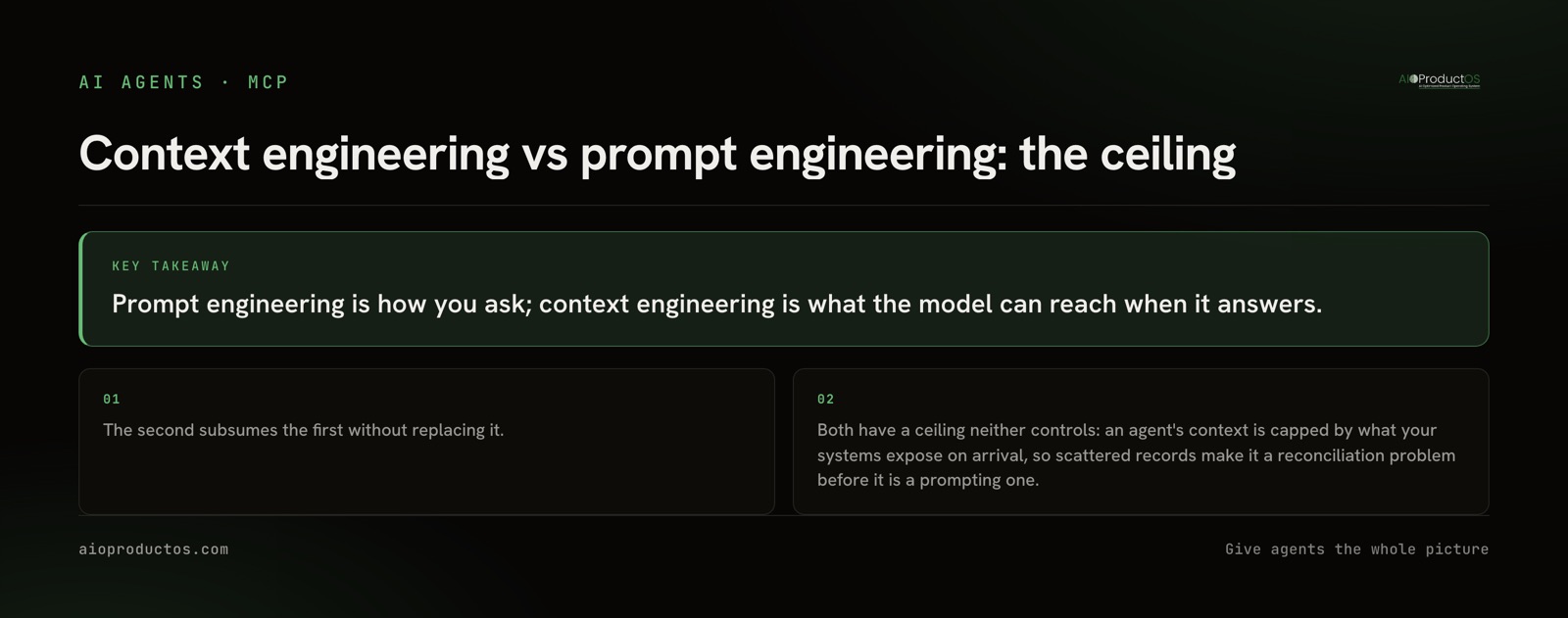
The subset framing is correct as far as it goes. It is also why the comparison is a weak decision aid: nobody is picking one. A team doing serious context engineering is still writing prompts, and a team writing only prompts is doing context engineering badly by default, because the window gets filled either way. The useful question is not which discipline to invest in. It is which of them your current failure belongs to, and whether it belongs to either.
The comparison, side by side
Both disciplines have a distinct unit of work, a distinct failure signature and a distinct debugging loop. That is the part worth holding on to.
| Prompt engineering | Context engineering | |
|---|---|---|
| The unit of work | One instruction: phrasing, examples, reasoning steps, output schema | The whole window: retrieval, memory, tool definitions, result formatting, compaction |
| What you control | What the model is asked to do | What the model has available while doing it |
| How it fails | The model misreads the task, or returns a shape you cannot parse | The model answers confidently from material that is stale, partial or contradictory |
| How you debug it | Rewrite, re-example, constrain the output, compare runs | Inspect what was actually in the window, and cut before you add |
| Who usually owns it | Whoever writes the feature | Whoever owns the data and the integrations, which is often nobody in particular |
| What it cannot fix | Anything the model was never given | Anything your systems do not expose in the first place |
That last row is the one every page-one result leaves blank.
Where the context actually comes from
Retrieval, memory and tool results are not raw material. They are outputs of systems you already run, and their quality is decided before any context engineering begins.
Take a concrete request an agent gets asked constantly: which paying customers asked for the feature we are building, and what do they pay? There is no prompt for that. There is also no retrieval strategy for it, because the answer does not exist in any one place to retrieve. The money is in the billing system, the request is in the feedback tool, the work is in the tracker, the delivery is in the repository, and not one of them holds the same customer record as the others. Give the agent access to all four and you have not given it the answer. You have given it a reconciliation job, performed by a model, at inference time, with no way to tell you which of the four it trusted.
That is what a context ceiling looks like in practice. Curate harder and the model gets four cleaner partial answers. Prompt harder and it stitches them with more confidence, which is worse. The average company runs 101 SaaS apps and spends around $21M a year on licenses nobody uses, per Okta and Zylo - access was never the scarce thing. Agreement was.
Which is why the durable work sits upstream of both disciplines, in what your systems hand over when an agent arrives. Records need ids and types rather than prose summaries, so a second call can chain onto the first. Access needs a real scope, enforced somewhere other than a prompt. Writes need a review path. This is the bet we build on: our own product spine puts revenue, feedback, work and code on one customer record in one schema, so the question above is a single query instead of a four-system reconciliation the model performs badly. The same distinction decides what any server can return - a server exposing one tool's own data cannot produce a join it does not hold, however well you engineer the window around it.
Where this argument is wrong
Three real concessions, and the first one undercuts most of what you just read.
Prompt engineering is still sufficient for a large class of work, and treating it as obsolete is expensive. Classification, extraction, summarization of text you already have, rewriting, translation, structured output from a document in hand - these are single-shot tasks where the entire relevant world fits in the request. There is no retrieval to design and no memory to manage. Reaching for a context pipeline here adds latency, cost and failure modes to buy nothing. If your work is mostly single-shot over supplied text, the prompt is the system, and the sophisticated move is to leave it there.
Context engineering has a failure mode of its own, and it is the opposite of the intuition. More context is not better. The recognized failure modes have names now - context rot as the window fills, context poisoning where one bad fact reproduces at every later step, context distraction, context confusion and context clash between contradictory accumulated material - and they share a shape: adding material past a point costs accuracy rather than buying it. A team that reads "context is the new prompt" and responds by stuffing everything reachable into the window has made things worse with more effort. The skill is subtraction under a budget, not accumulation.
And for most teams this comparison is a distinction without a decision. You are not choosing. You are noticing that your agent is wrong and looking for the layer to blame. Before either discipline, check the cheaper thing: read what was actually in the window on the failing run. Most of the time the answer is not a phrasing problem or a retrieval-strategy problem. It is that the fact needed was never in there, because no system you connected owns it.
Check the claim yourself, in about two minutes
The upstream argument is only worth what the surface behind it is worth, so test ours rather than take it.
Add https://platform.aioproductos.com/api/mcp to your assistant as a remote product management MCP server. It speaks Streamable HTTP with OAuth 2.1 and PKCE (S256) and supports Dynamic Client Registration, so there is no key to paste. Then ask two things. First, how many tools the server exposes: the answer should be 71, covering the product management read surface plus writes across initiatives, features, OKRs, sprints, releases, ideas, experiments and decisions, alongside 3 interactive ui:// MCP Apps. Second, ask the cross-system question from earlier and watch the shape of what comes back - typed records carrying ids, not a paragraph of prose. That difference is the whole point, because typed results are what let a model chain a second call onto the first instead of re-parsing its own summary.
If your client only launches local processes, run npx -y @aioproductoscom/mcp@latest. Started without a PRODUCTOS_TOKEN, the stdio server runs in demo mode against a fully seeded showcase workspace with a read-only subset of the tools - no account, nothing to cancel. To confirm the server exists before connecting anything, it is published in the official MCP Registry as com.aioproductos/mcp.
The decision, in one pass
Ask what your last bad answer was missing. If the model had everything it needed and still misread the task, that is a prompt problem and the older techniques apply unchanged. If it had too much and lost the thread, that is context engineering, and the fix is cutting rather than adding. If the fact was never available to it at all, neither discipline is your bottleneck, and no amount of work at the window will change that.
If you landed on the third, the next useful step is seeing exactly what your existing tools hand an agent and where each one stops. Start with what a well-designed tool surface looks like, or with the protocol itself if that layer is new to you.