A decision gets made at 09:00 CET. Two people in a call agree to cut a feature from the release, one of them updates the ticket to "won't do", and the thread moves on. At 09:00 PT, eight hours later, an engineer opens that ticket, sees a status change with no reasoning attached, and books a call to ask why.
That call is the actual cost of a remote product stack. Not the subscriptions - the reconstruction work. And it is the thing every "best tools for remote product teams" listicle skips, because prescribing six tools is easier than accounting for what six tools do to a decision that has to survive a time-zone gap.
What tools do remote product managers actually need?
Remote product managers need four surfaces covered - decisions, roadmap and feedback, execution, and evidence - not six apps. The deciding factor is not feature depth. It is whether a teammate who logs on after you log off can reconstruct why something was decided, from the artifact alone, with no meeting.
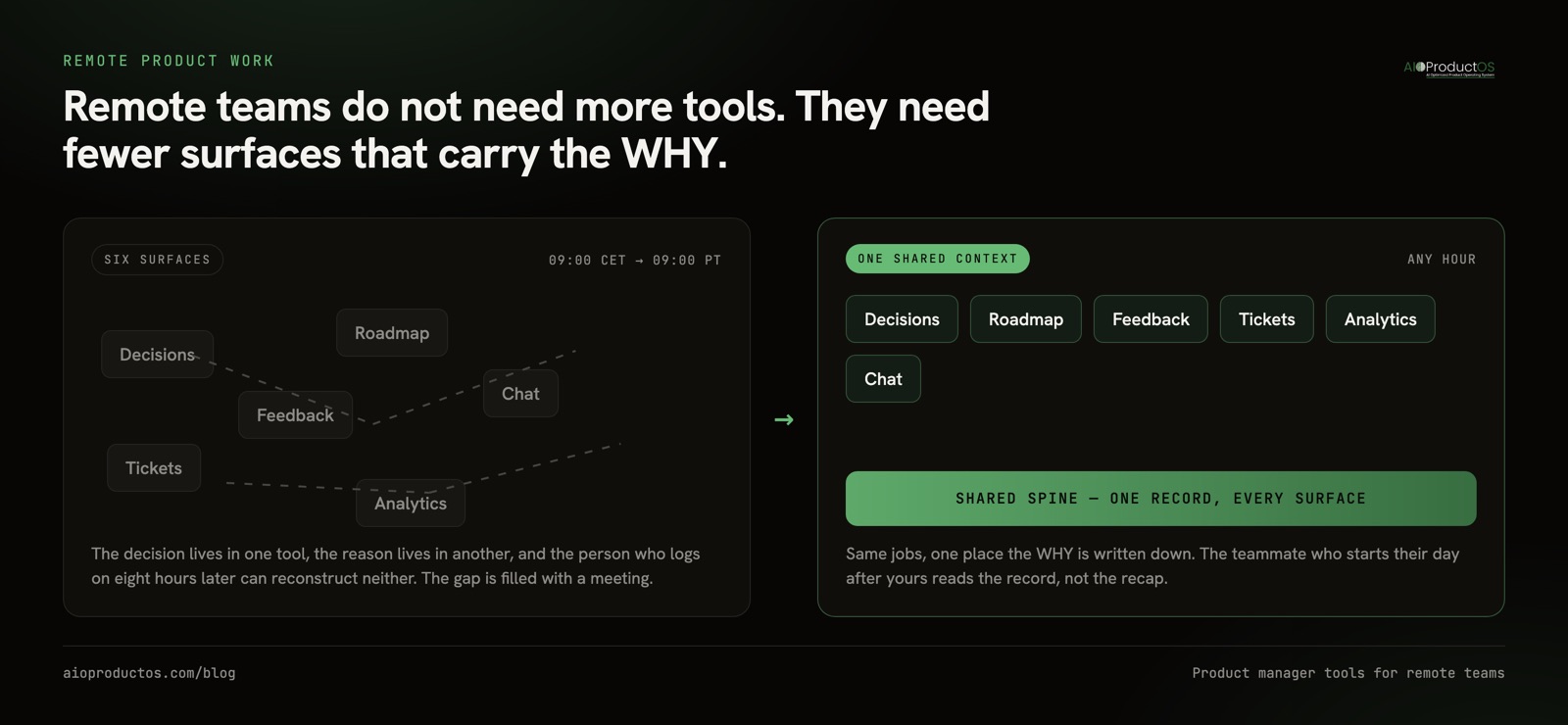
The standard recommendation set is remarkably consistent across the top-ranking guides: Notion or Confluence for knowledge, Miro for ideation, Productboard or Airfocus for roadmap, Slack and Zoom for communication, Jira or ClickUp for execution. Every one of those is a good tool. None of them is wrong on its own merits. What none of the lists do is price the prescription - and distributed teams pay for it twice, in fragmentation and in headcount-scaled billing.
The fragmentation cost is not soft. Gallup-backed research puts context switching at roughly $450 billion a year, with the average employee losing about 40% of productive time to it. Co-located teams absorb some of that by leaning over a desk. Remote teams cannot; the recovery mechanism is a calendar invite, at whatever hour suits neither person. We wrote up the mechanics of that in context switching is quietly eating your product team.
The test that beats the tool list
Instead of asking which tools, ask one question of each artifact your team produces:
Can someone in another time zone act on this without asking a human what it means?
Run it on your last five roadmap changes. A ticket that says "descoped" fails. A ticket that carries the customer who requested it, the revenue behind that account, the decision that cut it, and what the team expected it to move - passes. The distinction has nothing to do with how many apps you own and everything to do with whether context travels with the record or lives in the memory of whoever was awake when it was decided.
This is the reason a whiteboard app is not what fixes remote product work. Remote teams do not fail for lack of a canvas. They fail because the WHY of a decision is stored in a conversation, and conversations are synchronous by nature. A tool only earns its slot in a distributed stack if it turns reasoning into something durable and linkable.
The five jobs, and how each one fails asynchronously
| Job to be done | What a remote team actually needs from that surface | Async failure mode when it is missing |
|---|---|---|
| Decisions | The call, the reasoning, the alternatives rejected, welded to the thing it changed | Status changes with no rationale; the next shift books a meeting to reconstruct intent |
| Roadmap | Sequence plus the evidence for the sequence, readable without a walkthrough | Priority order looks arbitrary offshore; every planning cycle relitigates the same questions live |
| Customer feedback | Requests linked to the accounts and revenue behind them, in one feed | Whoever took the call becomes the single source of truth, and is asleep |
| Execution / tasks | Work items carrying the customer and the request that justified them | Engineers build the WHAT correctly and miss the WHY; rework surfaces at review |
| Analytics / evidence | Shared, queryable outcome data - did the shipped thing move anything | Debates settle by seniority in the overlap hour instead of by data anyone can pull |
Read the right-hand column as a single pattern: every failure resolves into a synchronous meeting. That is the real unit of measurement for a remote stack - meetings per decision - and it is invisible in a feature comparison table.
Per-seat pricing punishes distributed teams hardest
There is a second cost no listicle prices. Remote teams pull more people into each decision, not fewer - the support lead who took the call, the designer in another country, the contractor covering a third region, the account manager who owns the relationship. In a co-located team those people lean in for ten minutes. In a distributed one, they need a login.
Per-seat pricing turns that into a budget conversation. Multiply it across six tools and every adjacent collaborator costs six subscriptions, so teams ration access - and the moment you ration access, context stops travelling and the meeting comes back. The sprawl is already substantial before you add the remote multiplier: the average company runs 101 SaaS apps and wastes roughly $21 million a year on licenses nobody uses, per Okta and Zylo's SaaS Management Index. The consolidation trend is real too: 68% of tech leaders are consolidating vendors in 2026, and best-of-breed stacks require 280% more maintenance than consolidated ones - maintenance a distributed team has fewer spare hours to absorb.
If you want the arithmetic for your own team rather than an industry average, the SaaS stack cost calculator will do it with your real headcount, and we break the accounting down further in what SaaS tool sprawl actually costs.
For what it is worth on our own side of the argument: AIOProductOS prices flat by tier rather than per seat - Start at $199/month for 5 members, Team at $399 for 20 - with AI included and never credit-metered, and EU or US data residency on every plan. The design intent is exactly the one above: adding the person who needs context should not be a purchasing decision. Meetings become drafted tasks and support conversations land on the same customer record as the revenue, which is the comms surface doing the job the calendar otherwise does.
When six separate tools is still the right call for a remote team
The argument above tips into overreach if we do not name where it breaks.
You have real overlap hours. A team spread across Berlin, Lisbon, and Warsaw shares most of a working day. The async penalty is small, meetings are cheap, and a specialist stack you already know beats a migration.
One job dominates and needs depth. If research synthesis or design collaboration is the bulk of your work, Dovetail or a proper whiteboard tool will out-perform the equivalent feature inside a broader platform. Depth in one lane is a legitimate reason to keep a separate tool.
Your org already standardized. If engineering runs on Jira and that is a company-wide decision, fighting it to consolidate product tooling is a political project, not a product one. Connect to it instead.
Nobody is doing the join by hand. If your tools are integrated, adopted, and no one is copy-pasting context between them to answer a question, your stack is working. Switching costs are real and the status quo has earned its place.
The measurement to start with
Do not start by shortlisting tools. Start by counting, for the next two weeks, how many meetings existed only to explain a decision that had already been made. That number is your remote tooling problem, expressed in the unit that actually hurts - and no six-app stack reduces it unless the reasoning lives with the record.
For the full picture across categories, including where each specialist genuinely wins, see our guide to the best product management tools.