Every vendor now sells "AI agents for product managers." Most are a chat box with a new label. The workflows that actually hold up share one trait: the agent can reach your real product data and write back to it. A model with no access to your feedback, roadmap, analytics, and delivery is guessing - eloquently, but still guessing.
What AI agent workflows actually work for product managers?
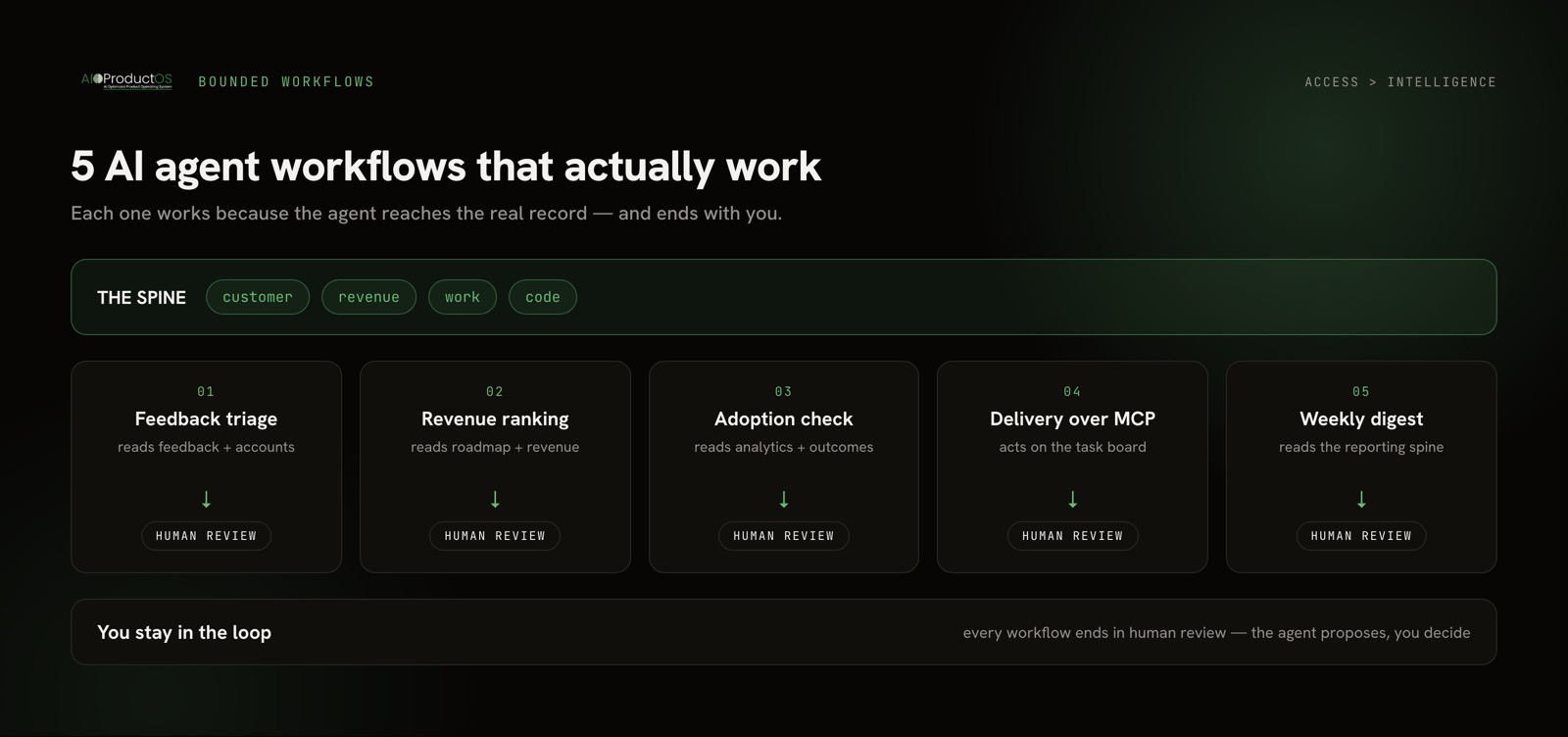
The workflows that work are bounded and data-connected: feedback triage, revenue-ranked prioritization, adoption checks, delivery-task execution over MCP, and a weekly reporting digest. Each works because the agent reaches the real product record - customer, revenue, work, and code on one spine - not because the model is clever. Access, not intelligence, is the binding constraint.
Why data access is the whole game
There is a reason to be skeptical of the category. Gartner predicts more than 40% of agentic-AI projects will be canceled by the end of 2027, and that only around 130 of the thousands of vendors claiming "agents" are real. The projects that get canceled tend to be the ones where the agent had nothing solid to stand on - a clever model wired to a silo, asked to reason about a product it could only half see.
The fix is unglamorous: give the agent typed access to the joined record. In AIOProductOS every customer is one record that ties revenue, feedback, work, and code together, and that spine is callable over MCP - now a Linux Foundation standard rather than a proprietary island. Named agents hold real seats with role-scoped permissions and act on typed spine records, not document summaries. That is what makes the five workflows below safe to hand off: the agent sees the customer and the revenue behind the ticket, and any MCP host - Claude, Cursor, or another - plugs into the same surface.
1. Triage inbound feedback into a drafted task
Where the data lives: customer feedback and conversations. AIOProductOS runs one feedback feed across reviews, requests, surveys, and support, linked to features and accounts.
The agent reads an incoming item, matches it to the account by email domain, and drafts a structured task with the context attached - what the customer pays, what they have asked for before. A request from a large account reads differently from a free-trial note, and the agent surfaces that automatically. You accept, edit, or discard each draft. Nothing reaches the roadmap because the agent decided it should.
2. Re-rank the backlog by revenue
Where the data lives: the roadmap and feature records, where every task already carries the customer's plan and revenue.
The agent re-scores features by request count and revenue at stake, using whichever framework you run - RICE, WSJF, Value-Effort, MoSCoW, Kano. Because the revenue is on the record, not in a separate spreadsheet, the ranking reflects money, not just vote counts. The output is a proposed order. You own the call - a strategic bet with no revenue behind it yet will always rank low, and that is exactly the kind of judgment the agent should not make for you.
3. Check whether a shipped feature actually landed
Where the data lives: product analytics and the outcome loop. Every shipped feature carries a verdict - adoption, MRR adopted, retention lift - on its task card.
Point the agent at a recent release and it pulls the adoption verdict from real first-party analytics rather than a vibe. The workflow turns "did the thing we shipped work?" from a quarterly guess into a check you can run any time. The agent reports the numbers; you decide the response - double down, iterate, or roll it back.
4. Pick up a delivery task over MCP
Where the data lives: the delivery board and task records. Agents take assigned tasks and submit for human review, and every task-run lands as a measured outcome on the record.
Assign a bounded task to a named agent the way you would a teammate. It works over MCP, acts on the typed record, and submits the result - it does not merge itself into your roadmap. Every run is measured on the card, so you get an audit trail of what the agent did, not just a claim that it helped. For the wider pattern, see agentic workflows for product teams.
5. Assemble the weekly reporting digest
Where the data lives: reporting, on the same spine. Revenue, demand, and work questions compute deterministically - no model call, no hallucination.
On a schedule, the agent assembles a recurring digest of what changed across feedback, usage, and revenue. Because the underlying numbers compute deterministically from the joined record, you can trust the deltas instead of re-checking them. Most teams either compile this by hand every week or skip it and fly blind; a scheduled agent makes it close to free. The digest is a read, not a directive - the team decides what to act on.
The five workflows at a glance
| Workflow | What the agent owns | Data it must reach | Who stays in the loop |
|---|---|---|---|
| Feedback triage | Reads + drafts task with context | Feedback feed + accounts | PM accepts / edits / discards |
| Revenue-ranked prioritization | Re-scores by request count + revenue | Roadmap + revenue on each task | PM owns the final order |
| Adoption check | Pulls the shipped-feature verdict | Product analytics + outcome loop | PM decides the response |
| Delivery-task execution | Takes task, submits for review | Delivery board over MCP | Human reviews before merge |
| Weekly reporting digest | Assembles deterministic summary | Reporting spine | Team decides what to act on |
Every row ends in a human step. That is the design, not a limitation.
When an AI agent is the wrong tool
These workflows work because they are bounded and the decisive input is on the spine. The moment a task needs context the agent cannot see, the pattern breaks - and forcing it through anyway produces confident, wrong output.
If a feedback item is politically loaded - a request tied to a promise a founder made in a room the agent was never in - the agent will triage it on revenue alone and miss the real weight. If a roadmap slip is deliberate because you rerouted effort to a strategic bet, an automated report will flag a choice as a problem. And a genuinely new direction, with no usage or revenue behind it yet, is precisely the call a ranking agent will get wrong, because the data that would justify it does not exist. This is also why the Gartner cancellation number is high: teams point agents at ambiguous, judgment-heavy work and are surprised when it fails.
The rule of thumb: delegate the workflow when the inputs are on the record and the output is checkable. Keep it human when the decisive input lives in someone's head. In those cases the agent is still useful for gathering evidence - it just should not run the workflow.
Try the workflows
All five run over the same hosted MCP surface (71 tools) that reads the joined customer-feedback-revenue-work spine, so every workflow sees the customer and revenue behind the work - not just the ticket. Named agents hold real seats with role-scoped permissions, and an agent seat is $29/month with EU or US data residency. The named-agent model behind these workflows is documented in full.