Search for "startup roadmap" and you get three kinds of page: a business-formation course, explainers aimed at investors, and template galleries with a grid of colored bars. All of them treat the roadmap as a document you write once and "revisit." At a startup without a product manager, writing it is the easy part. The failure is that nobody owns the upkeep, so the roadmap quietly rots. Items lose the customer evidence that justified them, the founder re-decides from memory in every planning conversation, and the document drifts away from what engineering is actually building. This post is about preventing that, with one owner, a strict rule for what goes on an item, and an AI assistant doing the bookkeeping.
Who owns the startup roadmap when there is no product manager?
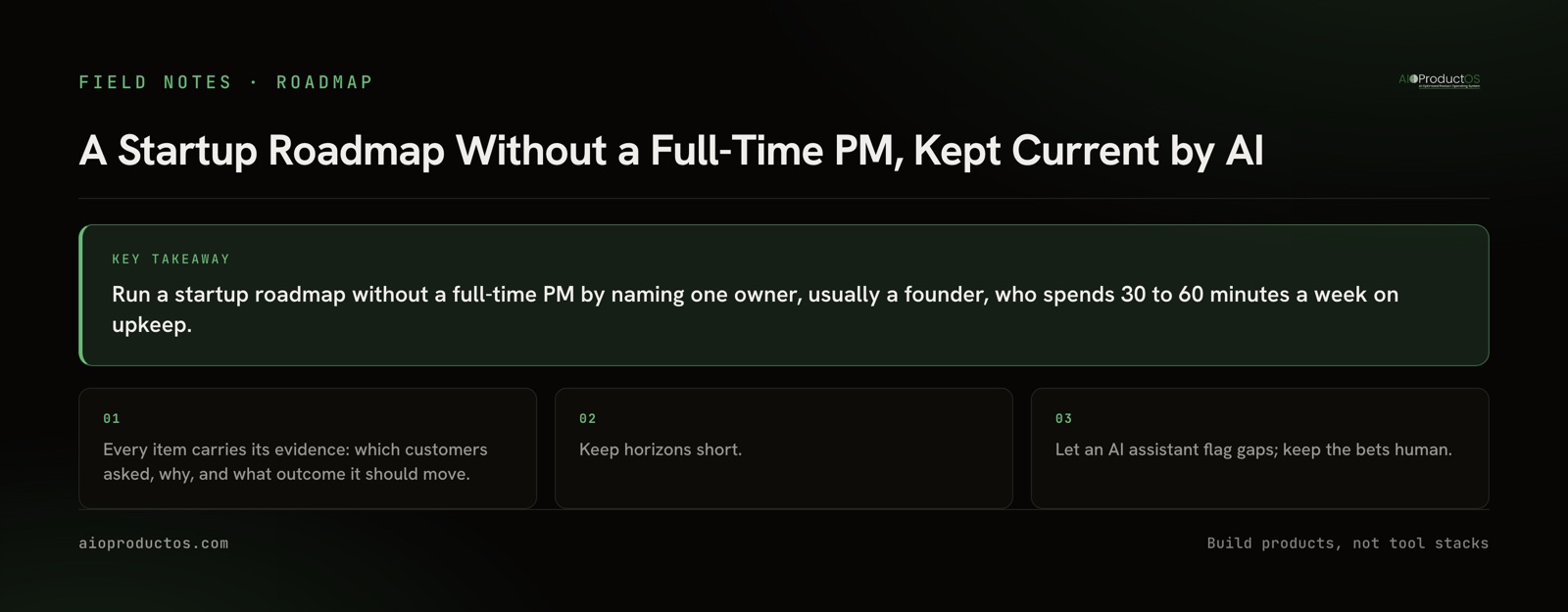
One named person owns it, and at most startups that is a founder. Ownership does not mean writing every item. It means 30 to 60 minutes a week keeping each item tied to the customers who asked for it, moving items between horizons, and saying no out loud. Shared ownership is no ownership.
The common alternative is that the roadmap belongs to "the founders" or to whoever ran the last planning session. In practice that produces three kinds of rot.
The first is evidence decay. An item went on the roadmap because two customers asked for it on calls in March. By June, the item is still there but the names are gone. Nobody can say who wanted it, so nobody can tell those customers when it ships, and nobody can check whether it was worth building.
The second is memory re-decision. Without evidence on the item, every planning conversation re-argues it from scratch. The founder's recollection of which customer said what becomes the tiebreaker, and recollection favors the most recent and the loudest conversation.
The third is delivery drift. Engineering picks up work that never made it onto the roadmap, and items marked "now" have nothing in progress behind them. The roadmap still looks tidy. It just describes a different company.
A named owner with a weekly slot fixes the first two by habit. The third needs a comparison against what is in delivery, which is exactly the kind of work an assistant can do. If you are setting up the underlying record from scratch, the first 90 days of startup product management covers building it; this post is about keeping the roadmap part of it alive once it exists.
What should a startup roadmap include?
Template galleries give you a grid but no rule for what goes in a cell. Here is the rule: every item carries four fields, and an item missing the second one does not get a "now" slot unless someone labels it a bet.
- The problem, in one sentence. Written as the customer's problem, not as the feature name.
- The evidence. Which customers asked, a link to each request, and what each of those accounts pays. Not a vote count; the names.
- The outcome it should move. One metric, declared before the work starts, so you can check it afterward.
- A horizon. Now, next or later.
That is the whole minimum. Dates, effort estimates, themes and swimlanes are all optional at this stage, and most of them are maintenance cost without much return. The evidence field is the one that earns its keep, because it is what lets you answer "why are we building this?" with names, and it is what lets you rank items by what is riding on them. If you want to go further and order items by the money behind them, ranking your roadmap by revenue walks through attaching a figure to each item.
How far ahead should a startup roadmap plan?
Only as far as you can see. At an early-stage startup that is usually the work in progress and whatever comes immediately after it. Use horizons instead of dates: now is committed and being built, next is the likely follow-on once now ships, and later is a parking lot for ideas still collecting evidence. The trade-offs between horizons and calendar timelines are laid out in now-next-later vs timeline roadmaps.
Short horizons matter more without a PM, not less. Every item further out is another item someone has to keep current, and the owner only has an hour a week.
The weekly upkeep: what an assistant does and what the owner does
Most of roadmap upkeep is bookkeeping: finding things, linking things, noticing gaps. That part an AI assistant connected to your product record can do well, because it is lookup and comparison work. The decisions stay with the owner.
| Upkeep task | Who or what does it | Why |
|---|---|---|
| Pull which customers asked for an item and what they pay | Assistant | A lookup on the record; slow by hand, instant as a query |
| Flag roadmap items with no linked customer evidence | Assistant | Evidence decay is silent; a weekly list makes it visible |
| Match new requests to existing roadmap items | Assistant drafts, owner confirms | Linking is mechanical, but a wrong match distorts the evidence |
| Compare the roadmap against what is actually in delivery | Assistant | Catches "now" items with nothing in progress and work with no roadmap item |
| Report whether shipped items moved their declared outcome | Assistant reads, owner judges | The reading is data; deciding what it means is not |
| Move items between now, next and later | Owner | This is the prioritization decision itself |
| Decide what to bet on without evidence | Owner | A bet is a judgment that today's customers are not the whole answer |
| Say no to a request and tell the customer | Owner (assistant can draft) | A no is a relationship decision, not a data one |
A workable weekly slot looks like this: ask the assistant for the three lists (items without evidence, the roadmap-versus-delivery comparison, and new requests that match nothing), spend ten minutes confirming or rejecting its suggested links, then spend the rest of the hour on the moves and the nos.
What has to stay human
It is tempting to let the assistant rank the roadmap outright. Don't. An assistant can tell you which customers asked for an item and what they pay; it cannot tell you that the segment you should be selling to next is not in your customer list yet. It can flag that an item has no evidence; it cannot tell you whether that item is a mistake or a deliberate bet. Strategy is precisely the set of decisions where the record is incomplete on purpose.
The same goes for saying no. The assistant can find every customer who asked for something you are declining. Deciding to decline it, and how to tell them, is the owner's job.
How do I connect Claude to my product roadmap and customer data?
Connect it over MCP, the open protocol Claude uses to call external tools. Your roadmap, requests and customer revenue need to live on one record the assistant can query; an assistant connected only to a ticket tracker can list tickets, but it cannot tell you who asked or what they pay, because the tracker never held that.
AIOProductOS exposes its whole product spine over MCP. Concretely:
- In Claude, add AIOProductOS from Anthropic's connector directory, where it is listed. Sign-in is OAuth, so there is no API key to paste.
- In any other MCP host, add a custom connector pointing at
https://platform.aioproductos.com/api/mcp. - In Claude Code, the AIOProductOS plugin bundles the workspace connection:
/plugin marketplace add AIOProductOS/claude-plugin, then/plugin install aioproductos@aioproductos. - To try it before connecting your own data, run
npx -y @aioproductoscom/mcp@latestwith no token. It starts in demo mode against a seeded showcase workspace with read-only tools.
On that record, every backlog item carries the customer request and the revenue behind it, and features rank by request count and revenue at stake. Revenue, demand and work questions compute deterministically from the record rather than from a model's guess, and any write the assistant makes lands in human review. Setup detail is on the product management MCP page.
Then verify it yourself. Ask the assistant exactly this:
For every roadmap item marked now or next, list the accounts that asked for it with their ids, each account's MRR, and the combined total. Separately, list any item with no linked customer request.
A correct answer has to do four things. It names the accounts behind each item, with ids you can open and check. It gives totals you can trace back to those accounts. It states plainly when an item has no linked evidence, instead of inventing a rationale for it. And when you follow up with "which work in delivery has no roadmap item?", it answers from the record rather than from the conversation so far. If it gives you a revenue total but cannot name the accounts behind it, or explains why an unlinked item matters without pointing at a request, the link is missing in your record, and the answer has just told you where.
When you should hire a PM instead
This setup has limits, and pretending otherwise would cost you more than a hire.
Hire a product manager when the owner cannot protect the weekly hour, because sales, fundraising or hiring keep eating it. A roadmap with a part-time owner who skips three weeks in a row is worse than an honest backlog, because it looks maintained.
Hire when decisions, not bookkeeping, are the bottleneck. If engineering regularly waits on the founder to choose between items, an assistant that produces better lists will not help. The scarce resource is judgment time, and only a person adds more of it.
Hire when you run more than one product line or more than one customer segment with conflicting needs. Each additional line multiplies the trade-offs, and those trade-offs are the human column of the table above.
Hire when customers start holding you to roadmap commitments in contracts or renewals. At that point the roadmap is a promise someone has to negotiate and defend, which is a full-time job.
And be honest about the other failure: if nobody is willing to say no, no assistant fixes that. Bookkeeping makes the cost of an undecided roadmap visible. It does not make the decision.
If you are earlier than all of that, the pattern above works: one owner, evidence on every item, short horizons, and an assistant doing the lookups. The AIOProductOS startup program takes 50% off every tier until you reach $500k ARR. To run this on your own roadmap and customer data first, start a 7-day free trial.