Most roadmap advice sells you one format as the answer. Now/Next/Later has become the fashionable pick, and the timeline roadmap gets treated as a relic. That framing is wrong. The two formats aren't competing philosophies - they encode different kinds of commitment, and the right one depends entirely on who's reading and what you owe them. This post gives you the decision rule, a copyable template, and an honest account of when the "outdated" timeline is actually correct.
What is a now next later roadmap, and when do you use it over a timeline?
A now next later roadmap groups work by confidence - Now, Next, Later - instead of by date. You reach for it when you're setting direction, shipping continuously, and can't honestly promise calendar dates. You reach for a timeline roadmap when you owe someone a real date: a regulated launch, a signed commitment, a board quarter. Audience and commitment decide, not ideology.
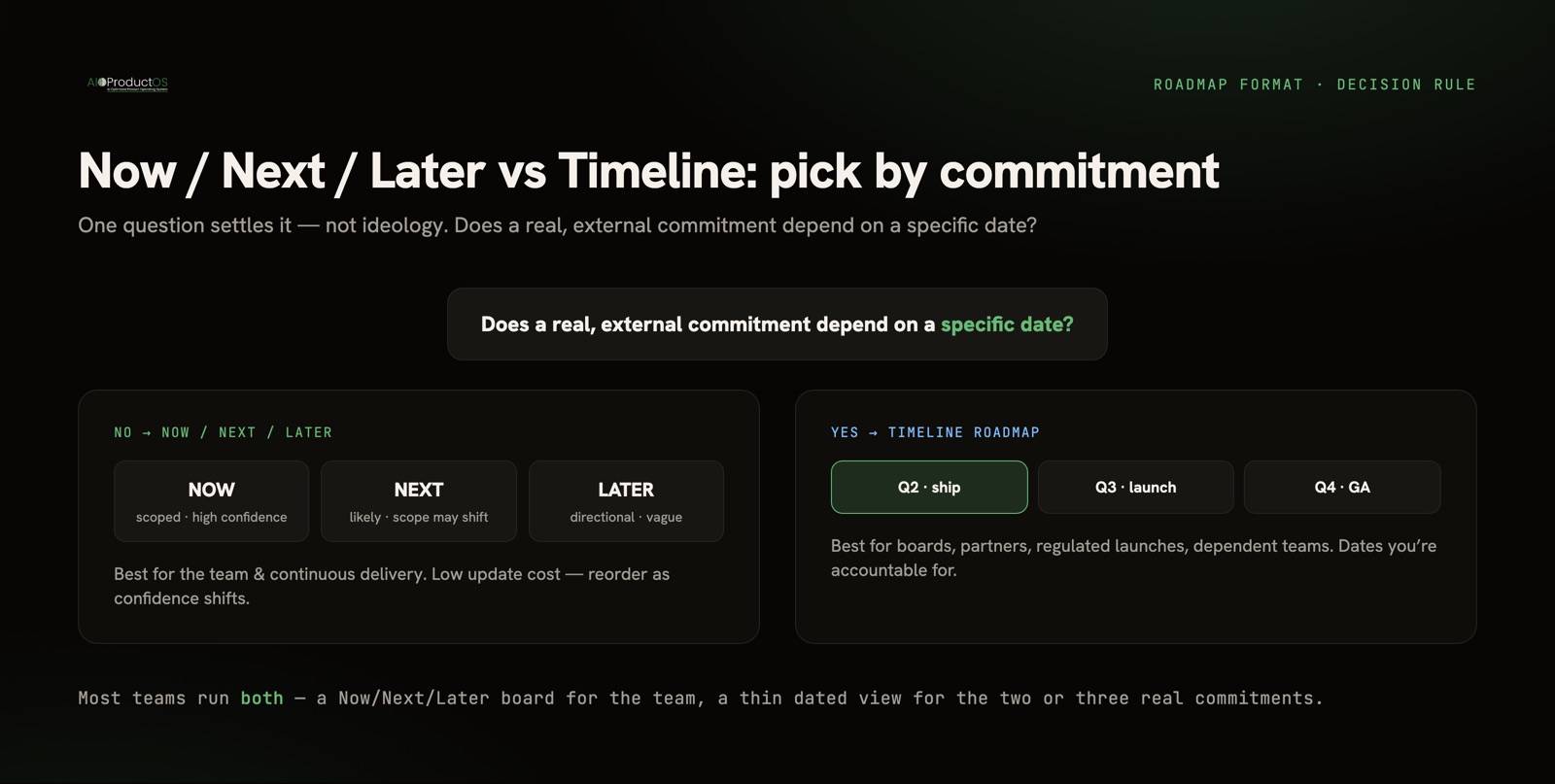
That one-sentence answer is the whole argument. The rest of this post is why it holds, and how to apply it without turning a real decision into a religious one.
The real question is commitment, not calendar
Both formats are answering the question "what are we doing and in what order?" Where they split is how much precision the order claims. A timeline roadmap says this ships in Q3. A Now/Next/Later roadmap says this is next, after the current work clears, whenever that is. Neither is more mature - they carry different promises.
The mistake page-one guides make is treating the format as a values statement: "modern teams use Now/Next/Later; timelines are waterfall thinking." That flattens a useful distinction. A team shipping continuous SaaS improvements to an internal audience is lying to itself with a Gantt chart. A team building a payment integration that must be live before a partner's contractual go-live is lying to its partner with "Later." Same company, two roadmaps, both correct.
The format popularized by ProdPad (Janna Bastow) organizes by confidence horizon precisely so you stop manufacturing dates you can't keep. That's its strength and its limit. When you do have a date you can and must keep, hiding it is not humility - it's withholding.
Now/Next/Later vs timeline at a glance
| Now/Next/Later | Timeline roadmap | |
|---|---|---|
| Commitment type | Sequence and intent, no dates | Specific dates you're accountable for |
| Best audience | Product & eng team, continuous delivery, internal direction | Board, investors, partners, regulated launches, dependent teams |
| Update cost | Low - reorder columns as confidence shifts | High - every slip re-dates everything downstream |
| Main failure mode | Vagueness used to dodge real commitments | Invented precision nobody can actually hit |
The update-cost row is where timelines quietly bleed teams. Every date slip forces a re-plan of everything after it, and re-planning is itself a tax - the average employee already loses about 40% of productive time to context-switching, and a roadmap that demands constant re-dating sits right on that seam. Now/Next/Later avoids the tax by not making the promise in the first place. That's exactly why it's wrong when the promise is real.
A copyable Now/Next/Later template
Here's a literal starting structure. Copy it, replace the placeholders, and keep the confidence rules as comments so the format doesn't quietly rot back into a dated backlog.
# Product Roadmap - Now / Next / Later

## NOW  (in flight · high confidence · scoped)
- [Theme] - outcome it serves - owner
  · why now: <customer/revenue signal>
- [Theme] - outcome it serves - owner

## NEXT (likely this cycle · medium confidence · scope may shift)
- [Theme] - outcome it serves
  · trigger to promote to Now: <what has to be true>
- [Theme] - outcome it serves

## LATER (directional · low confidence · deliberately vague)
- [Bet] - hypothesis we believe
- [Bet] - hypothesis we believe

# Rules
# - Every item names an OUTCOME, not just a feature.
# - NOW items are scoped; LATER items must NOT be.
# - No dates in any column. Dates go in a separate timeline view
#   for external commitments only.
# - Reorder on a fixed cadence; do not edit daily.
The discipline that keeps this alive is the outcome line. A Now/Next/Later board of bare feature names is just a Kanban backlog in three buckets. Tie each item to what it's meant to change - as we argue in how to write a product roadmap - and the format earns its keep.
When Now/Next/Later wins
Reach for it by default in these cases:
Continuous internal delivery. If you ship to production weekly and your audience is your own team, dates are noise. Sequence is the real signal, and Now/Next/Later carries it without the false precision.
Early or uncertain bets. When "Later" genuinely is a hypothesis you haven't validated, forcing it onto a calendar invents a commitment you'll break. The vague column is the honest one.
Prioritization that's still moving. When you're actively reordering based on which accounts and revenue are pulling hardest - the kind of revenue-weighted sorting we cover in ranking a roadmap by revenue - a low-update-cost format lets the roadmap follow the evidence instead of fighting it.
When a timeline roadmap is the right call
This is the section the "Now/Next/Later is always better" crowd skips, and it's where they're wrong. Use a timeline - dates on the page - when a real external commitment exists:
Regulated or hardware launches. A medical, financial, or hardware release with a fixed compliance or manufacturing go-live has a date whether you like it or not. "Later" is not an acceptable answer to a regulator or a factory slot.
Contractual and partner commitments. If a signed deal says the integration is live by a certain date, or a launch partner has coordinated their own marketing around yours, the date is the deliverable. A confidence horizon that omits it is hiding the one number that carries penalties.
Board and investor communication. Boards plan capital, hiring, and their own reporting around specific quarters. Handing them Now/Next/Later when they asked "what lands in Q3 and Q4" reads as evasion, not sophistication. Give them the dated view; keep the honest uncertainty in the notes.
Cross-team dependencies with fixed handoffs. When platform must ship an API before three teams can start, the handoff date is load-bearing for everyone downstream. Sequence-without-dates leaves them unable to plan.
The pattern: the more your audience is externally accountable for your timing, the more a timeline earns its place. Internal direction tolerates ambiguity; contracts, regulators, and boards do not.
The decision rule
One question settles it: does a real, external commitment depend on a specific date?
If yes, use a timeline for that audience - and only put dates on the items that genuinely carry the commitment, not on everything. If no, use Now/Next/Later and stop apologizing for the absence of dates. Most teams need both: a Now/Next/Later board for the team and continuous work, and a thin dated view for the two or three commitments that are real. Running both isn't indecision - it's matching each audience to the promise it's owed.
Whichever you pick, the format is only as good as the reasoning under it. A roadmap that can't trace each item to an outcome and the customer demand behind it fails in either shape - which is why we tie every shipped item to a verdict on adoption and retention in the outcome loop. When the work lives on one shared record - each task carrying the customer's plan and revenue, features ranked by request count and revenue at stake - the priorities under whichever roadmap you present trace to real demand instead of opinion.
Converting a timeline you already have
If you're sitting on a Gantt chart that keeps slipping, don't rebuild - reclassify. Walk each item and ask how confident you actually are. In flight or committed this cycle → Now. Likely soon but scope-fluid → Next. Speculative, the back half that was always a guess → Later. Delete the dates that were never real; keep as annotations only the few tied to an external commitment. The exercise usually reveals how much of the original timeline was invented precision - which is exactly the reason it kept slipping.
Choosing and comparing the tools that support both formats is its own decision - see our guide to the best roadmap tools for how the formats map to what different platforms actually let you build.