What does AI actually do well for a product manager?
AI does well on the high-volume, low-judgment parts of the job: summarizing feedback, drafting first versions, reformatting the same decision for three audiences, and answering lookup questions about your own data. It fails at the parts you have to defend in a room, which is mostly what to build, what to cut, and why.
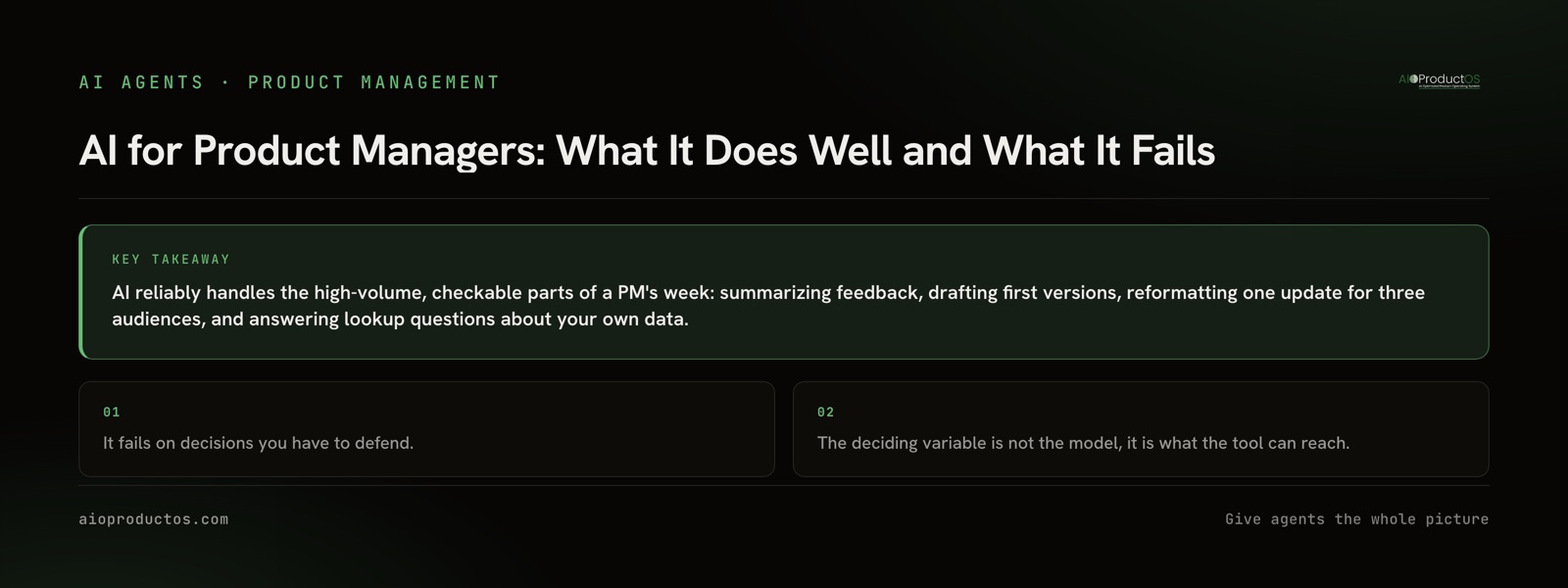
The split is not about how hard a task is. It is about whether the task has a checkable right answer. Summarizing two hundred support tickets has one, and you can spot-check it in a minute by reading ten of them. Choosing which of two roadmap bets to fund does not have one; it is an argument about a future nobody has seen yet, and the output looks equally confident whether it is right or badly wrong. That asymmetry, not model quality, is what decides where AI helps.
AI product manager and AI for product managers are two different questions
These two phrases get used interchangeably and they are not the same job. An AI product manager is a role: a PM who builds AI-powered products, owns model behaviour, evaluation sets and inference cost. AI for product managers is a practice: any PM, on any product, using AI to do product work faster.
The distinction matters here because most of what ranks for this search answers the first question or sells a course, and the working PM is usually asking the second. If you are hiring or job-hunting, you want the role question. The rest of this answers the practice one.
A product manager's week, job by job
Here is the audit. The fourth column is the one most roundups skip, and it is the one that decides whether the third column applies to you.
| Recurring job | What AI does well | Where it fails | What has to be true |
|---|---|---|---|
| Weekly feedback sweep | Clusters hundreds of tickets, reviews and survey responses into themes and flags new ones | Cannot tell you which theme matters, because volume is not value | The tool reads support, reviews, surveys and sales notes as one feed, not four exports |
| Prioritization call | Applies a scoring framework consistently and shows its arithmetic | Invents inputs when the evidence is missing, and never says "I do not know" | Each request is joined to the accounts that asked and what those accounts pay |
| Writing the spec | Produces a structured first draft in minutes from a rough brief | Writes plausible acceptance criteria for edge cases that do not exist in your product | It can read the existing feature, its history and the linked customer requests |
| Stakeholder update | Reformats one decision into engineering, sales and exec versions without drift | Softens or overstates status when it is guessing at progress | Delivery state is a record it can read, not a slide you maintain by hand |
| Delivery chores | Drafts release notes, grooms titles, keeps statuses tidy, writes the changelog entry | Silently closes or renames things when given write access without review | Every write lands in human review before it takes effect |
| Did the last release work | Pulls adoption, retention and revenue movement for a shipped feature on request | Confuses correlation with a verdict, and will narrate a win from noise | Shipped work carries an outcome record, so the question has a stored answer |
| Discovery interviews | Transcribes, tags and drafts follow-up questions afterwards | Cannot ask the unscripted follow-up that makes an interview worth running | Nothing. This one does not get better with more data |
Read the table across, not down. Every row where AI helps is a row where the answer is checkable in under five minutes. Every row where it fails is a row where a wrong answer looks exactly like a right one.
The precondition that decides every row
Look at the fourth column again and the pattern is hard to miss: almost every failure collapses into the same cause, which is reach. The model is not the constraint. What the model can see is.
This is why two teams get opposite results from the same assistant. A PM whose feedback lives in one inbox, whose requests are joined to accounts, and whose shipped features carry a verdict gets useful answers, because the question has a stored answer to find. A PM whose evidence is spread over a tracker, a spreadsheet, a feedback tool and three Slack channels gets confident fiction, because the assistant is filling gaps rather than reading records. Gallup/TheTab put the cost of that scatter at roughly $450bn a year, with the average employee losing 40% of productive time to context switching (Gallup/TheTab). AI does not remove the switching. It inherits it.
There is a quick way to test this before you buy anything. Take the last three questions you actually asked in a planning meeting, the real ones rather than hypothetical ones, and for each count how many systems hold a piece of the answer. If the count is one, an assistant bolted onto that system will do well. If the count is three, you are not really evaluating an assistant at all. You are evaluating whether anything in your stack can join three systems, and the assistant sits downstream of that. Most AI tool evaluations skip this step and then conclude the model was disappointing.
The second test is cheaper still. Ask the assistant something you already know the answer to, where the answer lives in a system it may not reach. A confident wrong answer tells you more in ten seconds than a month of pilot usage, because it shows you the failure mode you will otherwise miss: not silence, but fluency.
The practical move is unglamorous. Before evaluating an assistant, check whether the thing it will read is one record or four. In AIOProductOS that is the whole design: feedback arrives as one Insights feed across reviews, requests, surveys and support, every task carries the customer and revenue behind it, and shipped features get an outcome verdict on the card so "did it work" has a stored answer rather than a generated one. We wrote up the triage half of that separately in AI triage for customer feedback, and the drafting half in can AI write your PRD.
Where AI is the wrong tool for product work
Three places, stated plainly.
Any decision you will have to defend. A roadmap is a commitment to people who will hold you to it. You cannot delegate the defense of a call you did not make, and an AI-generated prioritization will not flag its own uncertainty. It produces the same tone for a well-evidenced ranking and a guess. If you would not sign a ranking a junior analyst handed you without showing their inputs, do not sign this one either.
Discovery conversations. The value of an interview is the follow-up question you did not plan, asked because of something in the customer's voice. Transcription and tagging afterwards are fine. The conversation itself is the job, and outsourcing it removes the only part that generates new information.
Small volumes. Below roughly a few dozen items, summarization costs more than reading. Twelve tickets is a coffee, not a pipeline. Reach for the tool when the volume genuinely exceeds what you can hold in your head, not because the button is there.
There is a fourth trap that sits underneath all three, and the market has already priced it in. Gartner expects more than 40% of agentic-AI projects to be cancelled by 2027, and reckons only about 130 of the thousands of vendors selling "agents" are real. Most of those cancellations are not model failures. They are agents pointed at data they could not reach, doing work nobody could verify. We took the strong version of that question head-on in can an AI agent do product management.
How to check this instead of trusting it
Everything above is checkable, so check it. Run npx -y @aioproductoscom/mcp@latest with no PRODUCTOS_TOKEN set. With no token it starts in demo mode against a fully seeded showcase workspace called Brightline, with a read-only subset of the tools, no account and no signup.
Then ask it the question the fourth column of the table is really about: which features are currently in flight, and for each one, which customer requests and how much revenue are attached to it? A tool-level MCP cannot answer that, because a tracker MCP sees tickets and a feedback MCP sees requests, and neither sees the join. Against the seeded workspace you should get features back with their linked requests and the revenue behind them in one response. If you would rather not run anything, what each tool's own MCP does and where it stops covers the same ground, and the agents surface documents the 71 tools and the human-review step that writes pass through.
That is the honest shape of AI for product managers in 2026. It compresses, drafts, translates and looks things up, reliably, as long as it can reach your records. It does not decide, and buying a tool that claims otherwise is how teams end up in the 40%. If the join is the part you are missing, pricing is flat by tier with AI included and never credit-metered so the cost of finding out does not scale with how much you use it.