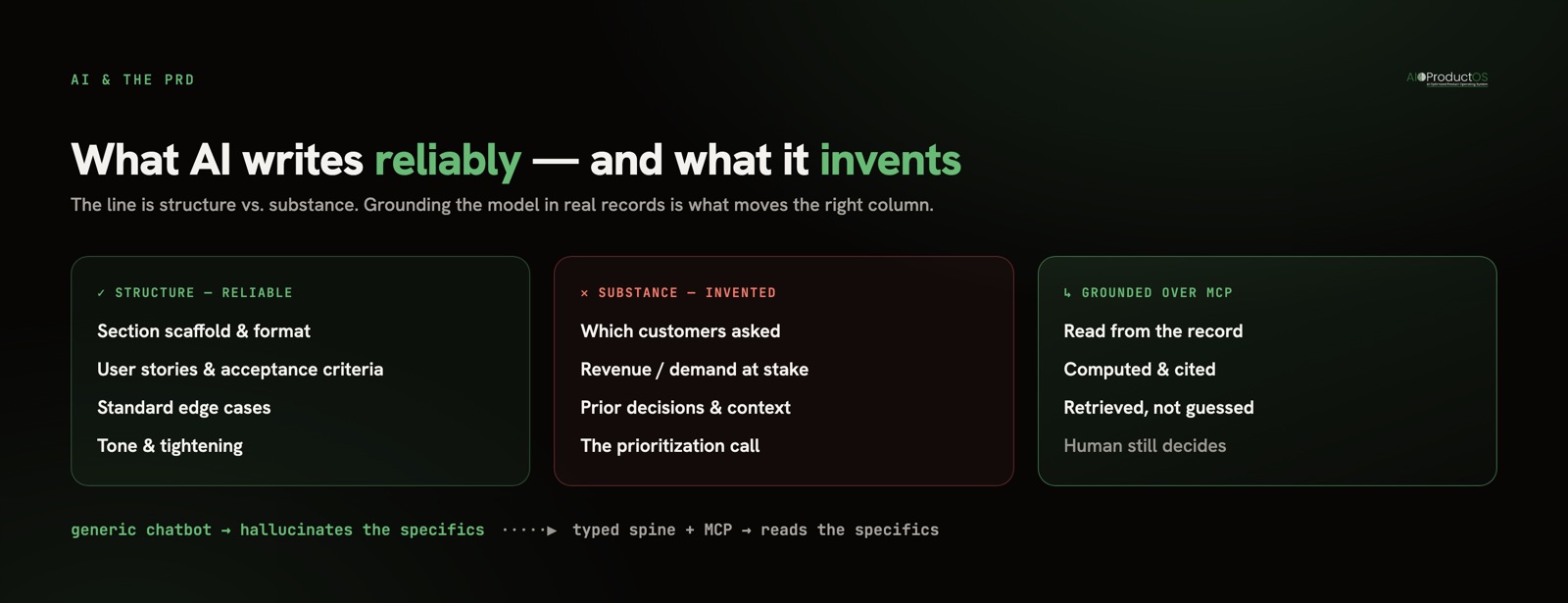
Short answer: AI writes the structure of a PRD reliably and the substance unreliably. It will produce a clean scaffold in seconds: problem statement, goals, user stories, acceptance criteria, edge cases. What it can't do is know which customers asked for the thing, how much revenue rides on it, or what you decided three months ago. Every page-one guide tells you "AI drafts, a human refines." Almost none of them tell you where the substance comes from - and that's the part that decides whether the PRD is worth writing.
Can AI write a PRD?
Yes for the skeleton, no for the specifics. AI reliably writes the structure of a PRD - the sections, the headings, the standard user-story format, the obvious edge cases. It fails at the substance: the real customer evidence, the revenue at stake, the prior decisions. Without access to your actual product data, the model invents those, confidently. Ground it first, then it's useful.
That single distinction, structure versus substance, is the whole subject. Hold it and everything else follows.
What AI writes well
The parts of a PRD that are structural are exactly the parts a language model is built for. These are repeatable, well-formed, and largely independent of your specific product:
- The scaffold. Problem statement, goals and non-goals, success metrics, user stories, acceptance criteria, open questions, rollout plan. A model has read millions of these and reproduces the shape faultlessly.
- The boilerplate expansion. Give it "users can't reset their password without contacting support" and it will expand that into a properly formatted story with acceptance criteria and a couple of edge cases you'd have written anyway.
- The tone and tightening. It turns a rambling brain-dump into crisp, consistent prose. It flags where a section is thin. It suggests the edge cases you forgot - expired tokens, concurrent sessions, the empty state.
- The translation. It rewrites an engineering-flavoured spec for an executive audience, or a one-liner into a full draft, without changing what you meant.
This is real leverage. The blank page is the most expensive part of writing a PRD, and AI removes it. If the value you want is "stop me staring at an empty document," a generic tool delivers it today. That's why free, no-signup generators exist - including our own free PRD generator, which runs in the browser and hands you a formatted scaffold with no account required.
What AI fails at - and why
The failure isn't grammar or formatting. It's that a chatbot has no access to your product's reality, so it fills the substance with plausible fiction.
Ask a generic model to write a PRD for "a billing improvement" and watch what it does. It will assert that "customers frequently request annual billing" - you never told it that. It will estimate "this affects roughly a third of your user base" - a number with no source. It will prioritise the feature "given its high revenue impact" - revenue it cannot see. Each sentence reads like substance. Each is invented. The model is doing what it always does: producing the most probable text, which is not the same as the true text.
This is the same class of problem the industry now openly worries about. Gartner predicts that more than 40% of agentic-AI projects will be canceled by 2027, and that only around 130 of the thousands of vendors claiming to sell "AI agents" are real (Gartner). The common thread in the failures is the same as in the hallucinated PRD: AI given a task without grounding in real data produces confident output nobody can trust. A PRD full of invented customer evidence isn't a first draft - it's a liability that looks like a first draft, because the fiction is formatted exactly like the facts.
So the honest limit is this: AI writes the parts of a PRD that don't depend on your specific customers, revenue, or history, and hallucinates the parts that do. And the parts that do are the parts that decide whether you're building the right thing.
How to give AI the context it's missing
The fix is not a better prompt. It's grounding - connecting the model to the real records instead of asking it to guess them. There are two levels.
The first level is manual: you paste the evidence in. Pull the actual feature requests, the revenue numbers, the last decision, and drop them into the prompt. A generator like the free PRD generator gets sharply better when you feed it real inputs instead of a vague topic. This works, but it's you doing the retrieval - the model is only as grounded as the context window you hand-assemble.
The second level is structural: the model reads your product data directly. This is what the Model Context Protocol (MCP) exists for - and the bet is no longer speculative. MCP went from zero to about 97 million monthly SDK downloads in roughly 16 months and was donated to the Linux Foundation in December 2025 as a governed open standard (Anthropic). Over MCP, an AI teammate can query the actual records rather than infer them.
In AIOProductOS that's the design. AI teammates act on typed spine records (customer, revenue, work) rather than document summaries, and the product management MCP exposes that joined spine to any MCP client. So when an agent drafts the "billing improvement" PRD, it can answer which accounts asked, how much revenue sits behind them, and what was decided before by reading the records instead of generating a probable-sounding number. Where the answer is a fact rather than a judgment, the AIOInsights copilot cites the record it read, and revenue and demand questions compute deterministically: no model call, so nothing to hallucinate. The grounded PRD carries evidence you can click through, not prose you have to fact-check line by line. (We walk through connecting a model to real product data in Give your AI assistant access to product data.)
Structure vs. substance: what to trust
| PRD element | Generic AI (no data access) | AI grounded in your spine |
|---|---|---|
| Section scaffold & formatting | Reliable | Reliable |
| User stories & acceptance criteria | Reliable | Reliable |
| Standard edge cases | Mostly reliable | Reliable |
| "Which customers asked for this" | Invented | Read from the record |
| Revenue / demand at stake | Invented | Computed, cited |
| Prior decisions & context | Invented or omitted | Retrieved |
| The prioritization call | Guessed | Human decides, on real evidence |
The line is consistent: trust AI for the shape, verify everything that claims to be a fact, and never let it own the decision.
When you should NOT hand a PRD to AI
There are cases where reaching for AI is the wrong move, and it's worth being blunt about them.
If the PRD is for a genuinely novel bet, a new market or an unproven behaviour or a strategic wager with no precedent, a generic model has nothing true to say and will pattern-match to the nearest cliché. The value of that document is the original thinking, which is exactly what an averaging machine erases. Write it yourself.
If the substance is sensitive or contested, say a decision several stakeholders disagree on, a promise made on a sales call, or a politically loaded trade-off, the PRD's job is to record a human judgment and its reasoning. An AI draft launders that judgment into confident neutral prose and hides the disagreement you needed to surface.
And if your review culture is loose, don't generate PRDs at all yet. AI produces plausible documents faster than a weak process can catch their errors, and a hallucinated fact in a well-formatted PRD is more dangerous than an obvious gap. The tool amplifies your discipline; it doesn't supply it.
In all three cases the pattern holds: when the point of the document is the human judgment, a human writes it. AI is for removing the mechanical cost around that judgment, not for making the call. That review-gated split, where the model drafts and retrieves and a person decides and is accountable, is the same model we build our AI teammates on.
The honest close
Can AI write your PRD? It can write the scaffold and a first draft in seconds, and that's worth having. It cannot write the substance unless it can read your real customer, revenue, and decision data - and if it can't, it will invent that substance in language indistinguishable from fact. So use it for the structure, ground it for the specifics, and keep a human on the decision.
Want the fast, honest version of the first half? The free, no-signup PRD generator gives you a clean scaffold in the browser - bring your real evidence, and it stops guessing.