Search for a feature request template and you get a gallery: title, description, requester, company, plan tier, status, priority, votes, tags. Every one of those lists is reasonable on the day you copy it. The trouble shows up later. By the next planning cycle, half the columns describe a world that no longer exists, and nobody can tell which half.
This post gives you a template built around that problem. It sorts every field by one question: is this a fact about the moment the request arrived, or a fact about the present?
What should a feature request tracking template include?
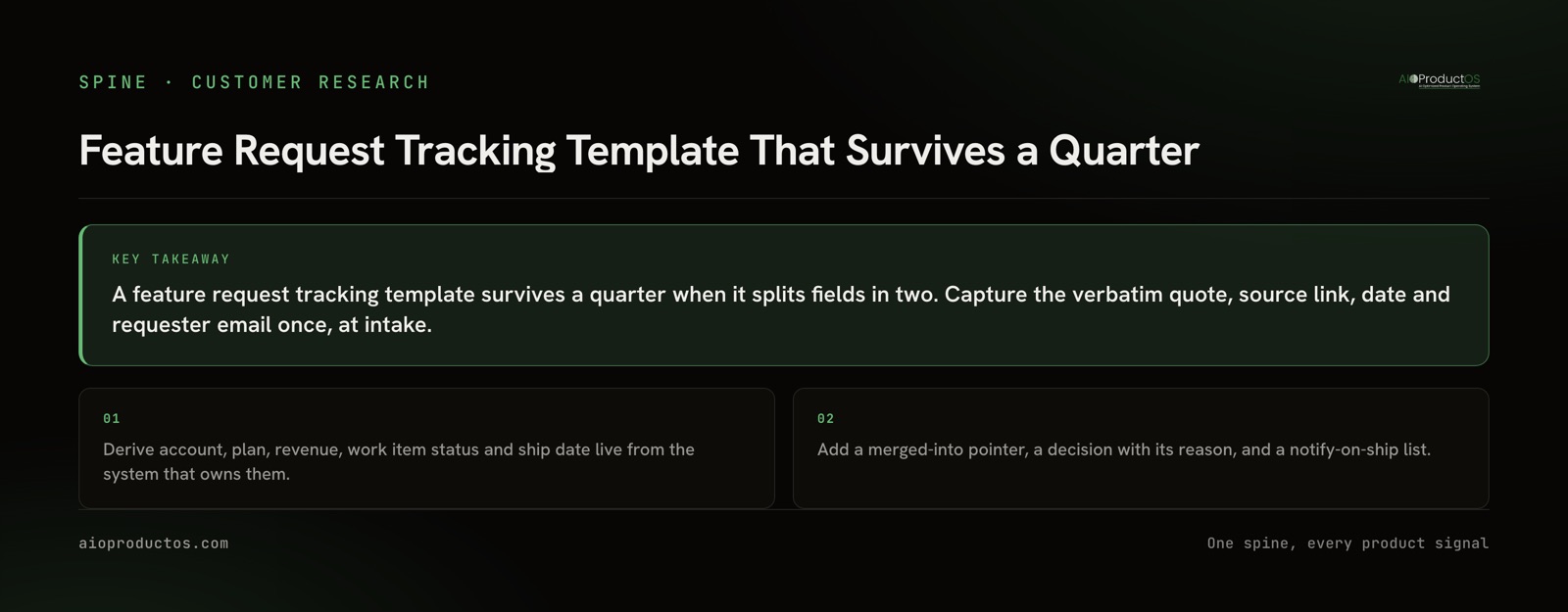
A feature request tracking template should include two kinds of field. Captured fields are written once at intake: the verbatim quote, a source link, the date and the requester's email. Derived fields are read live from the system that owns them: account, plan, revenue, linked work item status and ship date. Add a merged-into pointer and a decision field.
Why templates rot between reviews
Look at the columns a typical template asks you to fill by hand: plan tier, company size, vote count, priority, status. Each one is true when typed. Each one has an owner somewhere else that keeps changing it.
The account upgrades, and the plan column now undersells them. A customer churns, and their request still reads as coming from a paying account. Engineering moves the ticket to done, and the status column in your sheet still says "planned". Someone bumps the vote count after a sales call and forgets to link the request that justified it.
None of this announces itself. A stale cell looks exactly like a fresh one. So the sheet keeps getting used, and decisions get made on it, until a planning meeting where someone checks billing and finds the ranking was built on last quarter's customers.
The fix is not more discipline. It is to stop typing facts that another system already owns.
The rule: capture the moment, derive the present
Split every field into one of two kinds.
Captured fields describe the request itself. What the customer said, where they said it, when, and who said it. These never change, because the past does not change. Write them once at intake and protect them from edits. The most common corruption is well-meant: someone rewrites the customer's words into a tidy summary, and the original meaning is gone. Keep the quote verbatim and put any summary in a separate field.
Derived fields describe the world around the request right now. Which account the requester belongs to, what that account pays, whether the work exists, whether it shipped. These must be read from their system of record each time you look, not copied in. If your tool cannot read them, leave them out of the template rather than typing a snapshot that will lie to you later.
A few fields are judgment calls made by your team, such as which feature a request belongs to or what you decided to do about it. Treat those as captured, but date them, so a reader can tell how old the judgment is.
The template
One row per request, not per feature. Features are where requests point; they are not the unit you log.
| Field | Captured or derived | Filled by | Goes stale when | How it stays true |
|---|---|---|---|---|
| Request ID | Captured | Generated at intake | Never | Assigned once by the system, never reused |
| Verbatim quote | Captured | Whoever logs it | Someone rewrites it as a summary | Paste the customer's words; summaries get their own field |
| Source link | Captured | Intake | The link points at a private inbox or a retired tool | Link to the conversation where the whole team can open it |
| Date received | Captured | Set automatically | Never | Stamped by the system, not typed |
| Requester email | Captured | Intake | The person leaves the company | Keep it anyway; the account is derived from it, so the request outlives the person |
| Account | Derived | Matched from the email domain | Typed as free text and spelled two ways | Resolve from the domain against your account list |
| Plan | Derived | Billing system | The account upgrades, downgrades or churns | Read from billing at view time, never copied |
| Revenue (MRR) | Derived | Billing system | Any renewal, expansion or discount | Read from billing at view time, never copied |
| Linked feature | Captured, dated | Triager | The feature is renamed or split | Point at the feature's ID, not its title |
| Merged into | Captured, dated | Triager | The target is itself merged later | Follow the chain to the surviving ID |
| Request count | Derived | Count of linked requests | Someone edits the number by hand | Never store a number; count the linked rows |
| Work item status | Derived | Issue tracker | Every sprint | Read through the link to the work item |
| Ship date | Derived | Work item or release record | The release slips | Read when the work item closes |
| Decision and reason | Captured, dated | Product owner | The reason stops being true | Revisit whenever a derived field behind it changes |
| Notify on ship | Derived | Requester emails on linked requests | Contacts leave | Build the list from linked requests on ship day |
Notice what is missing: a priority column. Priority typed at intake is a guess made before anyone knew who else would ask. Rank from the derived fields instead, request count and revenue at stake, and record the call you made in the decision field.
The three fields most templates skip
Merged into. Duplicates are the normal state of a request log. The same need arrives as three tickets in three vocabularies. Without a pointer from each duplicate to one surviving record, demand gets split and every item looks weaker than it is. Merge, do not delete, so the original quote and requester stay findable.
Decision and reason. "Declined" with no reason is a decision you will re-debate the next time a customer asks. Write one sentence and a date. When the requesting account later upgrades, the reason may no longer hold, and that is your cue to revisit. Pruning the items you decide against is its own routine, covered in the product backlog cleanup template.
Notify on ship. If this list does not exist on the day the feature ships, the customers who asked never hear about it. Deriving it from the requester emails on linked requests means it is current by construction. The links that make this lookup possible are walked through in how to know which customers requested a feature, and what has to survive the handoff into delivery is in connecting feedback, roadmap and delivery.
Once plan and revenue are derived rather than typed, you can trust them enough to size a request. The free feature-request ROI calculator is a reasonable next step at that point.
When a spreadsheet is the right tracker
A plain sheet is a complete system for some teams, and pretending otherwise would be dishonest.
If one person triages every request, that person is the system of record. They know which accounts upgraded last month, and the derived fields live accurately in their head. If you have few accounts and they pay roughly the same, revenue next to a request tells you nothing that request count does not. Drop the plan and revenue columns entirely. A sheet with the captured fields, a linked feature column and a decision column will serve you well.
The same holds before you have paying customers at all. There is no billing to join, so there is nothing to go stale.
The sheet stops working at a specific moment: when you catch yourself re-checking its plan and status columns against billing and the tracker before every review. That re-check is the derived fields asking to be derived. Move them somewhere that reads the source, or remove them from the sheet so they cannot mislead.
Check your tracker with an AI assistant
You can test whether your derived fields are really derived. Connect an AI assistant to your records over MCP and ask:
"List feature requests from paying accounts with no linked work item. For each, give the account, its plan and MRR, and the original request."
A correct answer has four properties:
- Named accounts, not "several mid-market customers".
- A plan and MRR next to each, matching what billing says today. Spot-check the two largest against your billing system directly.
- The original request, as the customer's words or a link to the source conversation.
- A count that matches the list. If it claims more requests than it names, it is estimating, not reading a record.
If the plan figures are wrong, your plan field was copied, not derived. If the answer cannot produce the original wording, your quote field was summarized at intake. Either way, the failure points at the exact row of the template to fix.
Where AIOProductOS fits
We build a tool that keeps these fields on one record, so weigh this section accordingly.
In AIOProductOS, Insights is one feedback feed across reviews, requests, surveys, designs and support, linked to features and accounts. Support chat threads stay on the customer's record as an insight, so a request raised in chat is captured where it was said. The Stripe connector reads billing only: it lands each customer's plan, subscription status and MRR on the matching account record, which makes plan and revenue derived fields rather than typed ones. Every task carries the plan and revenue of the customers behind it, and features rank by request count and revenue at stake. The full list of sources is on the connectors page.
The assistant check above runs against the same record. Connect with npx -y @aioproductoscom/mcp@latest or the hosted endpoint. Revenue, demand and work questions compute deterministically, with no model call, so the numbers in the answer are the numbers on the record.
If you want your request log to stay true without a pre-meeting audit, start the 7-day free trial, no card required.