Most guides to AI backlog refinement say the same thing in different words: the AI drafts and critiques stories, and humans decide. That is true, and it is not much help, because refinement is not one task. It is several jobs, and they differ in how much you can trust an agent with them. This post splits refinement job by job, explains why an agent that reads only ticket text gives you neat stories with no evidence behind them, and gives you one question to ask that makes the output checkable. Ordering the backlog is a different problem, covered in what AI should and should not decide on a roadmap.
Can AI do backlog refinement?
Yes, for some jobs. An agent can own finding duplicates, linking each item to the requests and accounts behind it, and checking items against your definition of ready. It can propose merges, splits, acceptance criteria and estimates. The team keeps the final call on scope, size and readiness, because those depend on context the agent does not have.
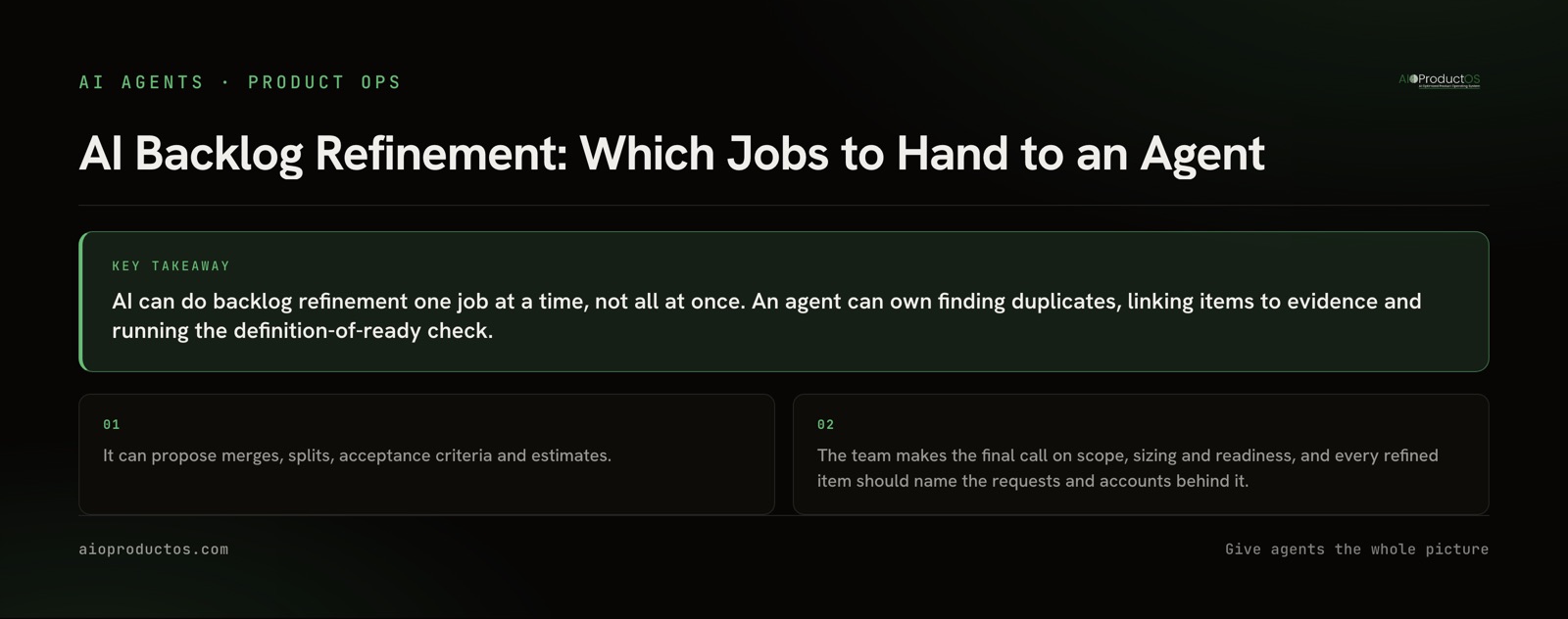
The split has three tiers. Some jobs are lookup and comparison, and an agent does them faster and more consistently than a person reading a long list. Some produce a proposal that a person accepts, edits or rejects. And some are calls about what the team will commit to, which belong to the people doing the work.
| Refinement job | What the agent can do | Who decides | How to check it |
|---|---|---|---|
| Find duplicate or overlapping items | Own the detection, propose the merge | PM confirms the merge | The merged item keeps every linked request and account from both originals |
| Link each item to its evidence | Own the lookup, if the record holds the links | Agent, reviewed by PM | Named requests and accounts you can open, each with a date |
| Check if it is still wanted | Own the lookup: newest request date, requester's account status | PM decides keep or cut | No item marked as wanted on requests from churned accounts alone |
| Critique story wording | Own the review (it changes nothing) | Author takes or leaves it | Each critique points to a missing role, outcome or condition, not to style |
| Split a large story | Propose the split | PM and engineers | Each child item delivers something on its own, and the evidence is shared out between them |
| Draft acceptance criteria | Propose a draft | PM, with QA and engineers | Each criterion is testable and traces to a request, or is marked as an assumption |
| Estimate | Propose a reference based on comparable past items | The people building it | The suggestion cites finished items and their actual sizes |
| Definition-of-ready check | Own the checklist run against criteria the team wrote | Team decides exceptions | Each failure names the specific field or criterion that is missing |
Why refinement on ticket text alone falls short
The questions refinement actually has to answer are mostly not about wording. Is this the same thing three customers asked for in different words? Who asked, and are they still customers? Is the newest request from last month or from two years ago? Is this a small fix for one account, or a pattern across a segment?
Ticket text answers none of that. An agent connected only to your tracker can rewrite "export broken???" into a clean user story with a role, an outcome and five Given-When-Then criteria. The result looks refined. It still does not say who needs it, so the team cannot judge whether the criteria describe the right behavior, whether the split matches how customers use the feature, or whether the item should be refined at all.
Deduplication shows the problem clearly. Two tickets titled "CSV export" and "download report as spreadsheet" are easy for a model to match. But "we can't get our data into finance" in a support thread is the same request, and it never became a ticket. An agent that can only read the tracker will never connect it. One that can read requests and accounts alongside the work can, and that is where the evidence for the item comes from. So the quality of the refinement depends less on the model than on what the agent can join. Connecting Jira tickets to customer requests covers how to build that link if your requests and work live in separate tools.
How do you use ChatGPT for backlog refinement?
The common approach is to paste a few tickets into a chat assistant and ask it to rewrite them as user stories with acceptance criteria, flag duplicates and suggest story points. It works for wording. You get consistent formatting, sensible edge cases and decent critiques of vague stories.
What you should not take from a pasted batch is anything that depends on data outside the paste. Its duplicate detection covers only the tickets you pasted. Its estimates come from how long the text is and how complicated it sounds, not from your team's history. Its acceptance criteria will include behavior that sounds reasonable and that no customer asked for, because the formula of a good story calls for criteria and the paste gives it no requests to draw them from.
A better setup connects the assistant to your tracker over MCP so it can at least read the whole backlog. Connecting Claude to Jira or Linear over MCP walks through that. Even then, a tracker MCP sees tickets, not the customers behind them. For drafting a single story by hand, the free user story generator and the user story template cover the format.
Ask your AI assistant to show the evidence
Make every refined item show where it came from. Connect an assistant to your product record over MCP, pick an item it just refined, and ask exactly this:
For this item, list the customer requests behind it with their dates, the account that made each request and whether that account is still active, any other open items you consider duplicates and why, and which acceptance criteria trace to a specific request versus which you assumed.
A correct answer names real requests you can open, each with a date. It names accounts, not "several customers", and says which are still active. It lists duplicate candidates by id with a reason you can check. And it separates criteria that trace to a request from criteria it made up, and says so plainly.
A wrong answer looks different. It gives a general summary of "user needs" with no named requests. It says demand is high without naming who asked. Its criteria are all presented as equally grounded. Or it lists dates and accounts that you cannot find when you open the record. Any of those means the agent refined the text without seeing the evidence, and the item is not ready no matter how clean it reads.
To try this against real data, AIOProductOS exposes its product record over MCP. Run npx -y @aioproductoscom/mcp@latest with no token to start in demo mode against a seeded showcase workspace, or add https://platform.aioproductos.com/api/mcp as a custom connector in any MCP host.
When you should refine without AI
Sometimes the honest answer is to leave the agent out.
If your backlog is small enough that the whole team can read every item in one session, an agent saves little time and costs you the discussion. A team that refines together learns the product and each other's assumptions. That shared understanding is often worth more than the stories that come out of it, and an agent writing stories ahead of time can cut the conversation short.
If your requests are not linked to accounts, an agent cannot do the evidence jobs at all. It will produce well-formatted stories and duplicate matches based only on wording. Fix the links first, or treat the output as a draft of the text only.
If the work is regulated or under contract, acceptance criteria usually have to trace to a specific clause or obligation. An agent's draft criteria are a starting point at best, and the traceability is a human sign-off.
And if the item is a deliberate bet with no requester, such as infrastructure, security or a new segment, the evidence jobs will come back empty by design. That is not a reason to drop it. It needs a named owner, which the backlog cleanup template covers along with pruning items nobody needs.
Tools that support this
Any setup works if the agent can read requests, accounts and work together and cite them for each item. In AIOProductOS, every backlog item carries the customer request and the revenue behind it, and Insights keeps reviews, requests, surveys and support conversations in one feed linked to features and accounts. Revenue, demand and work questions compute deterministically from the record rather than from a model's guess. AI teammates hold real seats with role-scoped permissions, take assigned tasks and submit their work for human review, which matches the split above: the agent does the lookup and drafting, and a person makes the call. The AI agents page shows how they are set up.
To run refinement against your own backlog and customer data, start a 7-day free trial.