What is a group product manager?
A group product manager (GPM) leads a team of product managers who each own an area within a group of related products, and is accountable for the group's outcomes. Most GPMs still own some product work themselves, which is why the role is often called player-coach. It usually sits between senior PM and director, though titles vary by company.
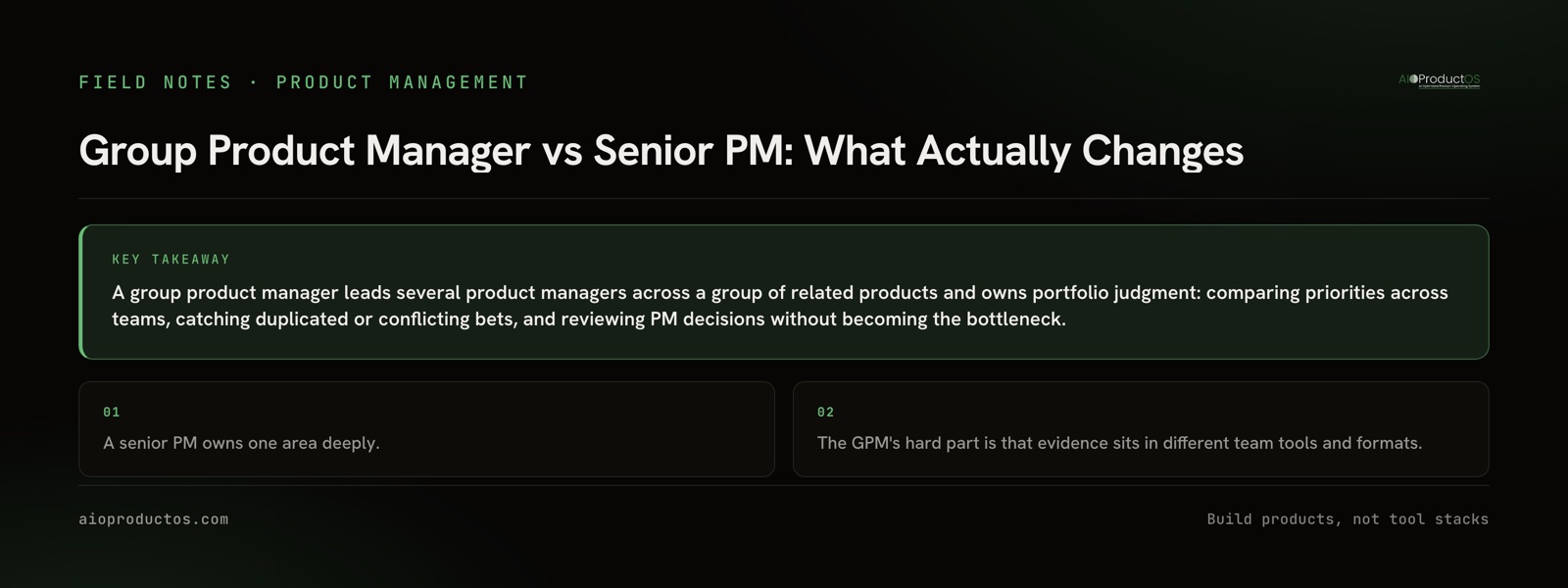
Nearly every definition stops there, with a list of responsibilities. What it leaves out is what changes in the actual work. A senior PM is judged on how well one area is understood and run. A GPM is judged on whether the bets made across several teams add up to something, and that is a different job with different failure modes. Short definitions of the terms used below live in the product glossary.
What actually changes when you go from senior PM to GPM
A senior PM works with one backlog, one pile of customer feedback, one roadmap and one set of engineers. The hard questions are about depth: is this the right problem, is the evidence strong enough, what is the smallest version that tests it.
A GPM inherits several of each. The new job is portfolio judgment, and it has three parts.
Comparing priorities across teams. Team A's top item and team B's top item were ranked by different people, from different evidence, often using different scoring habits. When both need the same shared platform team, or the group has to cut scope, the GPM has to decide which matters more for the group. That comparison is only fair if the evidence behind each item is in a comparable shape.
Catching duplicated or conflicting bets. Two teams building overlapping onboarding flows. The same enterprise request sitting in two backlogs under different names. One team simplifying a settings page that another team is about to extend. None of these show up inside a single team's view. They only show up when someone looks across.
Reviewing decisions without becoming the bottleneck. If every priority change routes through the GPM, the group moves at the speed of one calendar. The better pattern is to review the reasoning and the evidence behind a PM's call, and to step in only when the call has effects outside that PM's team.
The practical trap is where the evidence lives. One team keeps requests in a feedback tool, another in support tags, a third in a spreadsheet with its own columns. To compare them, the GPM ends up rebuilding everything into a status deck each week, and the judgment gets whatever time is left. It is the same pattern described in program management vs product management: two views reconciled by hand instead of one record read by both.
Who owns which artifact
Separating the roles by artifact is more useful than separating them by title. The split below is the common one, not a rule; some companies put the GPM and director at the same level, and sources disagree on which outranks the other.
| Artifact | Senior PM | Group PM | Director of product |
|---|---|---|---|
| Strategy | Supplies evidence from their area | Turns strategy into the group's bets | Sets strategy across groups and argues for headcount |
| Roadmap | Owns their area's roadmap | Owns the group roadmap and trade-offs between team roadmaps | Owns the cross-group narrative shown to leadership |
| Backlog order | Orders their team's backlog | Resolves conflicts between backlogs, does not reorder inside them | Rarely touches it |
| Customer evidence | Gathers and links evidence for their area | Keeps evidence comparable and spots requests that span teams | Reads aggregated themes |
| Outcome metrics | One or two metrics for their area | The group metric and how team metrics roll into it | Business targets for the product line |
| People | Mentors informally | Hires, coaches and reviews the group's PMs | Builds the org: levels, GPMs, hiring plan |
| Decisions | Makes and writes calls for their area | Reviews calls for cross-team impact | Arbitrates escalations between groups |
The middle column is the one most new GPMs underestimate. "Resolves conflicts between backlogs, does not reorder inside them" is a discipline, not a description. A GPM who reorders a team's backlog has taken the senior PM's job back.
A weekly portfolio review that is not a status meeting
A one-hour weekly review keeps portfolio judgment on the calendar. The structure that holds up:
- Before the meeting, each PM updates the record, not a slide. Their top items, the customer evidence linked to each, and what changed since last week. If an item has no linked evidence, it still comes up, but it is labeled as a bet.
- Overlap pass, about 15 minutes. Look for customer requests or accounts that appear in more than one team's backlog, and for items that touch the same part of the product.
- Evidence gaps, about 10 minutes. List roadmap items across all teams with no linked customer evidence or outcome. Platform work and deliberate bets are fine; unlabeled ones are not.
- Cross-team trade-offs, about 20 minutes. Only decisions that cross team lines. Priority inside a team stays with that team's PM.
- Write down what was decided, about 5 minutes. Who decided, on what evidence, and what would change the call. Roadmap stakeholder communication covers how to turn those decisions into updates for each audience.
The first 30 days
In week one, read every team's backlog and roadmap and write down where each team keeps its customer evidence. In week two, agree one way of linking a request to the item it justifies, so evidence becomes comparable. In week three, run the first overlap pass and expect to find duplicates. In week four, put decision rights in writing: which calls each PM makes alone and which come to the review. If most of the effort goes into formats and tooling, that is product operations work, and product operations tools is the place to start. Writing the outcome onto each item, as described in outcome-based roadmaps, makes the group metric roll up instead of being assembled.
What a GPM should be able to ask an AI assistant
An AI assistant connected to the team's product record can do the assembling, but only if it queries the record rather than summarizing documents about it. Three questions worth asking every week:
"Which customer requests appear in more than one team's backlog in the last 90 days, and which accounts asked?" A checkable answer states the window, the number of distinct accounts, the item ids in each backlog, and links to the underlying requests. If requests are not linked to items, the honest answer says it cannot see the overlap.
"Which roadmap items across all teams have no linked customer evidence?" A checkable answer lists item ids, the owning team, a count per team, and the date it was checked.
"For each team's top items, how many accounts asked and what revenue do they represent?" A checkable answer gives the account count and revenue per item, the window used, and does not present revenue at stake as the only reason to build something.
To verify, open two or three of the cited ids and confirm they say what the answer claims. An answer with no ids and no window is a summary, not a measurement.
In AIOProductOS, feedback from reviews, requests, surveys, designs and support lands in one feed in Insights, linked to features and accounts, and features rank by request count and revenue at stake. Boards render Scrum, Shape Up or Waterfall per product, so teams that work differently still write to the same record. Over the AIOProductOS MCP, an MCP-capable AI client can ask the questions above against that record: revenue, demand and work questions compute deterministically, with no model call in the number, and writes land in human review. Run npx -y @aioproductoscom/mcp@latest locally; started without a token, it runs in demo mode against a seeded showcase workspace, so you can try the questions before connecting your own data.
When you do not need a group product manager
With two or three PMs, a head of product or founder can run the portfolio review in an hour a week. Adding a GPM at that size adds a layer between the people deciding and the people building.
If a head of product already does cross-team comparison and coaching well, a GPM in between often duplicates that work rather than extending it. The role earns its seat when the head of product can no longer stay close to every team's evidence.
Sometimes the title is a pay band. A senior PM promoted to "group product manager" with no reports and no group scope has been recognized, which is fine, but nobody should expect portfolio judgment from a role that has no portfolio.
And if the products in a group share few customers and little surface area, there is little overlap to catch. Separate senior PMs reporting to a director may be the simpler structure.
A shared record does not settle every argument either. If PMs do not link requests to items, the overlap pass has gaps no assistant can fill, and if the real conflict is about who gets to make a call, better evidence makes the disagreement clearer without resolving it.
If you want every team in your group writing to one record of evidence, work and outcomes, start a 7-day free trial. No card required.