What is the difference between program management and product management?
Program management coordinates several related projects and teams toward one organizational goal, and owns how and when the work lands: dependencies, milestones, risks and cross-team status. Product management owns one product's direction, and decides what is worth building and why: the customer problem, the outcome to move, and the priority order.
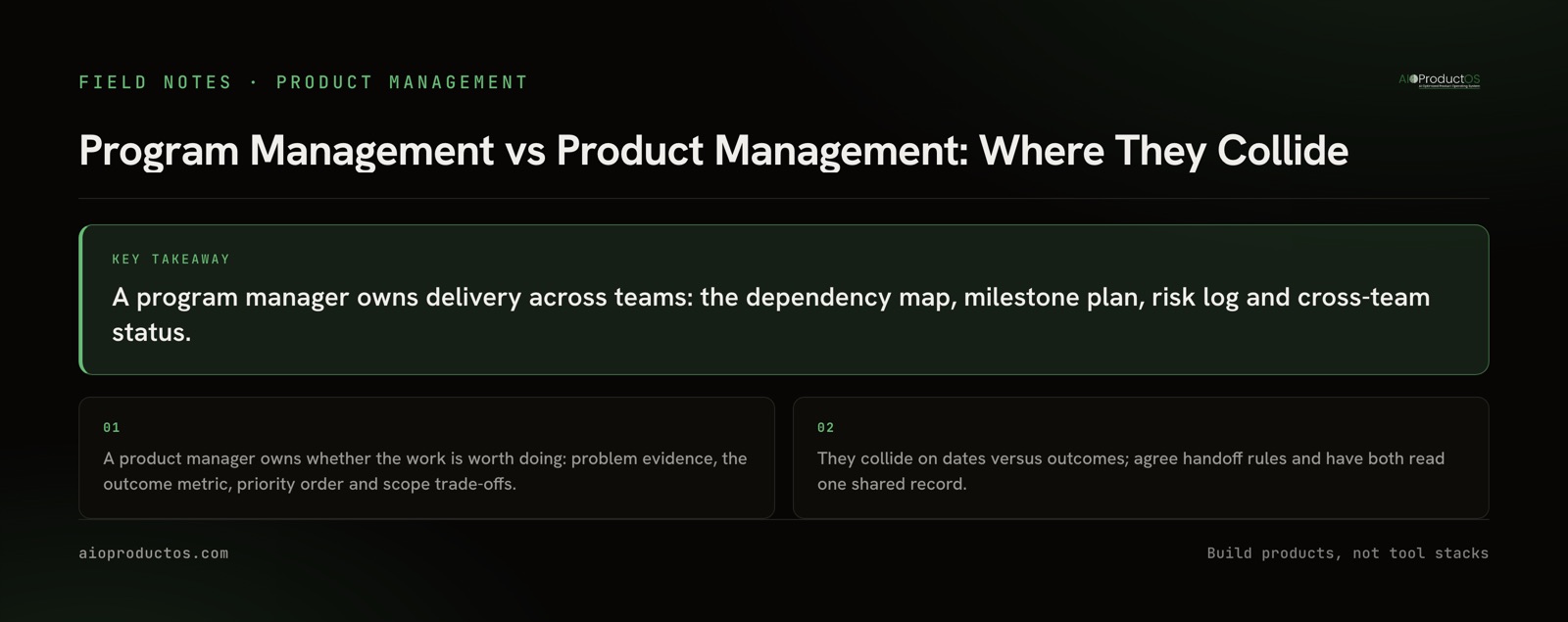
Most comparisons stop there, with two lists of responsibilities and a note on career paths. What decides whether the roles work well together is the seam: which artifact each one owns, where they predictably collide, and what stops that collision from becoming two competing status decks. Short definitions of the terms used below live in the product glossary.
Who owns which artifact
The cleanest way to separate the roles is by artifact, not by title. If two people both believe they own the milestone plan, or nobody believes they own the outcome metric, the job descriptions do not matter much.
| Question | Program manager owns | Product manager owns | Where they collide |
|---|---|---|---|
| What are we building? | The plan of record across teams | The priority order and the problem evidence behind it | A late priority change lands on a plan that is already sequenced |
| When does it land? | Milestone plan and release dates | The window in which it still matters to customers | A date is held after the reason for it has moved |
| What depends on what? | The cross-team dependency map | Which dependencies are worth carrying at all | A blocking dependency sits on low-value scope |
| What could go wrong? | The risk and RAID log | Product risk: wrong problem, weak adoption | Delivery risk is tracked; value risk is not |
| What gets cut? | Proposes cuts that protect the date | Decides which cuts keep the outcome intact | Cuts are chosen by size, not by value |
| Did it work? | Delivered on scope and on date | The outcome metric moved after release | "On track" gets reported as success |
The right-hand column is where the friction lives, and none of it is personal. A date nobody defends is not a date; shipping the wrong thing on time is still the wrong thing. The trouble starts when each side argues from its own artifact, because the artifacts do not reference each other.
Where program and product managers collide
A date versus an outcome. A program plan commits to a date because other teams, launches and customers depend on it. The outcome that justified the date, say faster onboarding for a segment of accounts, can shift halfway through: the segment churns, a competitor changes the picture, or early usage shows the problem was smaller than it looked. The program manager sees a date at risk. The product manager sees a date that no longer buys anything. Both are reading true facts from different documents.
Scope cuts. When a milestone slips, the fastest cut is usually the largest item. The largest item is often the one carrying the outcome. A program manager optimizing for the date and a product manager optimizing for value can agree on the size of the cut and still disagree completely on which item goes.
"On track" versus "worth it." Program status answers "will this land as planned?" Product status answers "will this move the number we care about?" A green program dashboard next to a feature nobody adopts is the most common version of this collision, and it usually surfaces months after release, in a review where nobody can say which work was meant to move which metric.
Handoff rules that prevent the collision
These are working agreements, not an org chart. They hold whether the two roles are separate people or two hats on one person.
- Product owns the order; program owns the sequence. The product manager decides what matters most. The program manager decides how the teams get there given dependencies and capacity. If the sequence forces a change to the order, that is a product decision, raised by program.
- Every committed date names the outcome it serves. A milestone without a stated outcome cannot be re-evaluated when circumstances change. Tie it to an objective, ideally one already written as OKRs, so a slipping date triggers a question about value rather than only about schedule.
- Program proposes cuts; product picks them. The program manager brings options sized to recover the date. The product manager chooses which option keeps the outcome intact, inside a turnaround both agreed in advance so the decision does not stall delivery.
- Status has two lines. Delivery status (on track, at risk, late) and outcome status (expected effect, early signal, measured result). Reporting only the first is how "on track" becomes a synonym for "good".
- Change the roadmap's shape when dates mislead. If most of the conflict is about dates on items that are still uncertain, a now-next-later roadmap commits to order and confidence instead of false precision. The now-next-later vs timeline roadmap comparison covers when each shape fits, and outcome-based roadmaps covers writing the outcome onto the work itself.
Read one shared record, not two status decks
Most of these collisions come from the same root: the program manager maintains a delivery view and the product manager maintains an evidence view, and the two are reconciled by hand in a meeting. The fix is a single chain both roles read from: customer evidence, linked to the feature it justifies, linked to the work items that deliver it, linked to the outcome measured after release. That is what a single source of truth for product means in practice, and connecting feedback, roadmap and delivery walks through building the links.
With that chain in place, a slipping work item visibly threatens a named feature, the feature visibly carries the customers who asked for it, and the cut conversation starts from the same facts on both sides. It also changes stakeholder updates: one record, two views, instead of two decks that disagree. Roadmap stakeholder communication covers what each audience needs to see.
In AIOProductOS, this chain sits on one product spine. Every task carries the requesting customer's plan and revenue, and features rank by request count and revenue at stake. The Stripe connector lands each customer's plan and MRR on the account record, and the GitHub connector lands repos, PRs and issues on that same record. Boards are methodology-aware, so a team running Scrum and a team running Shape Up still write to the same record. After release, every shipped feature carries a verdict on its task card in Outcomes: adoption, MRR adopted and retention lift.
What each role should be able to ask an AI assistant
An AI assistant connected to that record over MCP can answer each role's questions directly, but only if it queries the record rather than summarizing documents about it.
A program manager should be able to ask: "Which work items under initiative X are past due, and which teams own them?" A correct answer lists the work item ids, the owner of each, the due date, and the date window checked. If blocking relationships live in a slide rather than the record, the honest answer is "I cannot see those dependencies", and an assistant that answers anyway is guessing.
A product manager should be able to ask: "Which accounts asked for this feature, what MRR do they represent, and did the outcome metric move after release?" A correct answer names the account count, the MRR total, the release date, the before-and-after window used, and says plainly that a post-release lift from observational data is correlational, not proof the feature caused it.
To verify either answer, open two or three of the cited ids, check that the comparison window starts at the actual release date, and re-run with a narrower window. An answer with no ids, no window and no caveat is a summary, not a measurement.
Over the AIOProductOS MCP, any MCP client can ask these against the record: revenue, demand and work questions compute deterministically, with no model call in the number, and writes land in human review. Run npx -y @aioproductoscom/mcp@latest locally, or point your client at https://platform.aioproductos.com/api/mcp. Started without a token, the local server runs in demo mode against a seeded showcase workspace, so you can test the questions before connecting your own data.
When a separate program manager is overhead
A dedicated program manager earns the seat when several teams must deliver together against dates that are genuinely fixed by something outside the product, such as a partner launch, a contract or a regulatory deadline, and when cross-team dependencies are numerous enough that tracking them is a job in itself.
For a single product with one or two engineering teams, a separate program role usually becomes a relay between the product manager and the engineers. The product manager, or an engineering lead, can carry the milestone plan and risk log at that size, and the handoff rules above still apply to one person wearing both hats.
A shared record does not fix everything either. If teams do not link work items to features, the chain has gaps an assistant cannot fill. If updates lag reality by weeks, both roles will read stale facts with more confidence. And if the real conflict is about decision rights, such as who can move a committed date, a better record makes the disagreement clearer but does not settle it.
If you want both roles reading from one record of evidence, features, work and outcomes, start a 7-day free trial. No card required.