What is the difference between product management and product development?
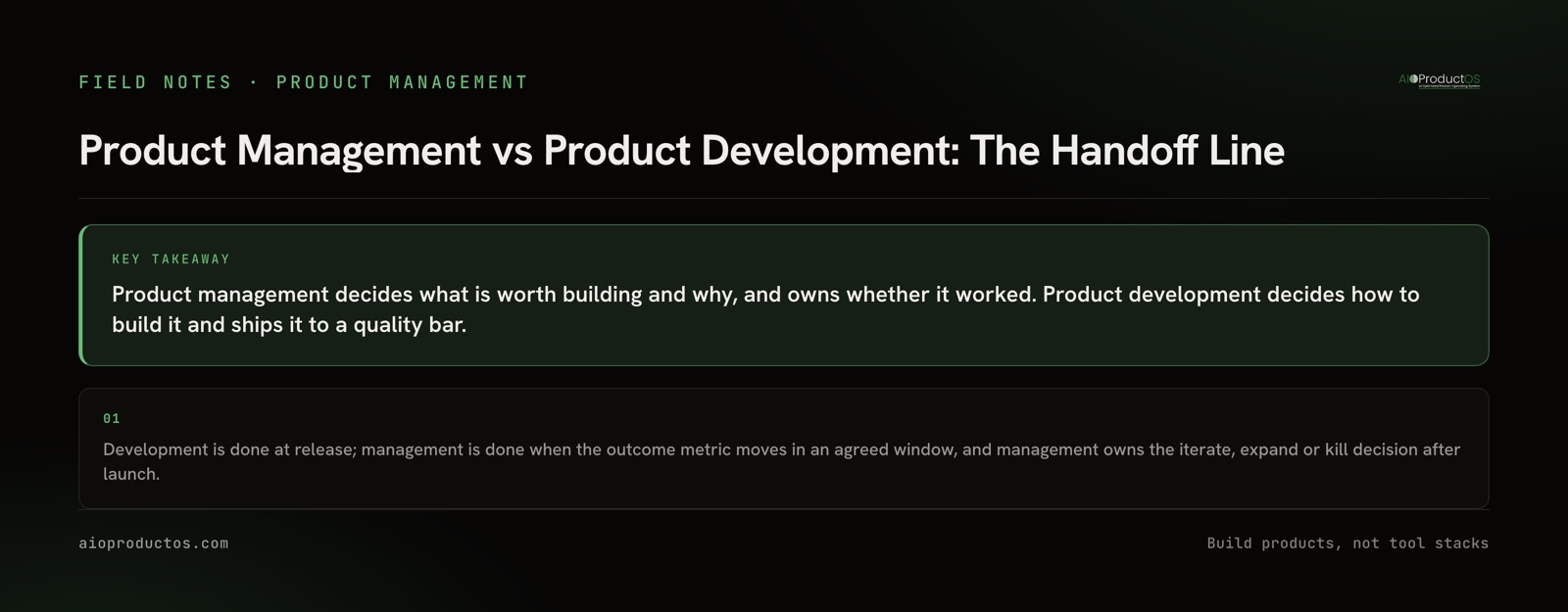
Product management decides which customer problems are worth solving, in what order, and what result would count as success. Product development designs, builds, tests and releases the solution to a quality bar. Management owns the what, the why and whether it worked; development owns how it gets built and when it ships.
Most explanations stop at that split and add a line about collaboration. The useful part is the line between the two: what crosses it in each direction, what "done" means on each side, and who makes the call once the feature is live. That last question is where most teams quietly drop the ball. Short definitions of the terms used below are in the product glossary.
What crosses the handoff, in each direction
Think of the boundary as a contract with four crossings. Two happen before the build, one at release, and one weeks after it.
| Artifact | Produced by | Consumed by | When it crosses |
|---|---|---|---|
| Problem brief: who has the problem, and the evidence | Product management | Development | Before estimation |
| Outcome target and measurement window | Product management | Development, then product management again | Before estimation |
| Priority order | Product management | Development | Each planning cycle |
| Feasibility read and estimate | Development | Product management | Before commitment |
| Scope options with cost | Development | Product management | Before commitment, and again if the build slips |
| Release: shipped, working, on the quality bar | Development | Customers, product management | Launch day |
| Measured result against the target | Product management, from analytics | Development and product management | End of the measurement window |
| Iterate, expand or kill decision | Product management, with development's cost input | Development | Right after the result is read |
Going in. Development needs three things before estimating anything: a problem brief that names who has the problem and the evidence for it, an outcome target with the window it will be measured in, and the priority order relative to everything else in flight. A brief that arrives as a solution, such as "add a bulk export button", skips the first two and leaves engineers guessing which trade-offs are allowed. A product requirements document is one container for all three; the format matters less than the outcome target being written down before work starts.
Coming back. Development returns a feasibility read, an estimate and scope options: the full version, a smaller version that still tests the outcome, and what each costs. Many of the real product decisions get made here, because the cheapest version that can move the metric is rarely the one in the original brief.
Going out, then coming back later. Development ships the release, and from its side that is the finish line. Management then reads the measured result at the end of the window and makes the after-launch call. This last crossing is the one most teams never make.
Two definitions of done
Development is done when the work is shipped, working in production and meets the quality bar: tests pass, nothing regressed, performance holds, docs are updated. That definition is concrete and checkable on release day, which is exactly why it wins by default.
Management is done when the outcome metric moved, or clearly did not, inside the window agreed before the build. If the target was "accounts on the Team plan use bulk export weekly within 30 days of release", management is not done on release day. It is done 30 days later, when someone reads the number and decides what to do with it. Measuring feature adoption covers how to pick a metric that can actually answer that.
Both definitions are correct. The trouble is that only one of them has a natural trigger.
Where the loop breaks: it stops at "shipped"
The ticket closes on release day. The sprint review shows it as delivered. The roadmap item turns green. Development's definition of done is satisfied, so nothing in the process reopens the work, and the product manager has already moved to the next brief because development is waiting on it.
Six weeks later, nobody can say whether the feature worked. Not because the data is missing, but because nobody was scheduled to look. The feature joins a pile of shipped work with no verdict, and the next planning cycle ranks new ideas against a backlog whose past bets were never scored. If usage is low, the team usually hears it from a customer or a churn review, which is the slow route to working out why nobody is using a feature.
Three habits close the loop:
- Put the measurement window and a decision date in the brief, before estimation. The date goes on a calendar, not only in a document.
- Let development's ticket close at release, but keep the feature record in a "measuring" state until the decision is logged.
- Report two statuses for every item: delivered or not, and verdict pending, positive, flat or negative. A delivered item whose verdict is still pending after its window is an overdue decision, and it should look like one.
Who owns the decision after launch
The product manager owns it. There are three honest outcomes:
- Iterate. The metric moved partway, or moved for one segment and not another. Fund a follow-up scoped to the gap.
- Expand. The metric moved as intended. Extend it to more segments, plans or surfaces, or put it in front of new users during onboarding.
- Kill. The metric did not move and the evidence does not point to a fixable cause. Remove the feature, or stop investing and schedule its removal, so it stops costing maintenance.
There is also a fourth outcome that is not a decision: leave it as it is and move on. That is a kill without the cleanup.
Development has a real input even though it does not own the call: what another iteration would cost, what the feature costs to maintain if it stays, and what removing it would take. If the result is inconclusive, extend the window once, with the reason written down, rather than letting it drift. Outcome-based roadmaps covers putting the target on the roadmap item itself, so this review has something to check against.
The stages of product development, and who leads each
Product development usually runs through discovery, definition, design, build, test, release and measurement. Product management leads discovery and definition and owns measurement. Development, meaning engineering and design together, leads design, build, test and release. The stages overlap, and each needs the other side present: engineers in discovery catch infeasible ideas early, and product managers at release catch scope that drifted from the outcome. The seam between product and program management is a different one, about cross-team dates rather than build versus value; program management vs product management covers it.
Ask the record whether shipped work was worth it
If shipped work, the customers who asked for it and the post-release numbers sit on one record, an AI assistant connected over MCP can run the after-launch review with you. Questions worth asking:
- "List items shipped in the last 60 days with no recorded outcome."
- "For feature X, show adoption, MRR adopted and retention lift since release, and the window you used."
- "Which accounts requested the features we shipped this quarter, and what MRR do they represent?"
- "Which features shipped this quarter have no experiment or decision linked to them?"
A good answer is checkable. It cites item ids you can open, states the measurement window and the date it starts, gives account counts instead of "several customers", and says plainly that a before-and-after lift from observational data is correlational, not proof that the feature caused it. Open two or three of the cited ids and confirm the window starts at the actual release date. An answer with no ids and no window is a summary, not a review.
In AIOProductOS, every shipped feature carries a verdict on its task card in Outcomes: adoption, MRR adopted and retention lift. The lift is correlational unless a declared A/B winner adds its measured lift, and every task also carries the requesting customer's plan and revenue. The AIOProductOS MCP exposes that record to any MCP client, with revenue, demand and work answers computed deterministically, no model call in the number, and writes that land in human review. An assistant can log the iterate, expand or kill decision, or open a follow-up experiment, and nothing changes until a person approves it. Run npx -y @aioproductoscom/mcp@latest to try the questions above; started without a token, it runs in demo mode against a seeded showcase workspace.
When one person should do both
Splitting the roles has a cost: a handoff, a meeting, a document someone has to keep current. In some settings that cost buys nothing.
In a team of a few people before product-market fit, the founder or a technical lead usually holds both jobs, and should. The feedback loop is days long, the founder talks to most customers directly, and a formal handoff would slow the one thing that matters. Founder-led products often stay that way well past that stage, while the founder still sets direction and hears from customers every week. Internal tools with a handful of known users rarely need a separate product manager either; the engineer can ask the users directly.
Two things carry over even then. The outcome target and decision date still need writing down, because one person wearing both hats is exactly who forgets to reopen shipped work. And some work honestly has no outcome metric: a security fix, a compliance requirement, a dependency upgrade. For that work, development's definition of done is the right one, and adding a measurement step adds ceremony without information.
If you want shipped work to come back with a verdict instead of a closed ticket, start a 7-day free trial. No card required.