Is a KPI the same as a key result?
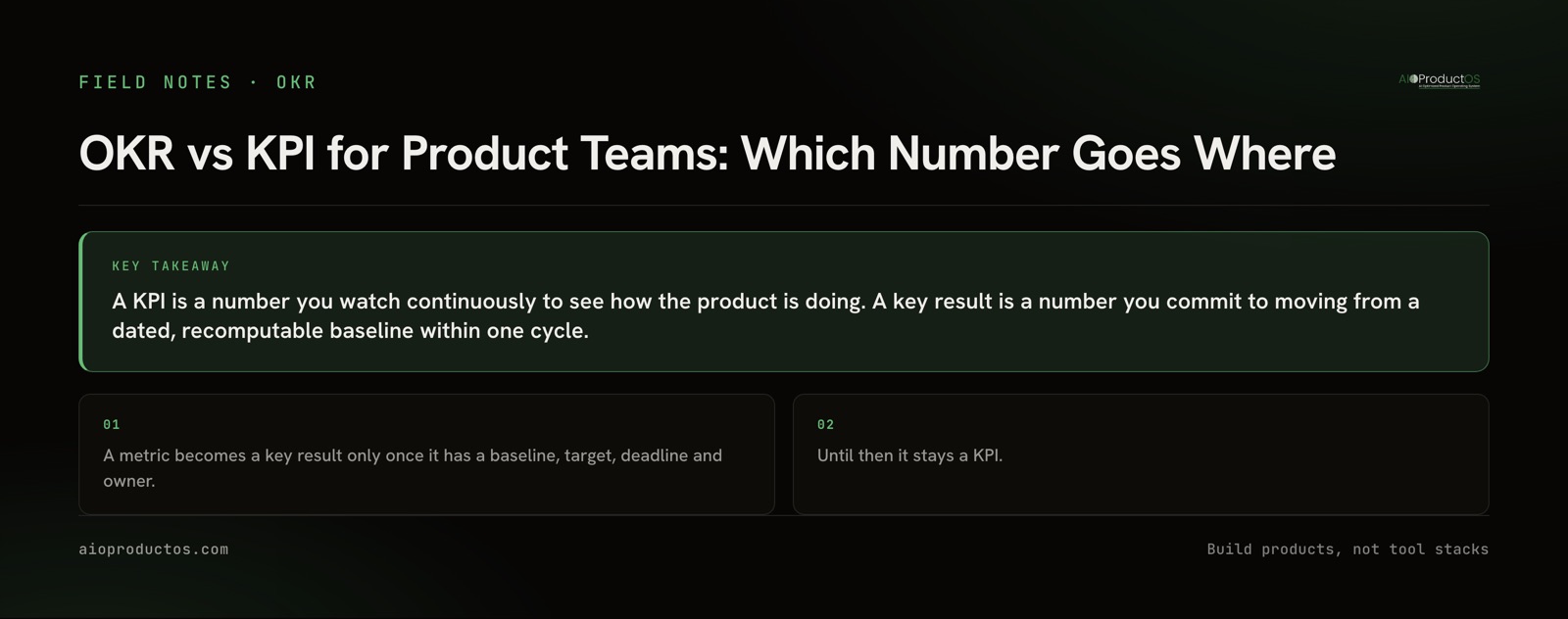
No. A KPI is a number you watch continuously to see how the product is doing, such as weekly active accounts or 30-day retention. A key result is a number you commit to moving from a dated baseline to a target within one cycle. The same metric can serve as both, but only after it has a baseline, a target, a deadline and an owner. Until then it is a KPI and belongs on the dashboard.
The one test that sorts the numbers
Ask two questions of any number. First, would you check it every week whether or not anything changed? If yes, it is a KPI. Second, can someone recompute its starting point from the source system on the day you set the target? If you would only look at it at quarter end, and you can name the exact query that produced its baseline, it is ready to be a key result. A number that fails the second question is not ready, however important it sounds in a planning meeting.
The table below applies the test to numbers that product teams argue about most. The values are the kind of numbers a team would see, not figures from any real company.
| Number | Where it belongs | Why |
|---|---|---|
| Weekly active accounts | KPI, and the guardrail for KRs | Watched every week. Becomes a key result only when the team commits to moving it this cycle. |
| 30-day retention of new accounts | Key result, with a dated baseline | A committed move on a named cohort and window, recomputable from the event data. |
| Monthly recurring revenue | KPI for the company; a key result only for a named segment | A company-wide revenue target usually belongs to finance, not to one product objective. |
| Defect escape rate | Key result | Moves because of specific work, and can be recomputed from the bug tracker. |
| Releases shipped | Output to exclude | Shipping is something you do. The key result is the behaviour the release should cause. |
| NPS | KPI | A slow survey signal. Useful as a health check, weak as the only key result. |
| Tickets closed | Output to exclude | Measures activity. A closed ticket says nothing about whether the customer got what they needed. |
Why the KPI becomes the baseline, and the key result is the promise
The clean way to use both is a chain. The KPI is the health check that tells you the business is still running. The key result is the commitment you made, and its baseline is recorded from the same source the KPI uses, on a stated date.
Here is a hypothetical example. A team watches weekly active accounts as a KPI, and it has been flat for four weeks. The team picks one cohort, new accounts created in the cycle, and commits to raising the share still active at day 30. The baseline is recorded as a hypothetical 40 percent, pulled from a saved query with the date and the exact window written beside it. The target is 50 percent by the end of the cycle. The KPI does not disappear. It becomes the guardrail: if the day-30 number climbs while weekly active accounts fall, the commitment has been met in a way that hurts the business, and the team has to say so at check-in.
The baseline test is the part most templates skip. If the number on the dashboard cannot be reproduced from a query, you have a KPI and an opinion, not a baseline. Record the query text, the window and the date in the key result itself. This is the same discipline described in the product OKR template, where each key result carries its source and its linked work.
When one number should be both
A number can carry both roles at once when it is the company's single most important health signal and the team has committed to a change in it this cycle. Revenue retention for a team on a subscription product is a common example. It is watched every week as a KPI, and it is also the key result for the retention objective. That is acceptable as long as the owner names the query and the cohort, and the KPI view and the key-result view read from the same source.
Be wary of the opposite case, where every KPI gets a target and gets promoted into the OKR set. Then the cycle has twelve commitments, none of which anyone can check at a glance. A team with more than three or four key results per objective is usually treating its dashboard as a list of goals.
When an OKR is the wrong tool
OKRs are a poor fit in four situations, and it is better to say so than to write objectives that look like commitments.
The first is a mature product with no change planned. If the honest plan is to keep the numbers steady, a KPI review is the right ritual, and inventing a key result to fill the template creates work for nothing.
The second is a number nobody owns. A key result without an owner cannot be checked in, and a KPI without an owner cannot be acted on. Fix the ownership before you promote anything.
The third is a number you cannot measure yet. If the baseline does not exist, the first cycle should be spent building the query and recording the baseline, not committing to a target that cannot be verified.
The fourth is a very small team on a stable product. Two people who talk every day do not need a quarterly scoring ritual to know whether retention moved. A short written list of KPIs with one named change per month may serve them better than a full OKR set.
How often each one gets reviewed
KPIs run continuously. Someone should look at them on a fixed rhythm, often weekly, because their job is to catch movement that nobody planned. OKRs run on a cycle. The useful pattern is a check-in every two to four weeks to update progress and decide whether a key result still deserves its place, and a final score at the end. If a KPI moves sharply in the middle of a cycle, review the key results that touch it before the next scheduled check-in, not after.
Check it yourself with an assistant
An assistant connected to your product data over MCP can test whether your OKR set follows this logic. Ask it three questions and check the answers against the source before you trust them.
- Which key results on this objective have a dated baseline and a recorded source query? The answer should list the key result ids, the baseline value, its date and the query or report it came from. Any key result with no source should be flagged, not guessed at.
- Which KPIs were moved by the linked work when it shipped? The answer should name the window and the denominator. The outcome verdict on a task card is a correlational lift, not proof that the work caused the change, so the assistant should say that in its answer.
- Recompute the baseline for one key result from the source system. The model should return the same number the key result recorded. If it does not, the baseline is wrong and the key result should not be repeated in a status update.
Any write an assistant makes through MCP lands in human review, so the check-in stays with a person. If you want to try these questions before connecting your own data, the stdio server's demo mode runs a read-only subset against a seeded showcase workspace, and you can draft the first key result with the OKR generator. For the wider question of which objective to pick in the first place, north star metric guidance covers how to choose the number an objective is anchored to.
Start with the test, then the template
The distinction is simple to state and easy to lose in practice. A KPI is what you watch. A key result is what you promised to change, measured from a baseline anyone can recompute. Put the number that passes both tests into an objective, leave the rest on the dashboard, and record the query next to every key result. When you are ready to set up the cycle on real data, start a trial, or compare plans on pricing first.