RICE vs WSJF: which prioritization framework should you use?
Pick RICE when you need a balanced, general-purpose score across a broad backlog and can estimate reach. Pick WSJF when speed and time-sensitivity dominate, since it weighs cost of delay against effort. Pick Value/Effort for fast, low-stakes triage. But the framework matters far less than whether the numbers feeding it are real. If you need the full decision process behind these methods, start with this product prioritization framework.
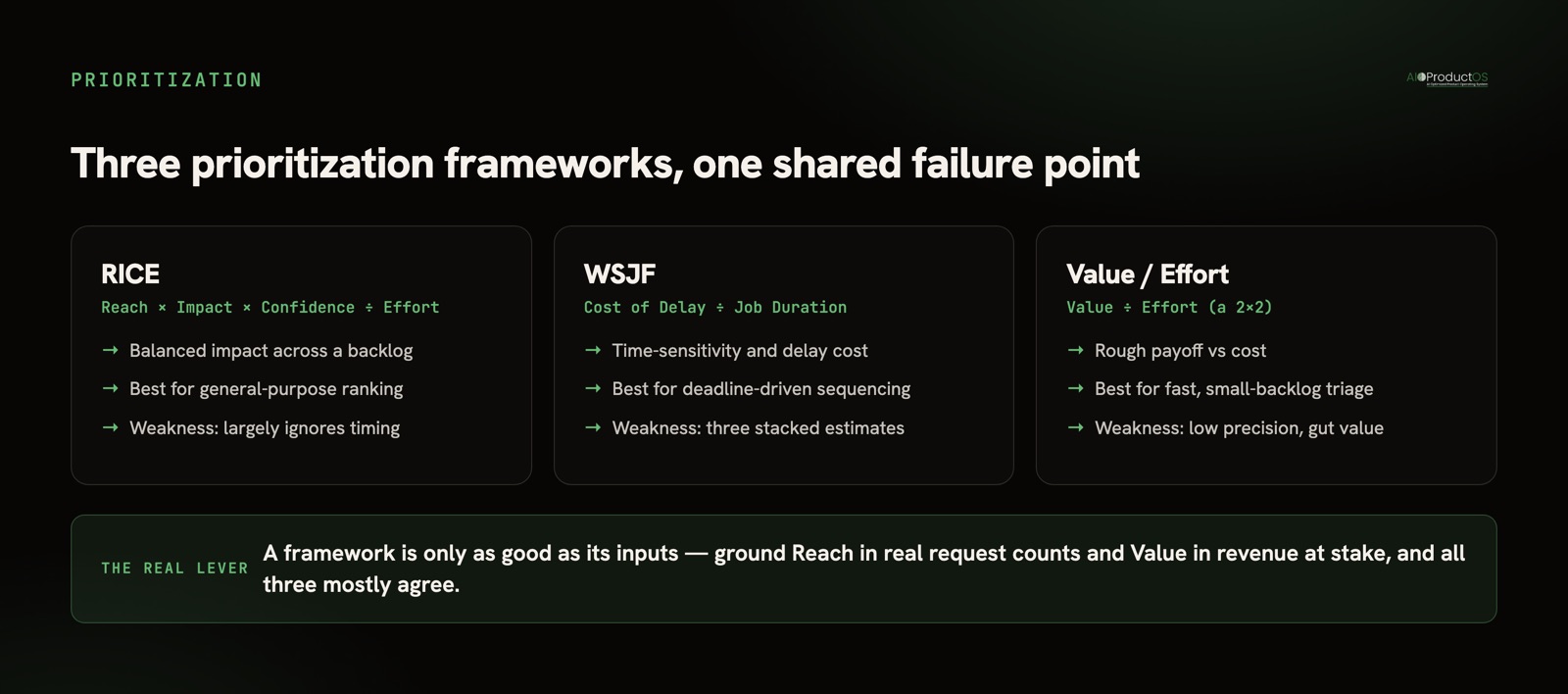
Every product team eventually hits the same wall: more good ideas than quarters to build them. A scoring framework is how you turn that pile into an ordered list you can defend in a roadmap review. RICE, WSJF, and Value/Effort are the three most common choices. They disagree less than the internet suggests, and all three fail in exactly the same place. If you only came to run the numbers, the free RICE prioritization calculator and WSJF calculator open in the browser with no signup. The rest of this post is which one to reach for, and why the inputs decide more than the formula does.
RICE: the balanced default
RICE was popularized by Intercom and scores each item as Reach × Impact × Confidence ÷ Effort. Reach is how many people or accounts the work touches in a set period. Impact is how much it moves the needle per person. Confidence is a discount for how sure you are. Effort is the person-months to build it.
The strength of RICE is balance. It refuses to let a loud request with tiny reach jump the queue, and the Confidence multiplier forces you to admit when a number is a guess. The weakness is that it treats all value as roughly interchangeable and mostly ignores time. A feature worth the same to 10,000 users next year and this month scores identically, even though shipping it late can quietly destroy most of its value.
WSJF: when timing is the deciding factor
WSJF comes from the Scaled Agile Framework and scores each item as Cost of Delay ÷ Job Duration. Cost of Delay is usually built from three parts: user or business value, time criticality, and risk reduction or opportunity enablement. Job Duration is a proxy for effort. The higher the score, the sooner it should ship.
WSJF's advantage is that it makes delay explicit. It is built for sequencing when several things are all valuable but only one can go first, and it naturally elevates deadline-driven or window-limited work that RICE tends to flatten. The cost is complexity and subjectivity: Cost of Delay is three fuzzy estimates stacked on top of each other, and relative sizing across a large group can drift into theater if nobody grounds the inputs.
Value/Effort: fast triage
Value/Effort is the simplest of the three, usually a 2x2 with value on one axis and effort on the other. Quick wins are high value and low effort; time sinks are the opposite. There is no formula to argue about, which is exactly the point.
It is the right tool for a fast triage session, a small backlog, or an early-stage team that does not yet have the data to populate RICE or WSJF honestly. The tradeoff is precision. Two features can land in the same quadrant and still be very different bets, and "value" here is often a single gut number with no reach, confidence, or timing behind it.
RICE vs WSJF vs Value/Effort at a glance
| RICE | WSJF | Value/Effort | |
|---|---|---|---|
| What it scores | Balanced impact across a backlog | Time-sensitivity and delay cost | Rough payoff vs cost |
| Formula | Reach × Impact × Confidence ÷ Effort | Cost of Delay ÷ Job Duration | Value ÷ Effort (often a 2x2) |
| Best for | General-purpose ranking with enough data | Sequencing deadline- or window-driven work | Fast triage, small or early backlogs |
| Main weakness | Largely ignores timing; Impact is coarse | Cost of Delay is three stacked estimates | Low precision; value is a single gut number |
The part every comparison skips: where do the numbers come from?
Read enough framework guides and you notice they all argue about the formula and none of them ask the harder question. Look at what actually feeds these scores. RICE's Reach. WSJF's user and business value. Value/Effort's value axis. In most teams, every one of those numbers is typed into a spreadsheet from memory during a planning meeting.
That is the real failure mode, and it is shared. A framework is a function; its output is only as trustworthy as its inputs. If Reach is a round number someone felt was about right, and value is a 1-to-10 that reflects who spoke loudest last sprint, then switching from RICE to WSJF just reorders the same guesses. You get a more official-looking ranking of the same fiction.
The inputs are guessed largely because the evidence lives somewhere else. Reach is really a count of how many accounts asked, which sits in your support inbox, your feedback tool, and your CRM. Value is really revenue at stake, which sits in billing. The average company now runs 101 SaaS apps and wastes roughly $21M a year on licenses nobody uses (Okta / Zylo), and the signals a good Reach or Value estimate needs are scattered across a dozen of them. Context-switching between those tools costs an estimated $450B a year, with the average employee losing about 40% of productive time to it (Gallup / TheTab). So the numbers get invented instead of counted, because counting them means stitching five systems together by hand.
The upgrade that beats any framework swap is grounding two inputs in real data. Set Reach from the actual number of accounts that requested a thing. Set value from the actual revenue attached to those accounts. Do that, and the framework you choose stops mattering much, because RICE, WSJF, and Value/Effort will mostly agree once they are fed the same real evidence. This is also why prioritization and roadmap sequencing are the same problem viewed twice; see how to rank a roadmap by revenue for the sequencing side of it.
When a framework is the wrong tool
Scoring is not always the right move, and it is worth saying so plainly.
Sometimes the correct call is a strategic bet that no formula will ever rank first. A platform rewrite, a new market, or a foundational capability often scores badly on RICE because its reach is speculative and its effort is enormous. If you only ever ship what the framework ranks highest, you will build a tidy local maximum and miss the thing that actually changes the company. Founder conviction, backed by a clear thesis, is allowed to overrule the spreadsheet. The discipline is to do it out loud and write down why, not to quietly delete the score.
Small teams often need no framework at all. If you have ten items and three people, a Value/Effort conversation over coffee will beat a weighted model, and the hours you would spend calibrating Cost of Delay are better spent shipping. Frameworks earn their keep when the backlog is large enough that intuition stops scaling and when stakeholders demand a defensible reason for the order. Below that threshold, they are ceremony.
And when the deciding factor is a hard deadline, a legal requirement, or an external dependency, you do not need a score at all. The date decides. Reaching for WSJF to rediscover a fact you already know is motion, not progress.
Grounding the inputs
If your Reach and Value numbers are already real, pick the framework that matches your situation and move on. If they are guesses, fix that first, because it is the higher-leverage change.
This is the problem AIOProductOS is built around. It keeps one shared record per customer that joins revenue, feedback, and work, so every task already carries the customer's plan and the revenue at stake. Features rank by request count and revenue rather than by a number typed from memory, and it supports RICE, WSJF, Value/Effort, MoSCoW, and Kano on the same grounded inputs, so the framework becomes a lens over real evidence instead of a wrapper around a guess. It will not make the prioritization call for you. It makes sure the numbers you are calling on are true.
Whichever framework you land on, start by getting the math right on a real example. Run your next batch of features through the free RICE prioritization calculator, and if timing is your deciding factor, the WSJF calculator sits right beside it. Both run in the browser, no signup, so you can pressure-test your inputs before you ever trust the ranking.