Every product team eventually hits the same fork: you need to understand your customers better, and someone asks whether to send a survey or book interviews. The internet will tell you surveys give breadth, interviews give depth, and you should use both. That's correct, and it's also where most advice stops, right before the part that actually determines whether the research changes anything.
When should you use a survey vs an interview?
Use an interview when you don't yet know why customers behave the way they do and can't even write the right questions. Use a survey when you already know the questions and need to measure how widespread an answer is across a large group. Interviews find the pattern; surveys size it. If the problem is still fuzzy, start with conversations, not a questionnaire.
The mistake is treating this as a personality choice, quant people reach for surveys, qual people reach for interviews. It's a sequencing choice driven by how much you already understand. When you're staring at a churn spike and have no theory for it, a survey will hand you numbers that confirm you're confused. When you have a clear hypothesis and need to know whether it holds for 5% or 55% of users, a round of interviews will give you five anecdotes and no way to weigh them.
Are interviews or surveys better for customer research?
Neither is better in the abstract, they answer different questions. Interviews are open-ended and conversational, so they're built for discovering the why behind a behavior and for hearing the exact words customers use, language you'll later reuse in positioning and in survey questions. You can follow a surprising answer wherever it leads. The cost is scale: a dozen interviews is a serious time commitment, and twelve people can't tell you what your whole base thinks.
Surveys invert that. They reach hundreds or thousands cheaply, quantify how common something is, and let you segment by plan, tenure, or revenue. The cost is that they only capture answers you already thought to ask. A survey can't notice the problem you didn't put on the form, and it can't ask "wait, why?" when the data gets weird. That single limitation, no follow-up, is why surveys alone so often produce clean charts that nobody knows how to act on.
Here's the practical split across the dimensions that decide most research plans:
| Dimension | Surveys | Interviews |
|---|---|---|
| Core question answered | How many? How widespread? | Why? What's really going on? |
| Data type | Quantitative, structured | Qualitative, open-ended |
| Sample size | Hundreds to thousands | 5-15 is often enough |
| Time cost | Low per respondent | High per participant |
| Best for | Sizing a known problem, tracking trends, NPS/CSAT | Discovery, unpacking motivation, capturing real language |
| Biggest weakness | No follow-up; only asks what you already know | Doesn't scale; small samples can mislead |
| Use when | You know the questions | You don't yet know the questions |
Can you use surveys and interviews together?
This is where the good research lives. Run interviews first while the problem is still open, and let them do two jobs: surface the problems you didn't know about, and give you the customer's own phrasing. Then take the recurring themes and turn them into survey questions, so you can measure how many people share each one. Interviews generate the hypotheses; surveys tell you which ones are worth a roadmap slot.
You can run the loop the other way too. A survey flags that power users on higher plans are quietly frustrated with onboarding, but the free-text answers are too thin to act on. So you book five of those specific respondents for interviews and find the actual blocker. Quant points you at where to dig; qual tells you what you'll find when you get there. Same decision, two inputs.
The sequence matters more than the labels. Whichever you start with, the second method should be chosen to cover the first one's blind spot, not to repeat it.
The real failure mode isn't the method. It's research that dies in a doc
Here's the part page one skips. You can pick the perfect method, write unbiased questions, and run a flawless study, and it can still change nothing, because the finding never reaches the person prioritizing the roadmap. Interview notes sit in one folder. Survey exports sit in a spreadsheet. Neither is attached to the feature it should influence or the customer it came from, and by the next planning cycle both have gone cold.
That gap is expensive in a way that has nothing to do with survey design. Context-switching, hunting for that insight across a research tool, a feedback inbox, and an analytics dashboard, costs an estimated $450 billion a year, with the average employee losing 40% of productive time to it (Gallup). A PM who has to stitch a survey trend to an interview quote to a revenue number by hand usually doesn't. The research becomes a document that got read once, not a signal that moves a decision.
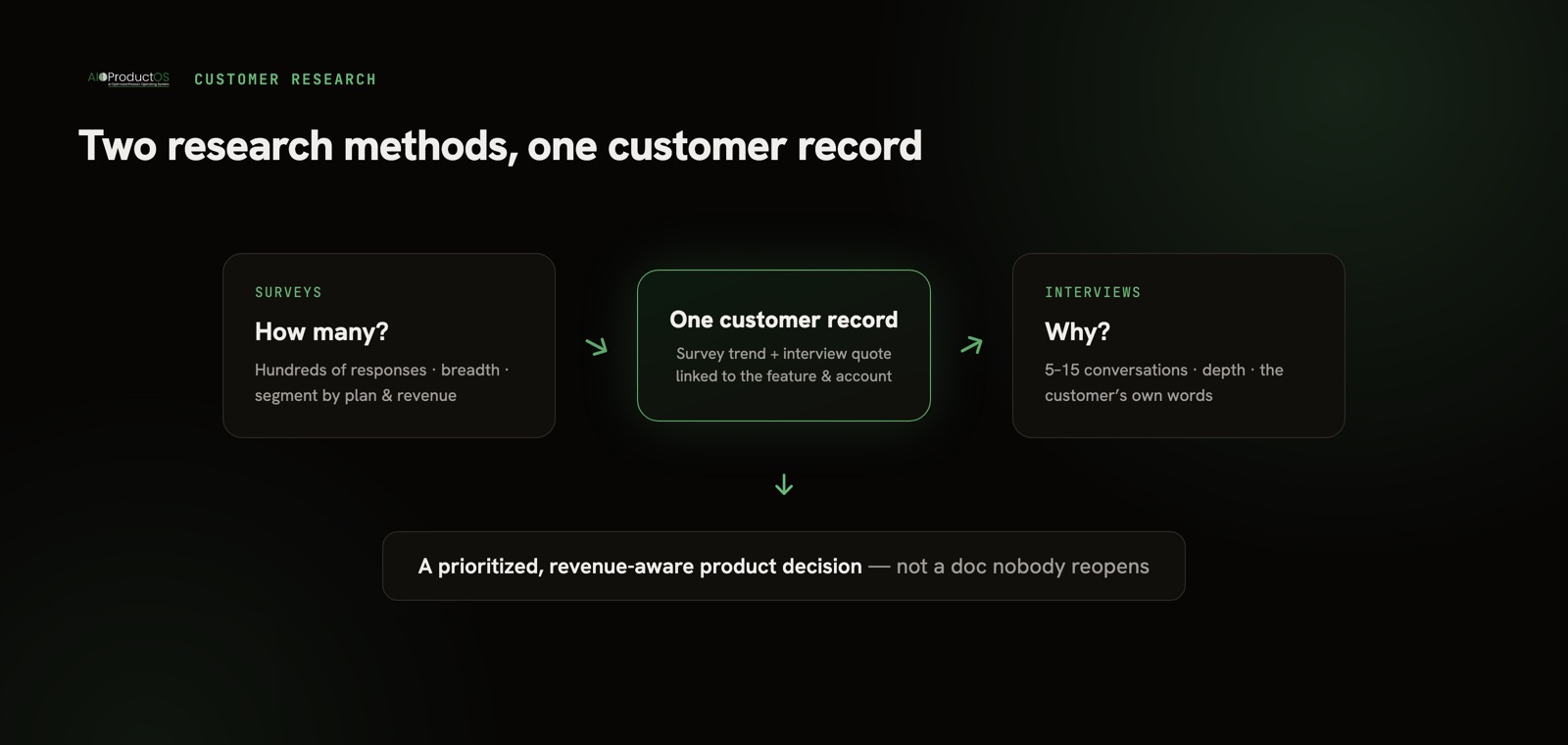
The fix isn't a better questionnaire. It's treating surveys and interviews as two inputs to the same customer record instead of two separate deliverables. In AIOProductOS, Insights is one feedback feed across reviews, requests, surveys, designs, and support, each item linked back to the feature it informs and the account it came from, with NPS and CSAT micro-surveys built in and NPS weighted by revenue. A survey result and an interview quote land on the same record as the customer's plan and the work in your backlog, so a claim like "a large share of enterprise accounts asked for this, and here are the three interviews explaining why" is one view, not a week of assembling. We walk through moving from raw signal to a shipped change in turning customer feedback into product changes.
That's the argument the method debate misses. The choice between surveys and interviews is real but small. The choice between research that routes into a prioritized, revenue-aware decision and research that evaporates is the one that determines whether any of it was worth doing.
When you don't need either
Not every question deserves a study, and reaching for research reflexively wastes the time it's supposed to save.
Skip both when the answer already exists in behavior. If you want to know whether people use a feature, your product analytics already say so, more honestly than a survey where people over-report the things they think they should do. Skip both when the decision is cheap and reversible: for a small, easy-to-undo change, shipping it behind a flag and watching what happens beats a two-week research cycle.
A survey alone is enough when you have a genuinely well-understood question and only need to size it, "how many of you would pay for annual billing," asked of a base you already understand deeply. Interviews are overkill there; you don't need the why, you need a count. And interviews alone are enough at the earliest stage, when you have so few customers that a survey would return a handful of responses anyway. Talk to all of them. The point isn't to always do both, it's to match the method to what you don't yet know, and to skip research entirely when you already know or can just try it.
The teams that get the most from customer research aren't the ones with the fanciest user research platform. They're the ones whose surveys and interviews land in the same place as their revenue and their roadmap, so the finding survives long enough to change a decision. If your research keeps dying in a doc, the method was never the problem. See how a connected feedback feed keeps it alive in our guide to the best feedback tools.