What is a user research platform, and which one do you actually need?
A user research platform is software for running structured research with users: recruiting participants, testing designs, or storing and analyzing what you learn. The category covers four separate jobs that do not replace each other. Pick the job first, then the vendor, because buying from the wrong row is the most expensive mistake here.
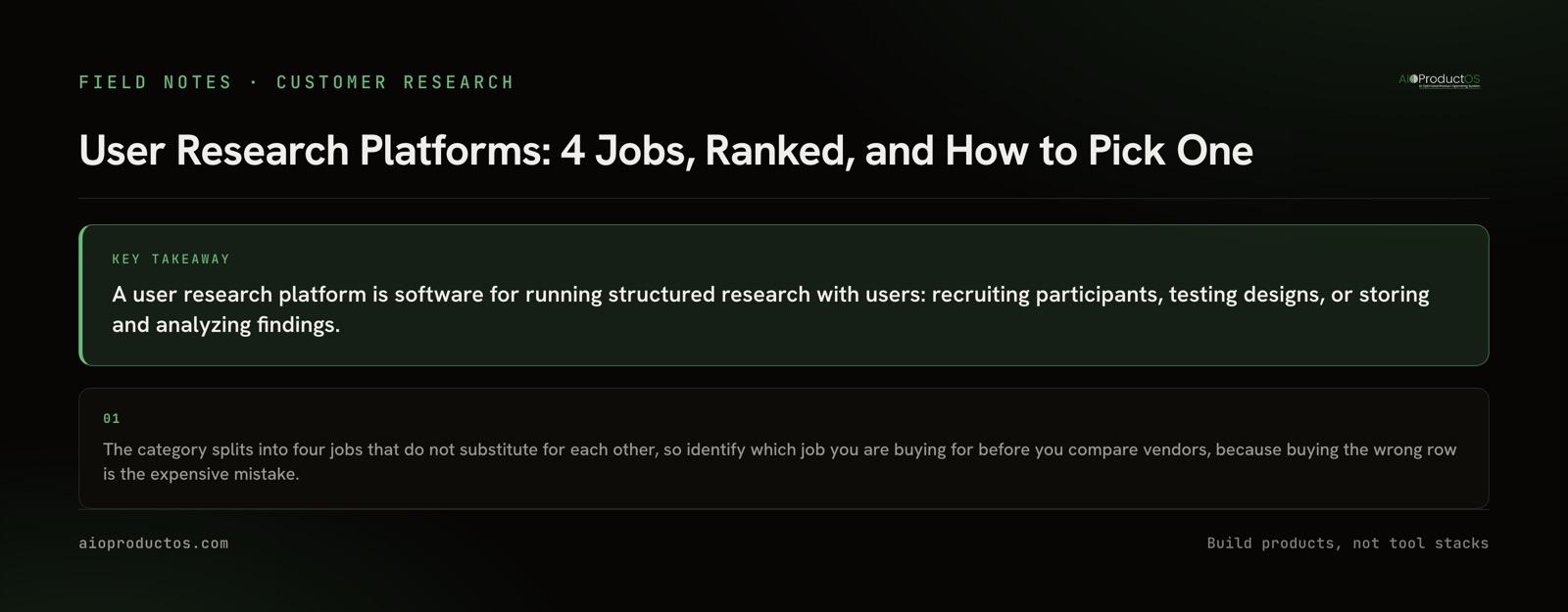
Search this term and page one is mostly written by user research vendors about the category they sell into. That is not dishonest, but it has a structural limit: the usual comparison article ranks fifteen brands in one flat list, as if a recruiting marketplace and a transcript repository were competing for the same budget line. They are not. A team that buys a repository when what it needed was access to strangers ends up with a beautifully tagged archive of research it could not run. A team that buys a recruiting marketplace when its real problem was that findings never reach the roadmap ends up paying per participant to generate more of the thing it was already losing.
So the list below is ranked by how unambiguous the need is, not by product quality. Row one is the job nothing else can stand in for. Row four is the one teams most often turn out to actually be in, and the one least often searched for under this term.
| # | The job | What it is for | Representative platforms | You are in this row when |
|---|---|---|---|---|
| 1 | Participant recruiting | Reaching people to talk to who are not already your users | User Interviews, Respondent, Prolific | You have a study designed and nobody to run it on |
| 2 | Unmoderated testing at speed | Prototypes, tree tests, first-click, task success without a moderator | Maze, Lyssna, UserTesting | You have a design and need behavioral evidence before you build |
| 3 | Research repository and analysis | Where transcripts, tags, themes and clips live and stay findable | Dovetail, Condens, Marvin | Several people run research and nobody can find last quarter's |
| 4 | Continuous in-product feedback | Requests, reviews, surveys and support from users you already have | Feedback and product platforms, including ours | The signal already exists and nothing is collecting it |
1. Participant recruiting
This is the sharpest need on the list. If you are pre-launch, entering a new segment, or researching a persona you do not yet sell to, no repository and no testing tool solves it. You need access to strangers who match a screener, plus scheduling, incentives and payouts handled for you.
Buy here when the binding constraint is people, not process. The cost model is usually per participant, which means it scales with study volume rather than with headcount, and that is worth checking against how often you actually run studies. If you run two studies a year, a marketplace is a per-study expense; if you run them weekly, it becomes a standing line item. Method and sample size are separate decisions from vendor choice, and we cover them in surveys vs interviews and how many customer interviews are enough.
2. Unmoderated testing at speed
The second unambiguous job. You have a prototype, a navigation change, or two layouts, and you need task-level evidence in days rather than a scheduled round of moderated sessions. These platforms run the test without a facilitator present, then hand back completion rates, click paths and recordings.
Buy here when your bottleneck is throughput of design decisions. The honest limit is that unmoderated tests answer "did they succeed" far better than "why did they do that", because nobody was there to ask the follow-up. Teams that need the why still need conversations, and running those without the awkwardness is its own skill.
3. Research repository and analysis
This job only becomes binding at volume. One person running four interviews a quarter does not need a repository; a folder works. Three researchers, sixty sessions, and a stakeholder asking whether anyone has already studied this do need one, because the alternative is re-running research that already exists.
Buy here when findings are being lost, not when research is being started. Watch the pricing shape: repositories tend to charge per seat, which quietly taxes exactly the thing you want, which is more people reading the research. If viewing costs money, viewing stops.
4. Continuous feedback from the users you already have
This is a different job from all three above, and it is where a large share of teams searching for a research platform actually are. You are not short of people to talk to. You have requests in a tracker, complaints in support, ratings in an app store, and survey responses in a spreadsheet. Nothing is joining them, so the signal exists and nobody can act on it.
This row is not served by recruiting or unmoderated testing at all, and only partly by a repository, because a repository is built for study output rather than for the continuous stream. The cadence question here is discovery, not procurement, and we treat it separately in continuous product discovery.
The ranking stops short, because the insight has to survive the platform
Here is the failure mode none of the four rows is designed to prevent. Research platforms are genuinely good at producing findings and structurally bad at what happens next. The finding leaves the tool as a slide, a tag, or a highlight reel, disconnected from the roadmap, the customer record, and the revenue. Six months later nobody can answer the only question that matters at planning time: which paying customers asked for this, and did shipping it work?
That gap is not a research problem, it is a joinery problem, and it is expensive in a way the vendor comparison never surfaces. Context switching, hunting for one insight across a research tool, a feedback inbox and an analytics dashboard, costs an estimated $450 billion a year, with the average employee losing 40% of productive time to it (Gallup/TheTab). A PM who has to stitch a usability finding to a support theme to a revenue number by hand usually does not.
This is where AIOProductOS sits, and it is worth being exact about it: we are not a user research platform. We do not recruit participants, run moderated studies, or do unmoderated usability testing. What we do is row four plus the destination the other three rows' output should land in. Insights is one feedback feed across reviews, requests, surveys, designs and support, with each item linked to the feature it informs and the account it came from, plus NPS and CSAT micro-surveys with NPS weighted by revenue. Every shipped feature then carries a verdict on its task card, so whether it worked is recorded rather than argued about. The mechanics of getting from raw signal to a shipped change are in turning customer feedback into product changes.
When a dedicated user research platform is clearly the right call
Three situations where you should buy one of rows one to three, and where we are not the answer.
You need unmoderated usability testing at volume. If your design team ships multiple flows a week and needs task success rates, click paths and session recordings on each one before build, buy a dedicated unmoderated testing platform. That is a real specialism with real depth, and we do not offer it.
You need to recruit strangers outside your user base. New segment, new market, pre-launch concept testing, or any study where your existing users are the wrong sample. A recruiting marketplace with screeners, scheduling and incentive payouts is the correct purchase, and nothing in a feedback platform substitutes for it. If the question is whether to buy the research as a service instead, we worked through that separately in doing customer feedback without a research firm.
You have a research team of several people and need a real repository. Once multiple researchers are producing transcripts, clips and tags, and discoverability across past studies is the daily problem, a dedicated repository earns its seat cost. A feedback feed organized around customers and features is not organized around studies, and pretending otherwise would waste your money.
How to choose, in one pass
Write down the sentence that describes your blocker before you open a single pricing page. If it starts with "we have nobody to talk to", you are in row one. If it starts with "we do not know if this design works", row two. If it starts with "we cannot find what we already learned", row three. If it starts with "customers keep telling us things and nothing happens", row four, and no amount of research tooling fixes it.
Then check the pricing shape against the behavior you want more of. Per participant scales with study volume. Per seat taxes readership. Included and flat does neither. The tool that makes the thing you want cheaper is usually the right one, whatever the ranked list says.
If the sentence you wrote down was the fourth one, start with our honest roundup of the best feedback tools, where each option is listed with the case where it beats us.