Search the term and you get a book, plus eight vendor pages defining the book. They agree with each other: describe the cadence, name the trio, talk to a customer every week. None of them is written for week six - when nobody has a call booked, the last three sets of notes are in a doc nobody has reopened, and the Thursday slot is quietly becoming a status meeting.
That is the part worth writing down. Continuous discovery rarely fails on motivation, and it almost never fails on method. It fails on plumbing.
What is continuous product discovery?
Continuous product discovery is a standing rhythm of customer contact - most commonly weekly - that feeds decisions while they are being made, rather than a research phase that runs once before a build. The team doing the discovery is the team doing the building, so what is learned changes what ships next.
The contrast with traditional discovery is structural rather than methodological. Traditional discovery is a phase: it has a start, a deliverable, and an end, and it gets commissioned when a project gets commissioned. Continuous discovery has no end, because it is attached to the calendar instead of to a project. Teresa Torres, whose work put the term into common use, sets the bar at a minimum of one customer touchpoint per week, held by the people who will act on it. Every page-one guide repeats that number. Almost none of them explain what has to be true for a team to still be doing it in November.
Why the weekly slot dies around week six
The decay is boringly consistent. Weeks one and two are easy, because the first participants are the people already asking for a call. Week three or four is when that reserve runs out and someone has to go find a person, check they are the right kind of person, get a time out of them, and send the follow-up. Week six is when that someone is mid-release.
None of that is intellectual work, which is exactly why it is the first thing dropped - and it is not cheap either. Context-switching across tools costs an estimated $450 billion a year, with the average employee losing 40% of productive time to it (Gallup), and hand-stitching a participant list, a calendar, a notes doc and a backlog every week is a fair sample of that.
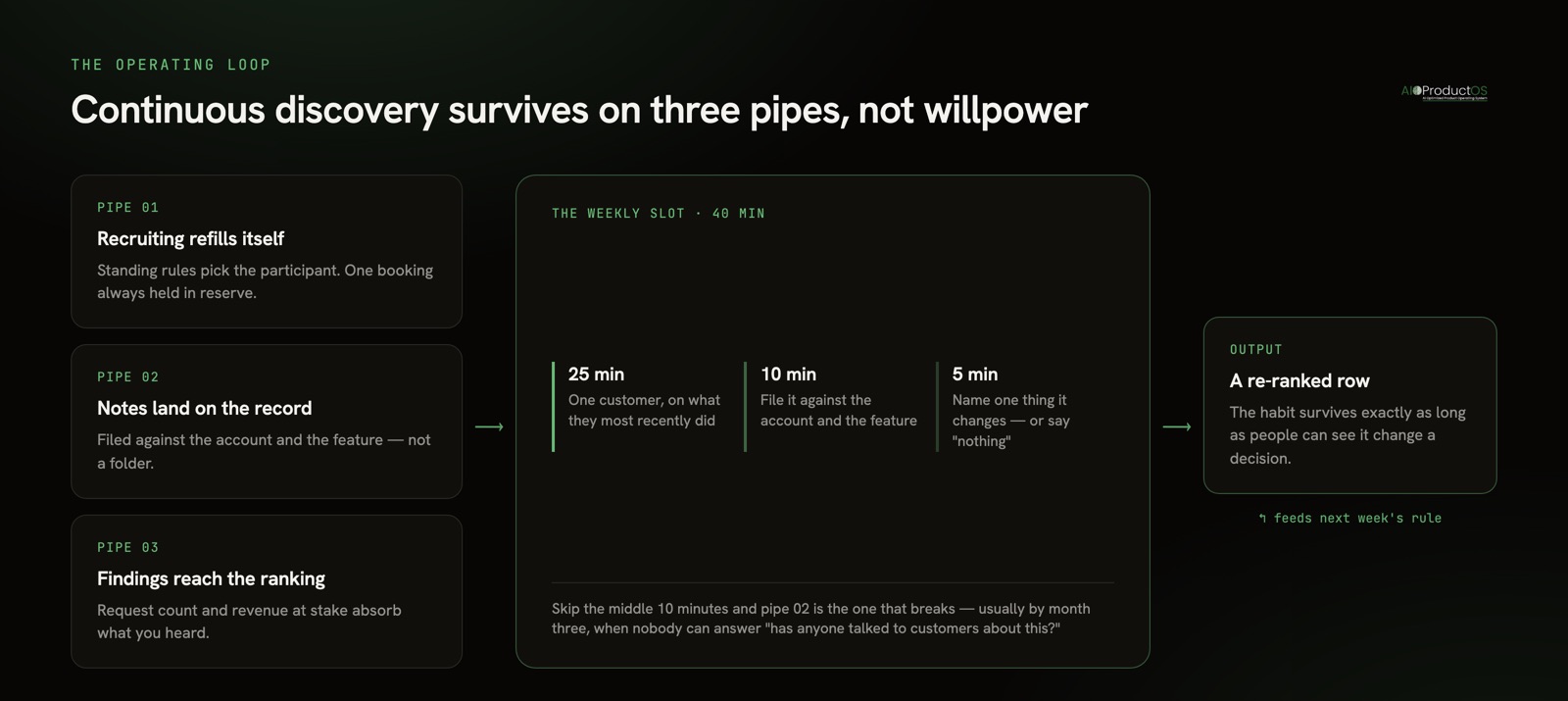
A research function absorbs this invisibly. Take the role away and three jobs become nobody's: refilling the participant pipeline, filing what was said so it can be retrieved by someone who was not in the room, and carrying a finding forward until it changes a ranked decision. Those are the three pipes. The cadence is downstream of all of them, which is why exhorting the team to care more never works.
The timings below are an illustrative composite of how the collapse usually reads, not measured data - but the mapping from symptom to broken pipe is the useful part.
| The symptom | When it usually shows up | The pipe that actually failed | What holds instead |
|---|---|---|---|
| "Nobody's booked for this week" | Week 3-6 | Recruiting has no standing source, so every week is a fresh decision | A rule that picks the participant for you, plus one booking always held in reserve |
| The slot becomes a status meeting | Week 6-10 | The slot has no default content, so the loudest agenda wins it | A fixed shape for the 45 minutes and one named person who runs it |
| "We keep hearing the same thing and nothing changes" | Month 2-3 | Findings never reach a ranked decision, so the habit stops paying rent | Each finding attached to the feature and account it should change |
| "Has anyone talked to customers about X?" and nobody can answer | Month 3+ | Notes landed in a folder rather than on the customer record | One destination, searchable by account and by feature |
Pipe 1: the participant list refills itself
The single highest-leverage change is removing the weekly decision about who to talk to. Decision fatigue is what empties the calendar, not reluctance.
Replace the decision with two or three standing rules that produce a name without anyone thinking. Rules that work well: one account that opened a support thread about the area you are currently building in; one account that churned or downgraded last month; one that crossed activation in the last two weeks. Rotate through them. Recruit one week ahead rather than for the current week, and keep a second booking in flight at all times, because the recruiting pipeline has to survive a no-show without the slot going dark. A dark slot is what teaches everyone the practice does not work.
The ask itself is a solved problem - invite wording, opening framing and the awkward moments are in customer interviews without the awkwardness. One thing worth flagging: sample-size thinking belongs to rounds, not to a cadence. You are not trying to reach saturation this week. When a decision does need a bounded round, how many customer interviews are enough covers where to stop.
What actually goes in the slot
A weekly slot with no default content gets colonised by whatever is urgent. Give it a fixed shape and it survives a busy week.
Roughly: 25 minutes with one customer, focused on the thing they most recently did rather than what they would like; 10 minutes immediately afterward, filing what was said against the account and the feature it bears on; and five minutes naming one thing it changes - an assumption you now doubt, a row you would rank differently, or nothing, said out loud. "Nothing this week" is a legitimate output, and saying it protects the practice from the pressure to manufacture an insight.
The trio question resolves itself here: whoever will act on the finding should hear it first-hand. A single attendee is workable; a rotating cast of six is not.
Pipe 2: the notes land on the customer, not in a folder
"Write it up" is where most continuous discovery quietly ends. A summary in a doc is findable by the person who wrote it, for about a month. It is not findable by the PM who joins in October and asks whether anyone has looked at onboarding.
Landing means the finding sits on the record it is about: the account that said it, the feature it bears on, and the revenue attached to that account. That is what makes "we already know this, here are the six conversations" a view rather than an archaeology project - and it is what lets a weekly note compound instead of expire. Note also that what you file is evidence about a problem, not a request; the difference is the whole subject of what customers need versus what they say.
This is the design Insights starts from in AIOProductOS: one feedback feed across reviews, requests, surveys, designs and support, with each item linked to the feature it informs and the account it came from, so a Thursday call quote sits beside that customer's plan and revenue on the same record. If you are choosing where the weekly note should go, our guide to the best feedback tools compares the honest options, including the ones that cost nothing.
Pipe 3: the finding has to change a ranked decision
The habit survives for exactly as long as people can see it changing something. If a quarter of weekly conversations goes by and the order of the backlog is identical, the slot is a ritual, and a busy month will delete it - correctly.
So the last pipe is the shortest and the most often missing: a path from a filed finding to the ranking. Concretely, that means the thing a feature ranks on can absorb what you heard. Features that rank by request count and the revenue at stake behind those requests will move when six conversations name the same problem; features ranked by whoever argued hardest in the meeting will not. The mechanics of the ranking side are in ranking a roadmap by revenue, and the discipline of turning a filed signal into a shipped change is covered in turning customer feedback into product changes.
The corollary is uncomfortable and worth stating: continuous discovery produces more reasons to say no than to say yes. If the weekly slot only ever adds rows, the pipe is leaking in the other direction - see how to say no to feature requests.
When a weekly cadence is the wrong call
Weekly is a good default, not a law, and defending it in the wrong context is how teams end up performing discovery instead of doing it.
When you have three customers. Pre-product-market-fit you are not sampling anyone - you are already in daily contact with everyone who uses the thing. A formal slot adds ceremony to conversations already happening. Keep the filing discipline, drop the cadence.
When a call takes six weeks to book. In deep enterprise, and in regulated or clinical contexts, access runs through procurement, a gatekeeper, or a consent process with its own clock. A weekly slot against that reality guarantees empty weeks, and empty weeks are how a team learns the practice does not work. A fortnightly rhythm with a genuine participant is worth more than a weekly one filled by an account manager standing in for a customer.
When the team is genuinely underwater. During an incident, a migration deadline, or a compliance push, committing to fortnightly out loud is more honest than defending a weekly slot everyone will miss. The failure mode to avoid is the unannounced lapse, because a cadence nobody formally paused is a cadence nobody formally restarts.
When the question is quantitative. "How many accounts hit this?" is not a discovery conversation, and five calls will hand you five anecdotes with no way to weigh them. That is an analytics query or a survey - the split is in surveys versus interviews.
Build the pipes, then set the cadence
Every guide on page one tells you the interval. The interval is the easy part, and it is not what breaks. What breaks is a participant list that needs a decision every week, notes nobody looks at, and a finding that never reaches the thing it should have re-ranked. Fix those three and the rhythm mostly runs itself.
Want the Thursday conversation to still be findable in November? See how Insights in AIOProductOS keeps every request, survey reply, support thread and call note on the same customer record as the plan, the revenue, and the feature it should change.