Free vs paid product management tools: which is actually worth it?
Free product management tools are worth it when you are early, small, and running fewer than three of them. Paid becomes worth it the moment "free" quietly turns into a stack of disconnected apps - because at that point the price you pay is no longer zero, it is context-switching, seat caps, and data you cannot easily get back out.
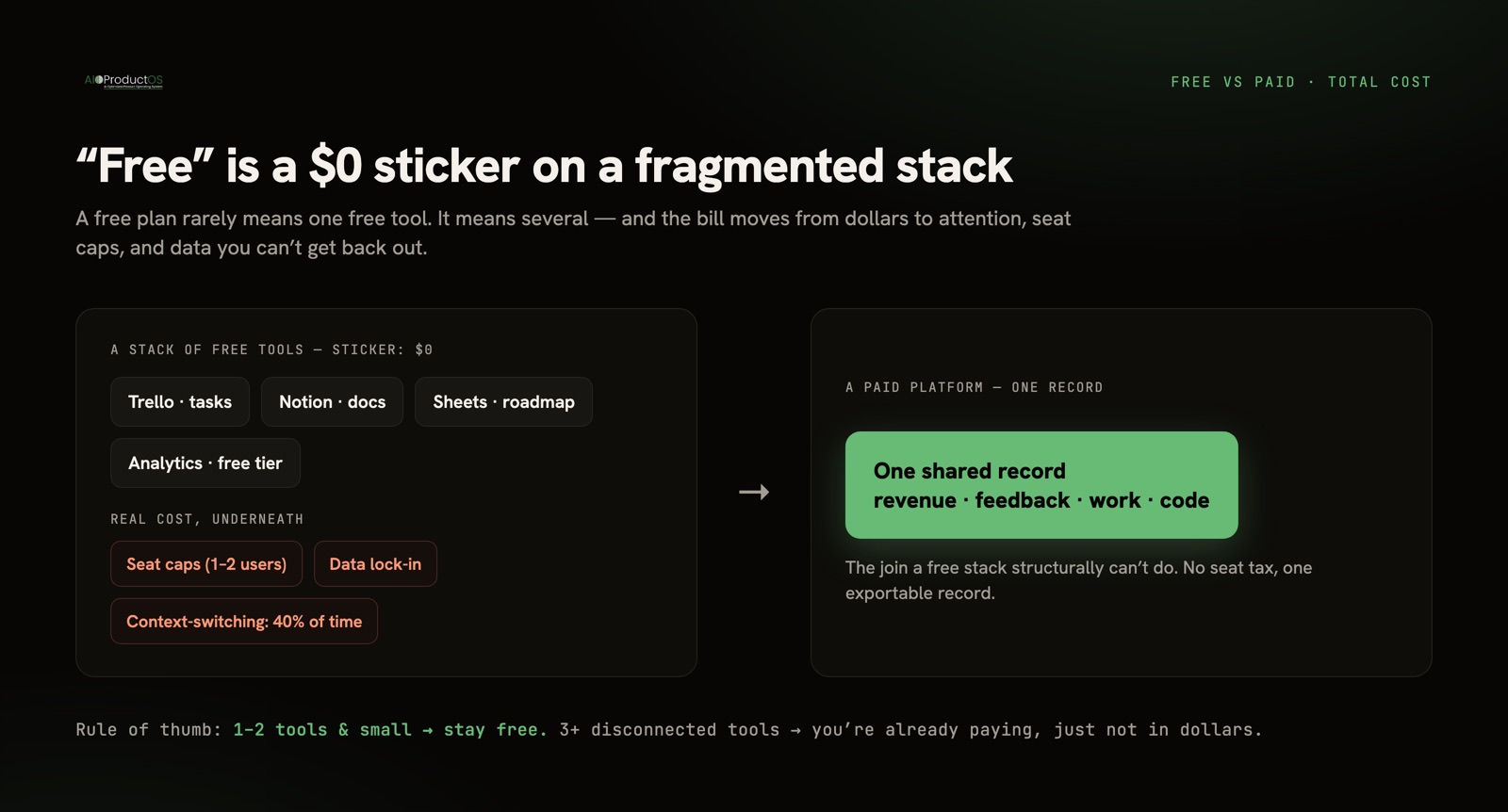
Most page-one guides to this question hand you a list of free tools and stop. They skip the part that actually decides the answer: "free" almost never means one free tool. It means Trello for tasks, a Notion workspace for docs, a Google Sheet for the roadmap, and a free analytics tier bolted on the side. Four tools, four logins, four sources of truth that do not agree with each other. That is the real comparison - not free vs paid, but one connected tool vs a sprawl of free ones. You can look at the connected side before you decide: the demo workspace is the real product, read-only, no account.
The hidden cost of "free"
Free tiers are real, and vendors are not being dishonest by offering them. But the sticker price is the smallest number in the decision. Three costs sit underneath it.
Seat caps. Free-forever plans almost always cap users, often at one or two, and gate integrations and history. The moment your third teammate needs in, or you want to keep more than a month of activity, you are on a paid tier anyway - usually priced per seat, which climbs with every hire.
Data lock-in. Free tools are where your backlog, your notes, and your customer feedback accumulate. Getting that back out cleanly, with the structure intact, is rarely a one-click export. The longer you stay, the higher the switching cost, which is precisely why the free tier exists.
The switching tax. This is the one the listicles miss. When your tools do not talk to each other, the cost lands on your team's attention. Context-switching between disconnected apps carries an estimated $450B/yr productivity cost, with the average employee losing 40% of productive time to it. A free stack manufactures that switching by design - every tool is its own island.
The sprawl compounds at the company level too. The average company already runs 101 SaaS apps and wastes roughly $21M a year on licenses nobody uses. Every "just add one more free tool" decision is a small deposit into that pile.
Free vs paid: what you actually get
Here is the honest side-by-side. Note that the "paid" column splits into two very different things - a single paid tool, and a paid platform that replaces the stack.
| What you're comparing | Free tools (a stack) | Single paid tool | Paid platform (one record) |
|---|---|---|---|
| Sticker price | $0 | ~$7-20 / user / mo | Flat by tier |
| Seats | Capped, often 1-2 | Per-seat, scales with hires | Included, no seat tax |
| Data lock-in | High, spread across apps | Medium, one silo | Low, one exportable record |
| Integrations / history | Gated on free tier | Usually included | Native - the join is the point |
| Real total cost | Context-switching + migration | Predictable but per-head | Predictable, one bill |
The per-seat math matters because it is where "cheap paid tools" stop being cheap. Jira runs $7.91 to $14.54 per user per month, Linear $10 to $16, Monday $9 to $19 a seat with a three-seat minimum, Notion $10 to $20 per member. Stack three of those for a ten-person team and you are paying for thirty-plus seats across tools that still do not share a customer record. We broke down one of these in detail in how much Jira actually costs, and the pattern holds across the category.
When free is the right call
Paid is not the answer for everyone, and pretending otherwise would be exactly the kind of marketing this guide is arguing against. Free is genuinely the right call in these cases:
You are pre-product-market-fit. If you are still figuring out whether anyone wants the thing, spend your money on building it, not on operating it. A free Trello board and a Notion doc are plenty.
You are solo or a tiny team. Seat caps do not bite when there is one seat. A single free tool with no integrations is not sprawl - it is focus.
You are running fewer than three tools. The switching tax only shows up when tools multiply. One free tool, or two that you rarely cross-reference, is a coherent setup, not a stack.
It is throwaway validation. For a two-week experiment or a one-off project, migration cost never arrives because you throw the workspace away. Free is optimal by definition.
The tipping point is specific: free stops paying off when you hit a seat cap, when the third disconnected tool joins the stack, or when you need the customer and revenue context that free tools cannot join. For small teams navigating that transition, we go deeper in the best product management tools for small teams.
The real question isn't free vs paid - it's one vs many
Vendor consolidation is happening, and the direction of travel across teams is away from best-of-breed sprawl toward fewer, connected systems. The reason is that a stack of specialized tools carries a maintenance and integration burden that grows faster than the value of any single tool in it. You can read the full argument in our breakdown of the cost of SaaS tool sprawl.
This is the gap a product operating system fills. AIOProductOS is a paid platform - there is no permanent free plan, though every workspace starts with a 7-day free trial, no card required. If you are shortlisting a product management tool with a free trial, the terms that separate vendors are whether a card is required up front and what happens to your workspace when the trial ends. What it does is collapse the job of a stack (tracker, analytics, feedback, roadmap, docs) onto one shared record per customer, so the work in your backlog stays tied to the customer insight and the revenue behind it. It is not a like-for-like swap for any one tool - the value is the join, the thing a free stack structurally cannot do. It replaces the sprawl of Trello, Notion, Google Sheets, and free ClickUp or Jira tiers, not a single best-in-class app.
The billing follows the same logic as the argument: flat by tier, no per-seat metering, AI never credit-metered. Plans start at $199/mo for five members, one product, and every module included, with a 7-day free trial, no card required, on your own data and a 30-day money-back guarantee. You can check the numbers on the pricing page, or estimate what your current stack really costs with the SaaS stack cost calculator before you decide either way.
So: is free worth it? Yes - right up until the point where it isn't, and that point is more predictable than most teams realize. Count your tools. If it is one or two and you are small, stay free and spend the money on your product. If it is three or more and they do not talk to each other, you are already paying - just not in dollars.
For the full landscape of options across both free and paid, start with our pillar guide to the best product management tools.