What is vendor lock-in, and how do you avoid it?
Vendor lock-in is when leaving a tool costs more than staying - because your data, your workflows, or your integrations are trapped inside it. You avoid it by checking one thing before you sign: can you get all your data out, in an open format, on any plan, today? Portability, not vendor count, is the real safeguard.
Most explainers on vendor lock-in are written for cloud infrastructure or contract lawyers. Product teams face a narrower, sharper version of the problem. Your roadmap, your customer feedback, your feature history, your analytics - these live across Jira, Productboard, a feedback tool, an analytics tool, and a spreadsheet nobody admits to. Each one holds a piece of the record, and each one has its own idea of whether you get to take that piece with you.
Why product teams feel lock-in harder than most
The trap starts with sprawl. The average company runs 101 SaaS apps and wastes around $21M a year on licenses nobody uses (Okta, Zylo). Every one of those apps is a small hostage negotiation: your data goes in easily and comes out on the vendor's terms. The more tools you run, the more exit doors you have to check - and the more places a single stuck door can strand a year of work. That sprawl carries its own price tag, which we broke down in what SaaS tool sprawl actually costs.
That is why 68% of tech leaders are consolidating vendors in 2026, and why best-of-breed stacks need 280% more maintenance than a consolidated one. Fewer tools means fewer contracts, fewer integrations to babysit, and fewer export formats to reverse-engineer at 2 a.m. before a migration deadline.
But consolidation is a direction, not a guarantee. Moving from ten tools to one only helps if the one you land on is easier to leave than the ten you left. Otherwise you have traded diffuse lock-in for a single, larger one. Hold that thought; it is the honest part of this post, and below we run the checklist on ourselves against our own portability commitments.
The three places product data gets trapped
- Format. The tool exports, but only to its own proprietary structure - or a PDF, which is a picture of your data, not your data.
- Path. There is no documented, self-serve way to move records out into another system. Getting in is a wizard; getting out is a support ticket.
- Terms. The contract says you own your data, then makes access contingent on an active subscription, so canceling and exporting become mutually exclusive.
Lock-in rarely announces itself. It shows up the week you decide to switch.
The portability checklist: what to demand before you sign
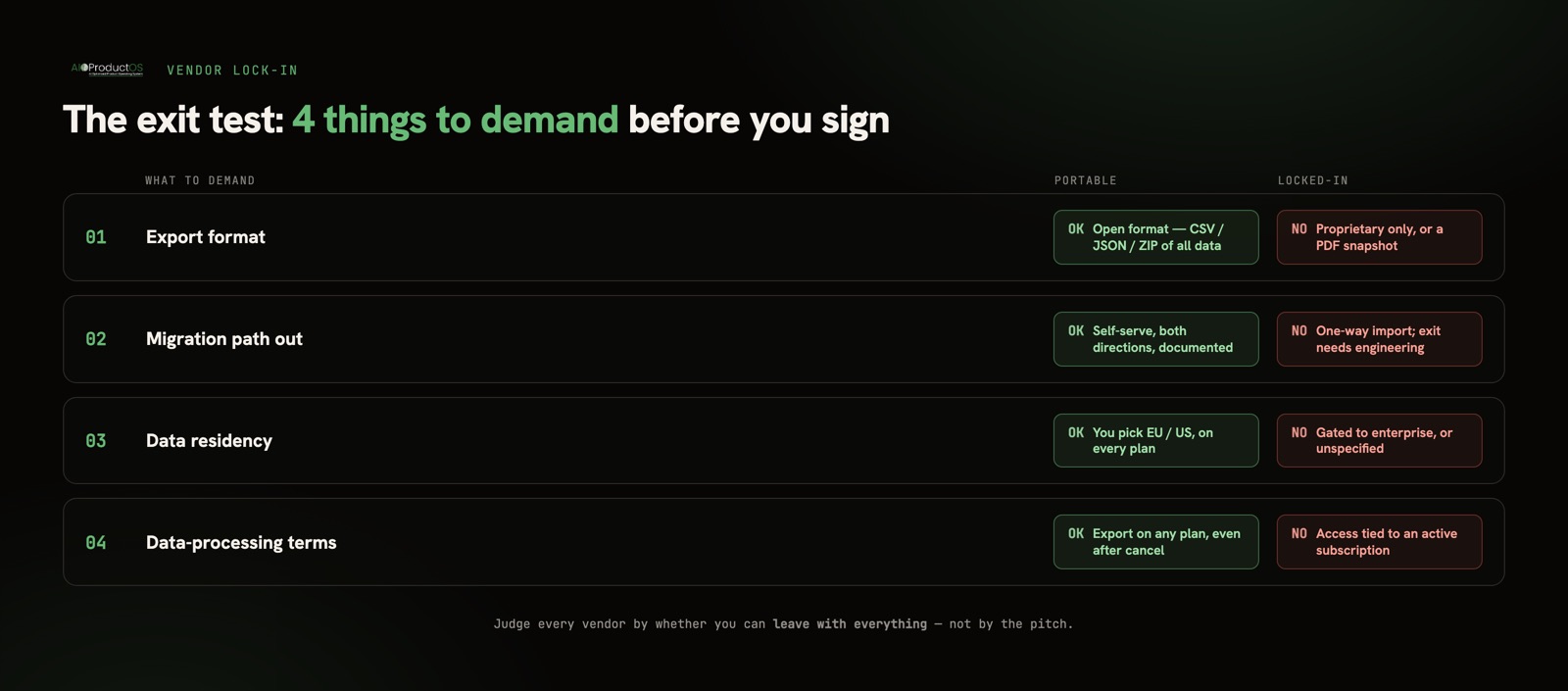
Before you commit any product tool to holding your roadmap and customer record, run it against four questions. Ask for specifics, not reassurance.
| What to demand | Green flag | Red flag |
|---|---|---|
| Export format | Full export in an open format (CSV, JSON, or a ZIP of tables) covering all your data | Proprietary format only, PDF snapshots, or "contact us to export" |
| Migration path out | Documented, self-serve import/export both directions; named target tools | One-way import wizard; no way to leave without engineering |
| Data residency | You pick EU or US, enforced at storage, on every plan | Residency gated to the top enterprise tier, or unspecified |
| Data-processing terms | Export available on any plan and after cancellation; clear DPA | Access tied to an active subscription or locked to renewal |
If a vendor can answer all four with a green flag, lock-in stops being a threat - you can walk whenever the value stops justifying the price. If they dodge even one, you are not buying a tool, you are signing a mortgage on your own data. This is the same math behind per-seat pricing traps: the sticker is one number, the switching cost is another, and the second one is the one that keeps you.
When consolidating is its own kind of lock-in
Here is the part the listicles skip. Moving from ten tools onto one shared spine concentrates your dependency on a single vendor. That is a real trade-off, and pretending otherwise would be dishonest. If that one vendor raises prices, degrades, or disappears, you feel it across your whole workflow at once instead of in one corner of it.
So what makes consolidation safe is not that you now trust one company more. It is that you have a genuine, standing exit - a complete export in an open format and a migration path out, available on every tier, not dangled at renewal. Vendor count is a distraction. The question that actually protects you is: if I wanted to leave next month, could I, with everything, without begging?
There is a practical version of this test, too. Ask for the export before you need it - run a real one during your trial, open the file, and check that the records are actually there and actually readable, not a truncated CSV or a PDF of a dashboard. A vendor that makes you file a support ticket to see your own data in month one will not suddenly become generous the day you try to leave. The behavior you see at the start is the behavior you get at the exit.
Apply that test to us as strictly as to anyone else. A spine that holds your customers, revenue, and roadmap in one place is only worth consolidating onto if you can un-consolidate on your own terms. Judge the exit, not the pitch.
What a real exit looks like
We built AIOProductOS to pass its own checklist. "Never: data lock-in" is a line on our public trust page, and it means specific, shipped things:
- A full-org GDPR export on every tier - roughly 65 tables of your data as a ZIP, not a summary and not a screenshot. It is not gated to Enterprise, and it does not vanish when you cancel.
- A migration path in both directions. Getting in is a 3-step migration from 12 sources: Trello, Asana, Monday, ClickUp, Shortcut, Productboard, Canny, Notion, Linear, Jira, PostHog, and plain CSV. The connector token is used once and never stored, and the import is free on every plan. The open export is the way back out.
- EU or US data residency, enforced at ingest - you choose, on every plan. Most competitors reserve residency for their top tier.
- BYOK envelope encryption (a per-org key, AES-256-GCM) and no AI training on your data, so what you put in stays yours in substance, not just in the terms of service.
- Roles enforced in the database with row-level security, not painted on in the UI - access is a property of the data, not a screen you might route around.
None of that requires you to like us forever. It requires that leaving is a button, not a battle. The 100+ live connectors work the same way - they move data through the spine on real sync, so the record stays reachable across the tools you keep.
Portability is the whole point. Run the checklist on every tool you already pay for. The ones that pass, keep. The ones that stall on "export" are telling you exactly how the relationship ends - while you still have time to choose otherwise.
Ready to test the exit before you commit? Our migration page shows exactly how your data comes in, and how it goes back out.