Most guides to feature ROI start the same way: estimate how many users the feature will reach, guess how much more they will use the product, put a dollar value on that usage, and subtract the cost of building it. The structure is fine. The problem is the first three inputs, which are all forecasts the product manager invents. For a feature that customers actually requested, you do not need to invent the benefit side. You can read it from the accounts that asked and what they pay.
How do you calculate the ROI of a feature?
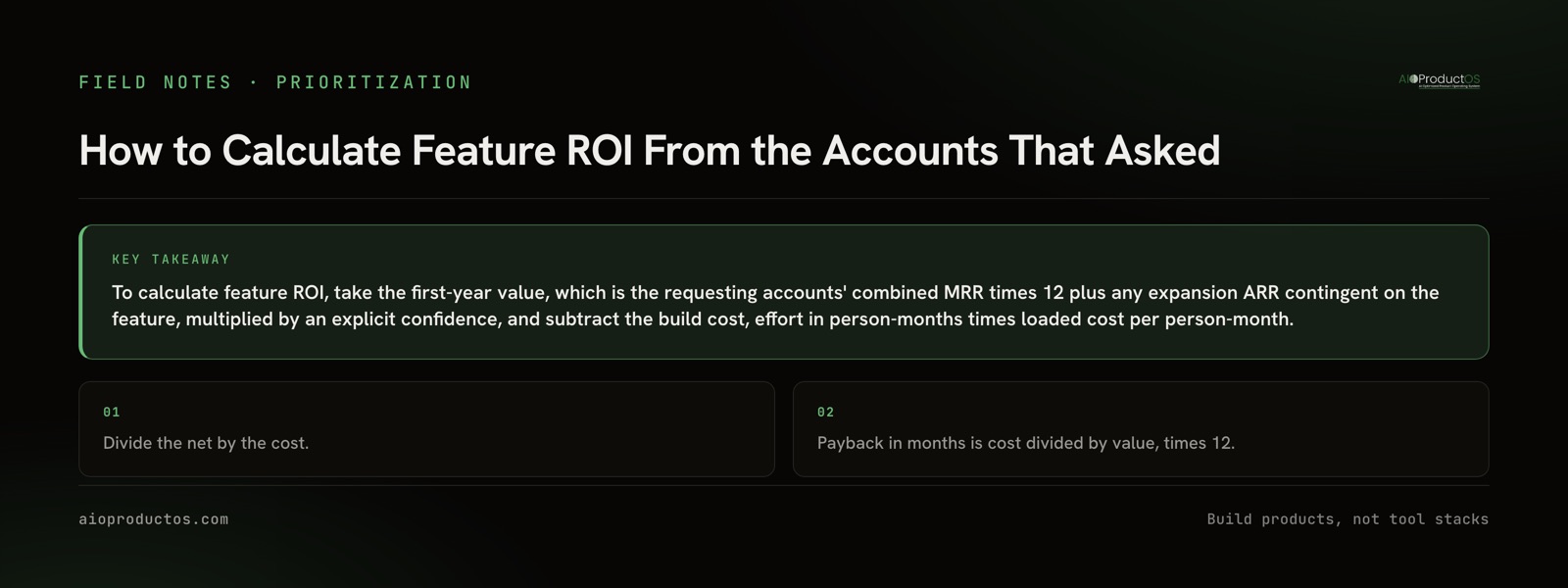
Estimate first-year value as the requesting accounts' combined MRR times 12, plus any expansion ARR that is contingent on the feature, multiplied by an explicit confidence. Subtract the build cost: effort in person-months times loaded cost per person-month. ROI is that net divided by cost; payback in months is cost divided by value, times 12.
Written out:
- First-year value = (requesting accounts' MRR x 12 + contingent expansion ARR) x confidence
- Build cost = effort (person-months) x loaded cost per person-month
- ROI = (value - cost) / cost
- Payback (months) = cost / value x 12
This is the formula behind our free feature-request ROI calculator, and the rest of this post covers where each number should come from, how each one gets bent, and what to do after the feature ships.
Why a usage forecast is the wrong starting point
A reach-times-usage model asks you to predict behavior that has not happened yet. Every term is a guess, and the guesses multiply, so a small optimism in each produces a large optimism in the result. Nobody checks it afterward because the forecast was never tied to anything you could look up.
A requested feature is different. Someone asked. That request came from a specific account, that account has a subscription, and the subscription has a price. The retention value is the revenue of the accounts whose continued use depends, at least partly, on the gap being closed. The expansion value is any upgrade or seat growth that an account has made conditional on it. Both are observed, not projected. You still apply judgment, but you apply it once, in one visible place: the confidence term.
That is the second thing most models skip. They either leave confidence out, which treats every requester as certain to churn without the feature, or they bury it inside the reach estimate where nobody can argue with it. Put it on its own line. A request where three named accounts said they will not renew without it deserves a different number from a request where those same accounts mentioned it once on a call.
For ranking a whole backlog this way rather than pricing one request, ranking your roadmap by revenue covers the four revenue pots and the full sort.
The five inputs, and how each one goes wrong
| Input | Where the number comes from | How it usually gets bent |
|---|---|---|
| Requesting accounts' MRR | Billing data joined to the accounts that made the request | Inflated by counting accounts that would stay anyway; understated when requests are logged without the account attached |
| Contingent expansion ARR | Open upgrades or seat growth an account has tied to the feature | Inflated by counting general upsell hopes as contingent; understated when sales notes never reach the product team |
| Confidence | The strength of the evidence behind each request | Inflated by defaulting to 80-90% out of habit; understated when a renewal explicitly depends on it |
| Effort (person-months) | Engineering estimate covering design, build, QA and review | Understated by estimating only coding time |
| Loaded cost per person-month | Finance: salary plus benefits, taxes, tooling and overhead | Understated by using salary alone |
The first row is where most of the error lives, and the calculator page says so directly: retained revenue overstates the case when the accounts would stay anyway. Confidence is how you correct for that, so set it from what the accounts actually said, not from how much you want the feature.
A worked example
The figures below are a hypothetical example, not data from any real company.
Five accounts have requested a feature. Their combined MRR is $6,000, so the retention value at stake is $72,000 a year. One of them has said it will add seats worth $18,000 ARR once the feature exists. Two of the five have tied it to their renewal; the other three asked for it without conditions. The PM sets confidence at 60%.
Engineering estimates 2.5 person-months, including design and QA. Finance puts the loaded cost at $15,000 per person-month.
- Value: ($72,000 + $18,000) x 0.6 = $54,000
- Cost: 2.5 x $15,000 = $37,500
- ROI: ($54,000 - $37,500) / $37,500 = 44%
- Payback: $37,500 / $54,000 x 12 = 8.3 months
Now drop confidence to 30%, which is what you would pick if none of the five had tied the feature to a renewal. Value falls to $27,000, below the cost. ROI becomes -28% and payback stretches to 16.7 months, past the first year. Same accounts, same feature, opposite answer. That is the point of keeping confidence explicit: the disagreement is about one number everyone can see, not about a forecast nobody can trace.
If you also track acquisition economics, the same months-to-repay logic shows up in CAC payback, and the same caveat applies: the payback month only matters if the accounts survive to it.
Ask an AI assistant for the inputs
The slow part of this calculation is not the arithmetic. It is assembling the list of requesting accounts and their revenue, because feedback usually lives in one tool and billing in another. If an AI assistant is connected to a source that holds both, ask it directly:
"Which accounts requested this feature, what is their combined MRR, and which of them tied it to a renewal or an expansion?"
Then ask it to list each account with its MRR, so you can check the total rather than trust it. AIOProductOS exposes its product data over an MCP server that any MCP client can connect to, and started without a token, the local server runs a read-only demo against a seeded showcase workspace, so you can try the question and verify it yourself before connecting your own data. In the product, Insights keeps feedback linked to features and accounts, which is what makes the MRR figure a lookup instead of a spreadsheet exercise.
How do you measure ROI after a feature ships?
Almost nobody does this, which is why ROI estimates never improve. Fix it at decision time, not after launch. When you approve the feature, write down three things next to the estimate.
A check date. Pick the first point at which the outcome is readable, usually the next renewal date of the requesting accounts or a fixed window such as 90 days after ship for expansion.
A success condition. State it in the same terms as the estimate. For the example above: the two renewal-tied accounts renew, and the $18,000 seat expansion is booked by the check date.
The accounts to read. List the requesting accounts by name. On the check date, read their renewal, expansion and contraction, and compare the booked value to the $54,000 estimate.
If the estimate was high, the confidence was wrong, and you now know by how much. Do that for a few releases and your confidence settings start reflecting your actual hit rate instead of habit. Be honest about what this read can show: renewals have many causes, so a renewal after ship is consistent with the feature mattering, not proof of it. AIOProductOS attaches a verdict to every shipped feature on its task card, covering adoption, MRR adopted and retention lift, and states plainly that the lift is correlational unless a declared A/B test supplies a measured one.
When feature ROI is the wrong lens
The formula counts revenue-shaped value and nothing else. That is deliberate, and it means some of your most important work will score badly.
Platform and infrastructure work. A migration or a reliability push has no requesting accounts, so it scores zero. Fund it as a fixed share of capacity rather than forcing a number onto it.
Compliance and security. A certification an enterprise segment requires may have no single requester today but gates every future deal in that segment. Treat it as a cost of being in the market.
Bets with no requesters yet. A new-segment feature is supposed to be something current customers are not asking for. ROI will show what the bet costs against today's revenue; it should not veto it.
Small accounts that signal a segment. Three small accounts asking for the same thing may represent a segment you want to grow into. Their MRR understates the case. Raise it as a strategic call, separately, instead of inflating confidence to make the number work.
For comparing requests against each other with effort and time pressure in the mix, RICE vs WSJF vs value-effort covers which scoring model fits which decision.
Price the request, then check it
Feature ROI earns its keep when the benefit side comes from accounts you can name, the confidence sits on its own line, and the check date is written down before the work starts. Put the numbers for your next request into the feature-request ROI calculator and save the result next to the success condition, so you can compare the two on the check date.