Most product ops maturity models are a ladder of adjectives: ad hoc, repeatable, defined, managed, optimized. You read the descriptions, nod at the one that sounds like your team, and learn nothing you can act on on Monday. The ladder rates how mature you feel. It does not tell you which fix comes next.
This post uses a different axis. It scores four joins between the places product information lives, because those joins are what product ops actually delivers.
What is a product ops maturity model?
A product ops maturity model is a scale that rates how reliably a team's product decisions run on joined evidence instead of memory. The version worth using scores concrete joins - account to request, request to ranking, ranking to delivery, delivery to outcome - and names the next fix for each stage, rather than describing generic levels of process.
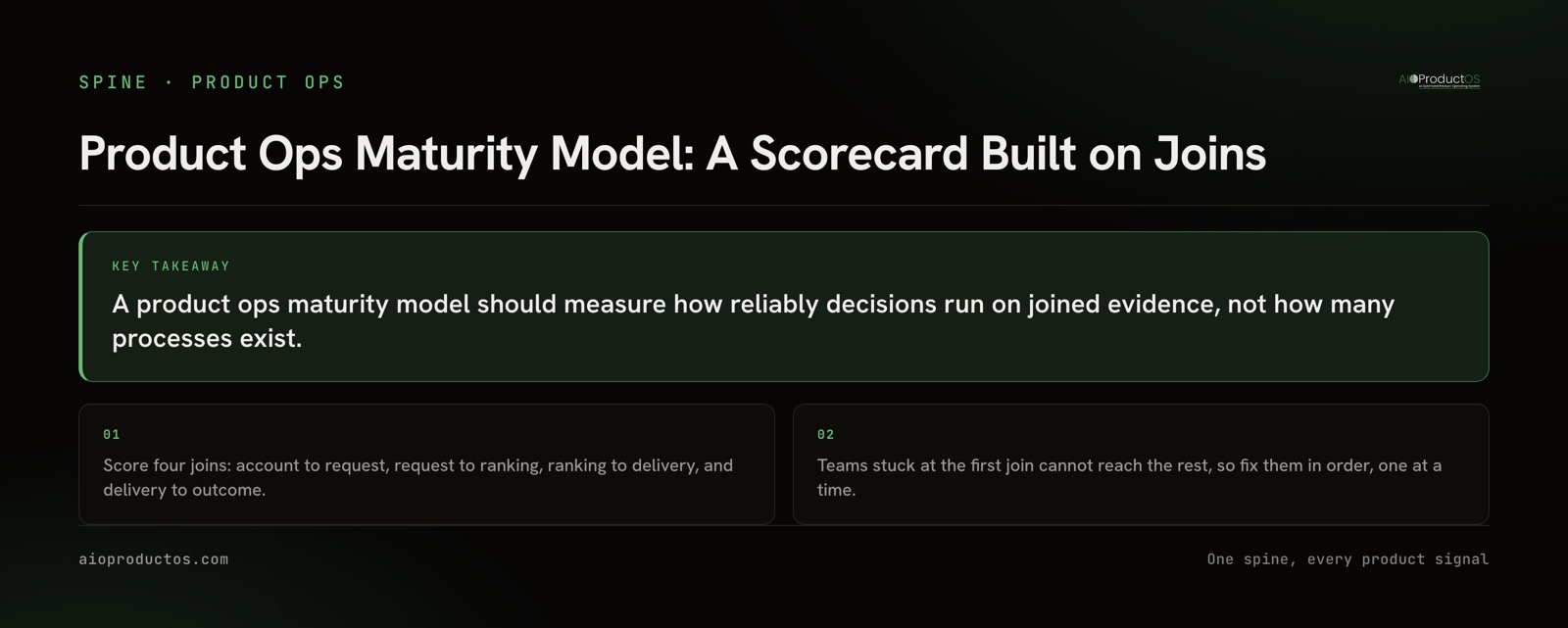
The reason to score joins is practical. A team can have a documented intake process, a planning ritual and a decision log, and still answer "which paying customers asked for this?" by messaging three people. The process exists. The join does not. Nothing downstream of a missing join can be trusted, which is why the order of fixes matters more than the total score. We covered the tool side of this in Product Operations Tools: Choose by Job, Not by Category; this post is the measurement side.
The four joins and what each stage looks like
| Join | Ad hoc | Connected by hand | Computed | Closed loop |
|---|---|---|---|---|
| 1. Account to request | Feedback is anonymous or in someone's notes | Someone tags accounts manually | Requests carry the account automatically | Each request shows the account's plan and revenue |
| 2. Request to ranking | Loudest voice or newest request wins | A scoring framework with estimated inputs | Scores fed by real request counts and revenue | Ranking is re-run when the underlying data changes |
| 3. Ranking to delivery | A ticket is just a ticket | A link back to the request, sometimes | The customer context travels with the work | Engineering sees who a task is for without asking |
| 4. Delivery to outcome | Shipped means done | Occasional checks on flagship features | Requesting accounts are checked after release | Outcomes feed the next ranking |
Read each row left to right. The cells are deliberately about what a person can observe, not about intentions. If you cannot tell which column you are in by looking, the answer is the left one.
Join 1: account to request
This is the base of everything. A quote without an account is an anecdote; a quote with the account and what it pays is evidence. Teams at the first stage usually have plenty of feedback and no way to weigh it. The fix is not a better survey. It is making the account a required field on every piece of feedback, ideally filled by the system rather than typed.
Join 2: request to ranking
Frameworks such as RICE are fine, but a score is only as honest as its inputs. When "reach" is a guess, the framework launders opinion into a number. The stage change is feeding it computed counts: how many accounts asked, and what those accounts pay. We walk through that in Rank Your Roadmap by Revenue.
Join 3: ranking to delivery
Work leaves the ranking and enters the tracker, and the reason usually does not travel with it. Six weeks later an engineer is asking a PM why a task exists. At the connected stage the ticket links back to the request. At the computed stage the context rides on the card without anyone adding it.
Join 4: delivery to outcome
The loop closes only when someone checks, after release, whether the accounts that asked actually adopted the feature. Most teams stop at "shipped". That is not a failure of discipline; it is that the requesting accounts are no longer attached to the work by the time it ships. Join 1 is the prerequisite for join 4.
How to score yourself in ten minutes
Take each join and answer one question with a stopwatch rather than an opinion.
- Pick a feature from last quarter. How long does it take to list the accounts that asked for it and what each pays? "Hours with a spreadsheet" is the connected-by-hand column. "One query" is computed.
- Look at your current top five backlog items. Can you trace each to a count of requesting accounts? If the answer is a feeling, you are at the left.
- Open three in-progress tickets. Can an engineer see who they are for without asking?
- Name one shipped feature and show whether the requesting accounts used it.
Score each answer from zero (no) to three (yes, without effort), then map the total to a band. The product-ops maturity assessment does exactly this in the browser, with no signup: scored questions across the four joins, four bands, and a plain-English read of what each band means. It runs client-side, so nothing you answer leaves the page.
What to fix first
Fix the lowest join, not the one that feels most interesting. Teams love to start at join 2, because ranking frameworks are fun. But a framework fed by guesses still produces guesses.
A sensible order for most teams:
- If join 1 is manual, put the account on every feedback record before anything else. That single change makes joins 2 and 4 possible.
- If join 1 is computed but join 2 is estimated, replace typed inputs with counts. Revenue next to request volume ends most prioritization arguments faster than any framework.
- If joins 1 and 2 are solid, attach context to delivery, then close the loop after release.
Each step is small. The compounding comes from the joins being cumulative: a team with join 1 computed is cheap to move up a band, and a team without it cannot move at all.
Where maturity scoring misleads
Be honest about what a scorecard like this cannot see.
It rewards instrumentation, not judgment. A team can score highly on joined data and still pick the wrong problems. Evidence-led is not the same as right. The scorecard measures whether decisions can be checked, not whether they are good.
Small teams may not need the top band. If four people sit in one room and everyone knows every customer by name, the cost of manual joins is low. The score matters more as the number of accounts and the number of people between a request and a release grow. Climbing a band has a price in tooling and attention, and for a very small team it can exceed the benefit.
Tools do not create joins by themselves. Buying a platform does not move you up a band if the account field stays optional and nobody reads the status back. A multi-tool stack can also reach a high band, if someone owns the glue. The point is that the glue exists and is owned, not that there is one product. The cost side of that choice is in The Real Cost of a Product Tool Stack.
Self-scores skew generous. People remember the one time they did something properly. Use the stopwatch questions, and ask a second person to score separately.
Letting an assistant do the checking
The four stopwatch questions are the kind an AI assistant can answer if it can read your product data. AIOProductOS exposes its product spine over MCP, so a connected client can be asked which accounts requested a given feature, what they pay, and what is attached to the related task. Local setup is one command, npx -y @aioproductoscom/mcp@latest, and the MCP page lists what it exposes. Without an account, the local server runs in demo mode against a seeded showcase workspace, so you can try the same questions on sample data. Whatever the assistant returns, verify it yourself against the source record before you trust a band: a model that cannot show its join should be treated as guessing.
If you want the same check on other tools, the pattern in Connect Claude to Jira and Linear over MCP applies, with the caveat that each tool's MCP sees only its own silo.
Start with the free product-ops maturity assessment, note your lowest join, and fix only that one this quarter.