Every roadmap template you can download is accurate on the day you fill it in. The failure comes later. By week three, two rows have quietly changed meaning, one is being built for a reason nobody can name any more, and the item that got cut is missing entirely - so the same argument gets relitigated next month. The grid was never the problem. The problem is that a roadmap row is a claim, and claims decay unless something forces them to be re-checked.
What should a product roadmap template include?
A usable product roadmap template has five columns, not three: the item, its horizon or date, the evidence that justified it, the owner, and the signal that will say whether it worked. Most templates ship only the first two. The other three are what keep the roadmap honest once reality starts moving.
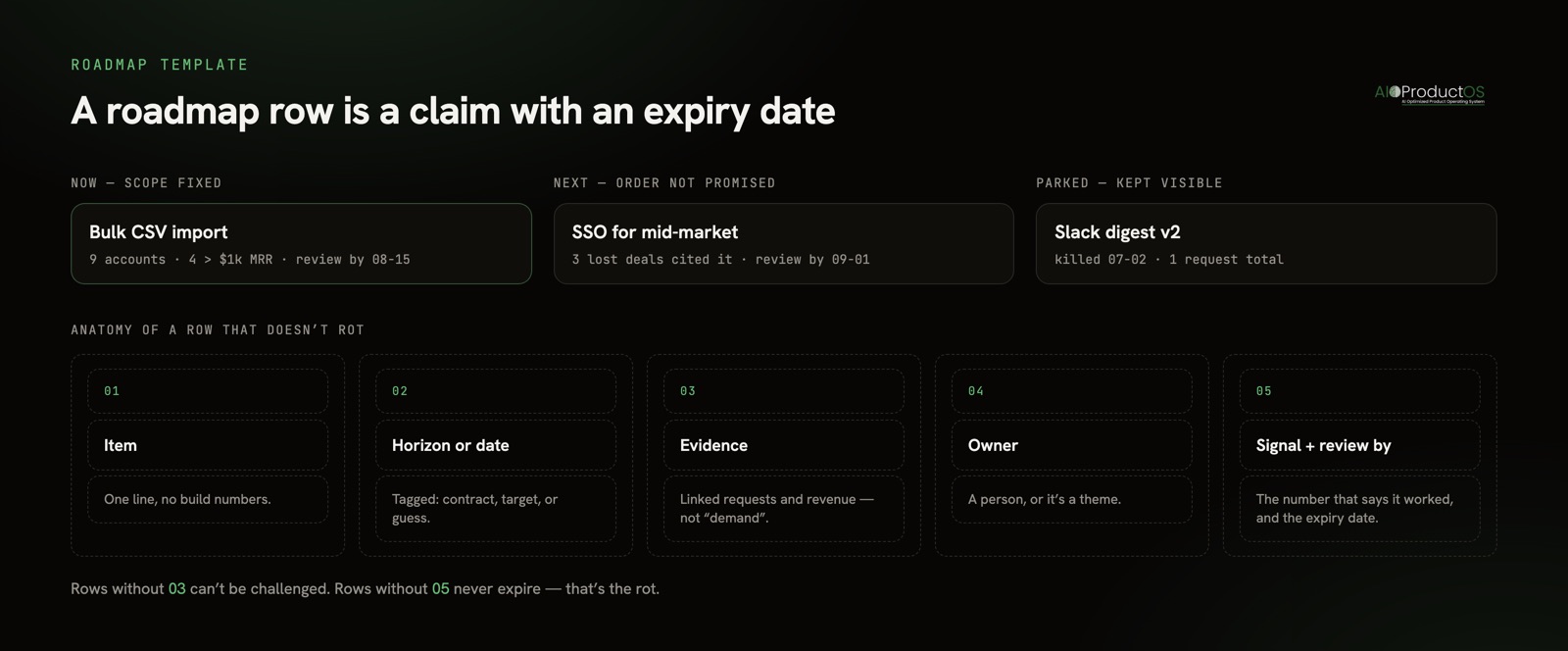
Evidence is the column that does the most work and gets dropped the most often. "9 accounts asked, 4 of them above $1k MRR" survives a leadership challenge; "high customer demand" does not. The signal column matters for the opposite reason - it's the only thing that turns a shipped row into a lesson rather than a line item that silently disappears. If you want the process for getting from raw input to a first draft, that's covered separately in how to write a product roadmap. This post is the artefact: three templates you can paste straight into a doc, each with the rule that keeps it true.
Template 1: Now / Next / Later
The default for teams shipping continuously. Paste this whole block:
## Now - in flight, scope is fixed
| Item | Why now (evidence) | Owner | Signal it worked | Review by |
|---|---|---|---|---|
| Bulk CSV import | 9 accounts asked, 4 >$1k MRR - link to requests | A. Rivera | ≥40% of new orgs import in week 1 | 2026-08-15 |
| | | | | |

## Next - queued, scope is rough, order is not promised
| Item | Why we believe it | Owner | What would change our mind | Review by |
|---|---|---|---|---|
| SSO for mid-market | 3 lost deals cited it in call notes | unassigned | Two more losses that don't mention it | 2026-09-01 |

## Later - direction only, no scope, no owner
| Theme | The bet | Evidence we're still missing |
|---|---|---|
| Mobile approvals | Managers approve away from a desk | We have no mobile session data |

## Parked / killed - kept visible on purpose
| Item | Date | Why it left the roadmap |
|---|---|---|
| Slack digest v2 | 2026-07-02 | Superseded by the weekly memo; 1 request total |
The rule that stops it rotting: every row carries a Review by date, and a row that passes its date without an update moves to Parked - it does not sit in Next indefinitely. The Parked section is the part people delete and then regret, because it's the only record of decisions already made.
Template 2: outcome-based (objective → bet → signal)
For teams accountable to a number, and for exec audiences who want to know what changes rather than what ships.
# Objective: cut time-to-first-value from 9 days to 3
Owner: Head of Product · Horizon: Q3 · Baseline measured 2026-07-01

## Bet 1 - guided import replaces the empty state
- Evidence: <your number> of trials never import anything (product analytics, June)
- Hypothesis: new orgs that land in a guided import activate in week 1
- Signal: activation (≥1 import + ≥1 board) within 7 days, from <baseline> to <target>
- Counter-signal: tickets tagged "import" rise more than 20%
- Decision date: 2026-09-15 → keep / iterate / kill
- Status: shipped 2026-08-04 · reading <current> · partial

## Bet 2 - <next bet under the same objective>
- Evidence:
- Hypothesis:
- Signal:
- Counter-signal:
- Decision date:
- Status: not started
The rule: a bet without a decision date is a wish. On the decision date somebody writes keep, iterate, or kill in the open, next to the reading. The counter-signal line is what makes the review honest - you name in advance the result that would make you stop, so a bad outcome can't be reframed after the fact.
Template 3: quarterly / timeline
For teams who genuinely owe someone a date. The columns exist to stop every date on the page reading as equally firm.
| Item | Commitment type | Date | Who we owe | Driver / evidence | Confidence | Last confirmed |
|---|---|---|---|---|---|---|
| SOC 2 evidence export | Contractual | 2026-10-01 | 2 enterprise accounts | Signed MSA §7.3 | High | 2026-07-28 |
| Billing migration | Internal target | 2026-09-30 | Finance | Vendor contract ends 2026-12-31 | Medium | 2026-07-28 |
| Mobile beta | Directional | Q4 | Nobody yet | 3 interviews, no usage data | Low - do not quote externally | 2026-07-14 |
The rule: Commitment type and Last confirmed are not optional. One tags whether a date is a contract, a target, or a guess; the other shows how stale that judgement is. A date last confirmed six weeks ago should look different on the page from one confirmed yesterday.
Which template fits which situation
| Template | Who it's for | What it hides | Update cadence |
|---|---|---|---|
| Now / Next / Later | Continuous delivery; internal direction and customer-facing "what's coming" | Real dates when you actually owe one; relative cost | Now weekly · Next biweekly · Later monthly |
| Outcome-based | Teams judged on a metric; exec and board audiences | The features themselves - delivery can't pick it up as-is | Per-bet decision date, plus a monthly objective read |
| Quarterly / timeline | Contractual, regulated, hardware, cross-team handoffs | Uncertainty - every date reads equally firm unless tagged | Re-confirm every 30 days; update immediately on slip |
The format debate is a genuine decision rather than a matter of taste, and it's argued out in full in Now/Next/Later vs timeline. Most companies run two of these at once: one for the team, one for the people holding them to dates.
The three rules that keep any of them true
Link the evidence, don't remember it. A row that says "customer demand" is unfalsifiable, which means it can't be challenged and can't be de-prioritised. Link the requests, the call notes, the revenue at stake. When you rank by something concrete - request count, MRR behind the ask, a RICE score - the argument moves from opinion to arithmetic. Ranking roadmap items by revenue is the version of this that survives a hostile stakeholder meeting.
Make rows expire. Rot is not caused by change; it's caused by rows that nobody is obliged to look at again. A review-by date on every row converts the quarterly rewrite into a rolling obligation, and the rewrite is what loses your decision history.
Write the verdict where the row lives. Six weeks after shipping, somebody records what actually happened next to the item - adoption, the metric move, or nothing. Without it, the roadmap only ever accumulates; it never learns.
The reason these rules are hard in a document is mechanical, not cultural. The evidence lives in a support inbox, the revenue lives in billing, the verdict lives in analytics, and the roadmap lives in a slide. Okta and Zylo put the average company at 101 SaaS apps, with roughly $21M a year wasted on licences nobody uses - and each of those apps is another place your roadmap's justification can sit where the roadmap can't see it. Gallup's figures, as compiled by TheTab, put the cost of context-switching at around $450B a year, with the average employee losing 40% of productive time to it. Maintaining a roadmap by hand across four tabs is exactly that tax, paid weekly, which is why it stops getting paid by week three.
When a timeline roadmap is the right call
The honest counter-case, because "dates are waterfall thinking" is advice that gets teams into trouble.
If you have signed a contract with a go-live date, the date is the commitment and hiding it inside "Next" is withholding, not humility. The same holds for regulated launches with a filing window, hardware with tooling lead times, and any cross-team handoff where one team cannot start until another finishes - that team is planning headcount against your date whether you print it or not. Board and investor communication is a fourth case: a board plans capital around specific quarters, and a horizon-based roadmap gives them nothing to plan against.
There is also a plain organisational case. Some companies genuinely run on dates - annual customer conferences, seasonal retail cycles, academic terms. Telling them to adopt Now/Next/Later because it's the modern format is imposing a process on a business that has a real calendar. The correct move there is Template 3 with the commitment-type column doing the work: the contractual dates stay firm and visible, the directional ones are labelled as guesses, and nobody confuses the two.
Where a pasted template stops being enough
A template solves the structure problem. It does not solve the maintenance problem, because the maintenance problem is that the evidence and the outcome live somewhere the document can't reach. That's the point where a roadmap either gets a tool that holds the join or goes back to being a slide.
That's the design AIOProductOS is built around: features rank by request count and the revenue at stake, every task carries the customer and the feedback behind it, and every shipped feature ends up with a verdict - adoption, MRR adopted, retention lift - on its own card. The row can't quietly lose its "why", because the "why" is the same record.
If you're choosing where these templates should live rather than just how to shape them, start with the honest comparison in our guide to the best roadmap tools - including where each one wins. And when a row needs to leave the roadmap, how to say no to feature requests is the conversation that follows.